Key Takeaways: From Dr. Prince Uchadiya’s Clinical Experience in Indore
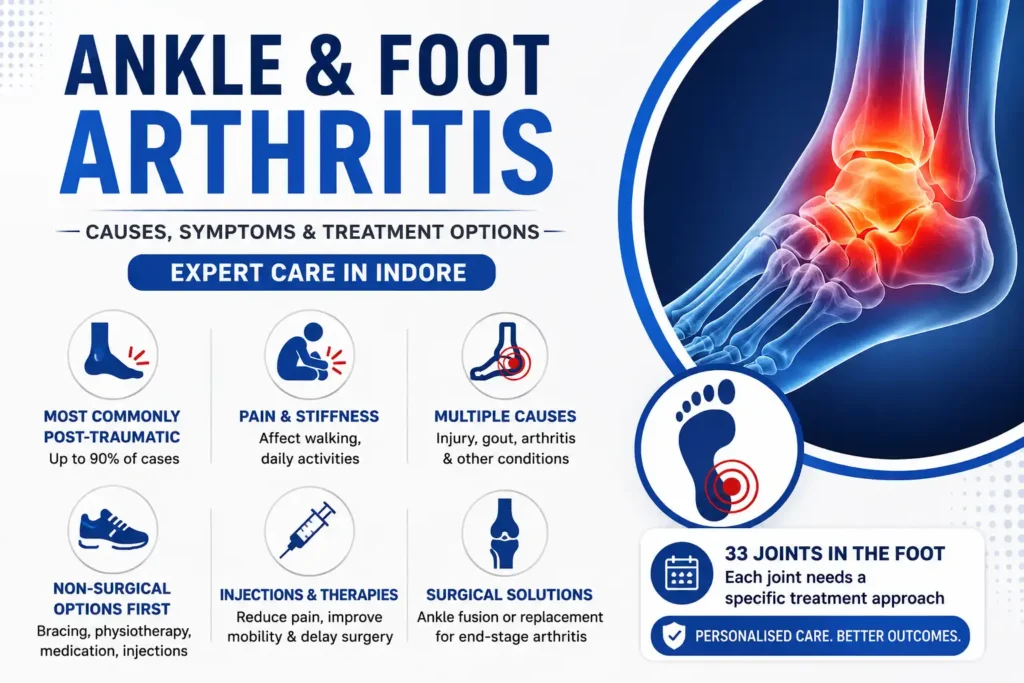
- Ankle arthritis is not the same as knee or hip arthritis. Up to 90% of ankle arthritis is post-traumatic in origin, meaning it develops years or decades after an ankle fracture, severe sprain, or dislocation that was not fully rehabilitated. In Indore, I regularly see patients in their 30s and 40s with severe ankle arthritis that traces back to a football or cricket injury they had at 18 and never properly treated.
- Ankle arthritis affects approximately 1% of the global population and is as debilitating as hip arthritis in terms of pain and functional limitation. PMC 25-Year National Study
- 70% of all ankle arthritis cases are post-traumatic in origin, 12% are rheumatoid, and only 7% are primary osteoarthritis, making ankle arthritis fundamentally different from knee or hip arthritis where primary degeneration dominates. PMC Epidemiology Study, 639 Patients
- Gout is a major cause of foot and ankle arthritis in India that is dramatically undertreated. In my practice, patients with recurrent gout attacks damaging the ankle, subtalar, and midfoot joints arrive after years of managing flares with painkillers rather than addressing the underlying uric acid elevation permanently.
- Most cases are managed without surgery through footwear modification, bracing, physiotherapy, anti-inflammatory treatment, and corticosteroid or hyaluronic acid injections.
- When surgery is needed, ankle fusion and total ankle replacement are both effective options for end-stage arthritis. Both produce significant pain relief and functional improvement. The choice depends on the patient’s age, activity level, bone quality, and specific joint anatomy.
- Ankle fusion carries a lower long-term revision risk than ankle replacement, but total ankle replacement preserves motion and avoids the secondary hindfoot loading that fusion transfers to adjacent joints. 25-Year England Registry Study of 41,000 Patients
- The foot contains 33 joints. Arthritis can affect any of them, and the specific joint involved determines the treatment pathway. Subtalar, midfoot, and first metatarsophalangeal joint arthritis each have their own management algorithm.
Why Ankle and Foot Arthritis Is Different From Knee or Hip Arthritis
When most people hear “arthritis,” they picture an elderly person with worn-out knee joints. Ankle and foot arthritis does not follow that template. The ankle joint has a remarkably low rate of primary osteoarthritis compared to the knee and hip, where primary degeneration from age and wear drives the majority of cases. In the ankle, research consistently shows that up to 90% of arthritic change is post-traumatic, meaning it is triggered by a specific injury event, often years or decades before symptoms become severe enough to seek treatment.
This distinction matters clinically because a 40-year-old with severe ankle arthritis from a poorly managed fracture at 22 is a fundamentally different patient from a 70-year-old with primary knee osteoarthritis. The younger age of presentation, the underlying cause, the activity demands, and the decades of life ahead all affect the treatment decision. At Dr. Prince Uchadiya Orthopaedic And Joint Care Clinic in Nipania, Indore, this individualised assessment is the starting point for every ankle and foot arthritis consultation.
Types of Ankle and Foot Arthritis: Understanding Which One You Have
1. Post-Traumatic Arthritis
The most common type by a significant margin. Post-traumatic ankle arthritis develops after injuries that damage the cartilage lining the joint surface, including ankle fractures, severe ligament sprains, and dislocations. The cartilage damage from the initial injury initiates a degradation process that continues over years. By the time significant arthritic pain develops, the triggering injury may be a decade or more in the past.
In Indore, this pattern is seen frequently in men who had ankle fractures from road traffic accidents on two-wheelers and were treated only with immobilisation without addressing the joint surface anatomy accurately. Young men who sprained their ankles repeatedly during sports and never underwent proper ligament rehabilitation are another consistent group. The cumulative cartilage damage from years of lateral instability in an unreconstructed ankle eventually produces post-traumatic subtalar and tibiotalar arthritis.
2. Osteoarthritis
Primary osteoarthritis of the ankle, where the cartilage degenerates from age and mechanical wear without a prior injury, is relatively uncommon in the ankle compared to the knee and hip. When it does occur, it tends to affect older patients and is more common at the first metatarsophalangeal joint, the big toe joint, where the condition is known as hallux rigidus. The subtalar joint, which handles inversion and eversion of the foot, also develops primary osteoarthritis, particularly in patients who are overweight or have had biomechanical malalignment throughout their lives.
3. Rheumatoid Arthritis
Rheumatoid arthritis is an autoimmune condition where the immune system attacks the synovial lining of joints. The foot and ankle are frequently involved, often early in the disease course. Rheumatoid arthritis characteristically affects multiple joints simultaneously, typically in a symmetrical pattern. The small joints of the forefoot, the metatarsophalangeal joints, are often the earliest affected. Morning stiffness lasting more than an hour, symmetrical joint swelling, and systemic features like fatigue and warmth in multiple joints distinguish rheumatoid from osteoarthritic presentations. Management involves disease-modifying medications in addition to orthopaedic care, and rheumatology involvement is essential.
4. Gout
Gout is caused by the deposition of monosodium urate crystals in joints when serum uric acid levels are chronically elevated. The first metatarsophalangeal joint, the big toe joint, is the classic and most common site, producing the condition known as podagra. But gout also affects the ankle, subtalar joint, and midfoot. Published data shows that 50% of patients with chronic gout report ankle and foot involvement beyond the great toe.
In India, gout is significantly underdiagnosed and undertreated. Patients manage acute flares with painkillers and anti-inflammatory medication without addressing the underlying hyperuricaemia that is causing the crystal deposition. Over years, repeated acute attacks cause progressive joint damage and chronic gouty arthritis that eventually requires the same orthopaedic management as other forms of ankle and foot arthritis. In Indore specifically, dietary patterns including high purine intake from red meat and high fructose consumption, combined with widespread underuse of urate-lowering therapy, mean that chronic tophaceous gout causing joint destruction is a regular finding in the clinic.
5. Psoriatic and Other Inflammatory Arthropathies
Psoriatic arthritis, reactive arthritis, and ankylosing spondylitis-associated arthropathy can all involve the foot and ankle. Enthesitis, inflammation at the points where tendons and ligaments attach to bone, is a specific feature of these conditions and produces heel pain, Achilles tendon insertional pain, and plantar fasciitis-like symptoms alongside joint swelling. Recognising the inflammatory pattern is important because these conditions require systemic treatment rather than purely local orthopaedic management.
Recognising the Symptoms: What Ankle and Foot Arthritis Feels Like
Pain that develops gradually and is consistently related to weight-bearing activity, stiffness that is worst in the morning or after a period of rest and loosens up with movement, swelling around the affected joint that may be persistent or episodic, and a progressive reduction in walking distance before pain forces a stop are the classic features.
Specific patterns by joint help localise the problem. Tibiotalar arthritis produces pain on the front and inside of the ankle, worsening with uneven ground and stairs. Subtalar arthritis produces pain below and behind the ankle, worse walking on camber or rocky surfaces, often described as the foot feeling unstable or rolling inward. Midfoot arthritis produces pain across the top of the foot with prolonged standing or walking. First metatarsophalangeal arthritis produces stiffness and pain at the base of the big toe, characteristically worse during push-off when walking and with tight footwear.
In inflammatory arthritis, episodic flares of acute intense swelling, warmth, and redness in the joint are interspersed with periods of relative calm. Gout attacks classically reach maximum severity within 24 hours, are exquisitely tender to the point that even bedsheet contact is unbearable, and typically resolve completely within 7 to 10 days without treatment. The frequency and severity of flares increases over time without appropriate urate-lowering therapy.
How Ankle and Foot Arthritis Is Diagnosed in Indore
The clinical history and examination direct the investigation. The mechanism of any prior injury, the pattern of joint involvement, the character of symptoms, systemic features, family history, and occupation are all relevant. Examination assesses the specific joint producing symptoms, range of motion, ligament stability, foot alignment, gait pattern, and skin and nail changes that may indicate psoriatic disease.
- Weight-bearing X-ray: Essential for ankle and foot arthritis assessment. The joint space narrowing, bone spur formation, subchondral sclerosis, and joint alignment visible on a standing X-ray reflect the true functional state of the joint under load. Non-weight-bearing X-rays underestimate the degree of joint space loss significantly. Patients should always have standing films for any arthritis assessment of the lower limb.
- MRI: Useful in earlier stages where cartilage damage is present but not yet visible on X-ray, for assessing bone marrow oedema, osteochondral defects, ligament injuries, and synovitis. It also helps distinguish inflammatory from degenerative causes.
- Blood tests: In any patient where inflammatory or systemic arthritis is considered, rheumatoid factor, anti-CCP antibody, CRP, ESR, uric acid, and a full blood count are the minimum investigations. A serum uric acid level above 360 micromol/L in a patient with episodic joint attacks is strongly suggestive of gout.
- Joint fluid aspiration: Aspirating fluid from an acutely swollen joint and analysing it under polarised light microscopy is the definitive test for gout (needle-shaped monosodium urate crystals) and CPPD (rhomboid-shaped calcium pyrophosphate crystals). It also excludes septic arthritis when infection is a clinical concern.
Ankle and Foot Arthritis Treatment in Indore: The Full Non-Surgical Pathway
The majority of patients with ankle and foot arthritis are successfully managed without surgery, sometimes for many years, through a structured combination of the following:
- Footwear modification: Rocker-bottom shoes or soles reduce the peak load transmitted through the arthritic joint during walking by allowing the foot to roll through rather than flex acutely at the affected joint. For tibiotalar arthritis, a well-cushioned shoe with a slight heel raise and a stiff sole reduces ankle joint stress substantially. For midfoot arthritis, a rigid carbon fibre insole placed inside the shoe eliminates motion at the arthritic midfoot joints. These are not expensive interventions and they produce meaningful symptom relief. They should be the first recommendation, not the last resort.
- Custom orthotics and bracing: A custom ankle-foot orthosis (AFO) or a hinged ankle brace offloads the arthritic joint, controls abnormal motion, and provides proprioceptive support. For subtalar arthritis specifically, a lateral wedge insole that corrects hindfoot valgus reduces compressive load on the subtalar joint. For severe ankle arthritis not yet requiring surgery, a rigid AFO can provide significant functional improvement and delay the need for surgical intervention by years.
- Physiotherapy: Strengthening the muscles supporting the ankle and foot, improving proprioception, and maintaining range of motion in adjacent joints reduces the functional impact of the arthritis. Physiotherapy does not reverse cartilage damage but it meaningfully improves function and pain through neuromuscular control. Gait retraining to reduce antalgic patterns that overload other joints is part of a comprehensive physiotherapy programme. Patients connecting with the post-injury rehabilitation programme at the clinic receive structured guidance through this phase.
- Anti-inflammatory medication: NSAIDs reduce synovial inflammation and joint pain in osteoarthritis and inflammatory arthritis. In gout, colchicine and NSAIDs manage acute attacks. Urate-lowering therapy with allopurinol or febuxostat is the definitive long-term treatment for gout and must be started after the acute attack has resolved, not during it. Disease-modifying antirheumatic drugs (DMARDs) are the cornerstone of rheumatoid arthritis management and are prescribed in collaboration with rheumatology.
- Corticosteroid injection: A precisely targeted corticosteroid injection into the arthritic joint provides significant short-to-medium term pain relief and reduces synovial inflammation. It is particularly useful for tibiotalar and subtalar arthritis, and for first metatarsophalangeal joint arthritis. The injection is most effective when combined with footwear and orthotics management rather than used in isolation. Ultrasound or fluoroscopic guidance significantly improves injection accuracy for the ankle and subtalar joints.
- Hyaluronic acid injection (viscosupplementation): Hyaluronic acid injected into the arthritic joint supplements the natural joint fluid, improves lubrication, and provides pain relief in some patients with early-to-moderate osteoarthritis. The evidence base is stronger for the knee than the ankle, but in selected patients with mild-to-moderate ankle arthritis it can provide useful symptom relief that extends the non-surgical management period.
Surgical Treatment for Ankle and Foot Arthritis in Indore
Surgery is considered when conservative management has been adequately tried and failed to provide acceptable function and pain control, or when the arthritis is severe enough at presentation that non-surgical measures are unlikely to provide sufficient relief. The surgical approach depends on which joint is affected, the severity of arthritis, the patient’s age and activity level, bone quality, and the presence of deformity.
Ankle Joint Surgery
- Ankle arthroscopy and debridement: In early to moderate ankle arthritis with anterior impingement from bone spurs, arthroscopic removal of the impinging osteophytes and debridement of the joint provides pain relief and improved range of motion. This is a day procedure and is most effective when significant cartilage loss has not yet occurred. It buys time before more definitive surgery is needed and is performed through small arthroscopic portals. The arthroscopic approach used at Dr. Prince Uchadiya’s clinic is consistent with the minimally invasive techniques described on the minimally invasive surgery page.
- Ankle fusion (arthrodesis): The traditional gold standard surgical treatment for end-stage ankle arthritis. The articular cartilage is removed from the tibiotalar joint surfaces and the bones are held in compression with screws or a nail while they fuse together as one unit. The result is a pain-free, stable ankle with no motion at the fused joint. Gait is preserved and most patients walk well after fusion. Adjacent joints, particularly the subtalar and midtarsal joints, compensate for the lost ankle motion over time. A 25-year national study of 41,000 patients confirms ankle fusion carries a lower cumulative revision surgery risk than total ankle replacement over long-term follow-up. Arthroscopic ankle fusion reduces non-union rates, blood loss, and hospital stay compared to open fusion.
- Total ankle replacement (arthroplasty): The arthritic joint surfaces are replaced with a metal and polyethylene implant that recreates the ankle joint mechanics and preserves motion. Total ankle replacement provides better pain relief in some studies and preserves the gait mechanics that ankle fusion alters. The key advantage is maintained ankle movement, which reduces the compensatory loading on adjacent hindfoot joints. The trade-off is a higher long-term revision risk compared to fusion, and greater technical demand on the surgeon. Total ankle replacement is best suited to older, lower-demand patients with well-preserved bone stock and minimal deformity. The decision between fusion and replacement is one of the most individualised decisions in foot and ankle orthopaedic surgery and requires a detailed specialist consultation.
Foot Joint Surgery
- Subtalar fusion: For isolated subtalar arthritis, fusion of the posterior subtalar joint eliminates painful inversion and eversion motion while preserving ankle flexion and extension. The patient loses some ability to walk on uneven ground but is significantly more comfortable for daily activities.
- Midfoot fusion: For arthritic midfoot joints, fusion of the affected tarsometatarsal joints stabilises the foot and eliminates painful motion. A custom-made insole is worn post-operatively to protect the adjacent joints.
- First metatarsophalangeal joint surgery: For hallux rigidus (arthritic big toe joint), early stages are treated with cheilectomy, removal of the dorsal bone spurs, to restore extension range. Advanced stages are treated with first MTP joint fusion, which reliably relieves pain and allows near-normal walking.
What Patients in Indore Should Expect at Their First Consultation
Patients with ankle and foot arthritis from across Indore, including from Vijay Nagar, Scheme 54, Mahalaxmi Nagar, Palasia, and surrounding areas, attend the Nipania clinic for assessment. The first consultation covers a full history of the symptoms and any prior injury, clinical examination of the foot and ankle including gait assessment and alignment, review of any existing imaging, and a clear explanation of which joint is arthritic, what type of arthritis it is, what has caused it, and what the treatment options are in realistic terms.
For patients who have already received a recommendation for surgery and want clarity on whether that recommendation is appropriate, or for those who have been managing symptoms conservatively and want to understand their long-term options, a structured orthopaedic second opinion is available at the clinic. Decisions about ankle fusion versus replacement, or whether non-surgical options have been exhausted, benefit considerably from an experienced specialist perspective before any irreversible surgical commitment is made.
Frequently Asked Questions: Ankle and Foot Arthritis Treatment in Indore
1. I twisted my ankle badly years ago. Can that really cause arthritis now?
Yes, and this is the most common pathway to ankle arthritis. A severe ankle sprain that disrupts the cartilage surface of the joint, or a fracture that leaves the joint surface imperfectly aligned, initiates a degradation process that continues silently over years. By the time pain becomes limiting, the cartilage loss may be significant. Research consistently shows that up to 90% of ankle arthritis is post-traumatic in origin. The time lag between the injury and the onset of disabling arthritis is typically 10 to 20 years.
2. My big toe is very stiff and painful. Is this arthritis?
Stiffness and pain at the first metatarsophalangeal joint, particularly during the push-off phase of walking, is the classic presentation of hallux rigidus, which is osteoarthritis of the big toe joint. It is one of the most common foot conditions seen in orthopaedic practice. In early stages, a stiff-soled shoe with a slight rocker modification and occasional steroid injection manages symptoms well. In later stages where motion is severely restricted and pain is constant, surgical options ranging from bone spur removal to joint fusion provide reliable relief.
3. What is the difference between ankle fusion and ankle replacement? Which is better?
Ankle fusion eliminates all motion at the arthritic joint by fusing the two bones together. It is reliable, durable, and carries a lower long-term revision risk. Ankle replacement preserves joint motion using a prosthetic implant. It produces better gait mechanics and avoids the compensatory loading on adjacent joints that fusion produces, but carries a higher long-term revision risk. Neither is universally better. The right choice depends on age, activity demands, bone quality, deformity, and personal priorities. Younger, more active patients often do better with fusion because of its durability. Older patients with lower demands and well-preserved bone may benefit from replacement’s motion preservation. This decision is made in detail during the consultation.
4. Can gout really destroy my ankle joint permanently?
Yes. Uncontrolled chronic gout causes progressive joint destruction from urate crystal deposition. Over years, tophi (large crystal deposits) erode into the bone and cartilage, producing structural damage that is not reversible. The orthopaedic consequences of chronic tophaceous gout are managed the same way as other forms of end-stage arthritis, with fusion or debridement depending on the degree of damage. The crucial difference is that gout is a preventable cause of joint destruction if uric acid levels are controlled early and consistently. Allopurinol or febuxostat taken long-term keeps uric acid below the crystallisation threshold and prevents further joint damage. Managing flares alone without lowering uric acid permanently is the single most common reason patients develop chronic gouty arthropathy.
5. How long does recovery take after ankle fusion surgery?
Ankle fusion requires strict non-weight-bearing for the first 6 weeks to allow the bones to begin fusing. A walking boot or cast is worn for a further 4 to 6 weeks with gradual weight-bearing introduction. Full weight-bearing typically resumes by 10 to 12 weeks, and most patients reach their final functional level by 6 months. The fusion rate with modern screw fixation is approximately 90% or higher. Smoking significantly reduces fusion rates and patients are strongly advised to cease smoking before and after the procedure.
6. Can I avoid surgery for ankle arthritis indefinitely?
In mild to moderate arthritis with preserved joint space, conservative management including orthotics, footwear modification, physiotherapy, and periodic injections can maintain acceptable function for years. In end-stage arthritis where joint space is completely lost and pain is constant, conservative measures provide diminishing returns. The decision about when surgery is appropriate is based on functional impact, adequacy of conservative measures, the patient’s age and activity requirements, and the degree of arthritis visible on standing X-ray. There is no obligation to proceed to surgery at any particular point. Many patients manage well with comprehensive non-surgical care and choose surgery only when their quality of life becomes unacceptable on that programme.
7. Is ankle replacement available in Indore?
Total ankle replacement is an advanced procedure that requires specific foot and ankle surgical expertise and the availability of appropriate implant systems. Patients in Indore seeking information about ankle replacement or wanting to know whether they are candidates should arrange a specialist consultation. The consultation at Dr. Prince Uchadiya’s clinic includes a full assessment of whether ankle replacement or fusion is the more appropriate option for the specific patient’s anatomy, age, activity level, and arthritic pattern.
8. My foot has multiple arthritic joints. Do I need multiple surgeries?
Not necessarily. When multiple adjacent joints are arthritic, a single surgical procedure can address several of them simultaneously. Triple fusion, which fuses the subtalar, talonavicular, and calcaneocuboid joints together, is a well-established procedure for patients with widespread hindfoot arthritis. The appropriate surgical plan for multi-joint arthritis is determined by mapping exactly which joints are symptomatic and which are contributing to the pain through careful clinical examination, diagnostic injections into individual joints, and imaging assessment.
9. Does weight affect ankle arthritis?
Yes, directly. Every kilogram of excess body weight increases the compressive load on the ankle joint during walking by a multiple of body weight. For a joint already limited in its cartilage reserve, this additional load accelerates damage and worsens symptoms. Weight management is a meaningful, modifiable intervention in ankle and foot arthritis management. It is not the complete answer, particularly in post-traumatic arthritis where the original injury created the damage, but it substantially affects the pace of progression and the symptom burden.
10. Is ankle arthritis surgery covered under Ayushman Bharat in Indore?
Ankle fusion and certain other surgical procedures for ankle and foot arthritis fall within PM-JAY package coverage for eligible patients. The specific procedure and its classification determine the coverage available. Patients with Ayushman cards are encouraged to discuss eligibility and coverage at the time of consultation. Dr. Prince Uchadiya’s clinic has experience guiding patients through the Ayushman Bharat surgical process including pre-authorization for appropriate orthopaedic procedures.