A 48-year-old woman comes into the clinic
with a shoulder that has been aching for four months.
She woke up one night in sharp pain
and found she could barely lift her arm above her head the next morning.
Over the following weeks, putting on her dupatta became an ordeal, reaching for a shelf became impossible, and sleeping on that side was out of the question entirely. Her family doctor called it a shoulder problem and gave her painkillers. But the pain did not stop, and the stiffness kept growing.
When she finally saw Dr. Prince Uchadiya, the diagnosis was adhesive capsulitis, more commonly known as frozen shoulder. And the first thing she needed to understand was not just what frozen shoulder is, but which of the three frozen shoulder recovery stages she was in, because the right treatment depends entirely on that answer.
Frozen shoulder is one of the most misunderstood orthopaedic conditions in clinical practice. It is not simply a stiff shoulder. It is a progressive, biologically driven condition that moves through three distinct stages, each with different symptoms, different treatment priorities, and a different recovery trajectory. Understanding these stages is not just useful information for patients. It is the foundation of effective management.
What Is Frozen Shoulder and Why Does It Happen?
Frozen shoulder, medically termed adhesive capsulitis, occurs when the connective tissue capsule surrounding the shoulder joint becomes inflamed, thickened, and progressively contracted. The shoulder joint is surrounded by a flexible sleeve of tissue called the glenohumeral capsule. Under normal conditions, this capsule is loose and pliable, allowing the arm to move freely through its full range of motion in all directions.
In frozen shoulder, this capsule undergoes a process of abnormal fibrosis. Inflammatory cells infiltrate the tissue, triggering a cascade of scar tissue formation. Thick, inelastic bands called adhesions develop within the capsule. The volume of lubricating synovial fluid inside the joint decreases. The result is a joint that has physically less space and less flexibility than it should, producing pain, progressive loss of motion, and eventually a shoulder that is functionally locked in a restricted range Frozen Shoulder Recovery Stages .
According to the Cleveland Clinic, frozen shoulder affects roughly 2 to 5 percent of the general population and is most common in women between the ages of 40 and 60. The condition can develop without any obvious cause, but several well-established risk factors significantly increase the likelihood of developing it.
Who Is Most at Risk of Developing Frozen Shoulder?
Certain medical conditions and situations dramatically increase the risk of developing frozen shoulder. Understanding these risk factors matters because patients in these categories need to be more vigilant about early shoulder symptoms and should seek evaluation sooner rather than waiting for the condition to progress.
- Diabetes: Between 10 and 20 percent of people with diabetes develop frozen shoulder at some point. This is the strongest known systemic risk factor. Elevated blood glucose promotes abnormal glycosylation of collagen, making the joint capsule stiffer and more prone to fibrotic changes. Patients with diabetes also tend to have more severe frozen shoulder with longer duration and higher recurrence rates.
- Thyroid disorders: Both hypothyroidism and hyperthyroidism are associated with increased frozen shoulder risk. Thyroid hormones play a role in connective tissue metabolism, and their disruption appears to predispose the shoulder capsule to abnormal scarring.
- Shoulder immobilisation: Any period of prolonged shoulder immobility, whether from a fracture, rotator cuff surgery, post-cardiac surgery recovery, or stroke-related arm weakness, significantly increases the risk of the capsule contracting. This is why early movement after any shoulder injury or upper limb surgery is so important.
- Cardiac disease and stroke: Stroke patients with arm weakness are particularly vulnerable because the shoulder goes through extended periods with little active motion. Heart disease and cardiac surgery have also been linked to adhesive capsulitis, though the mechanisms are less well understood.
- Parkinson’s disease: The rigidity and reduced voluntary movement associated with Parkinson’s creates conditions that predispose the shoulder capsule to developing adhesions.
- Women between 40 and 60 years: The hormonal changes during perimenopause and menopause are thought to influence connective tissue behaviour, contributing to the significantly higher prevalence of frozen shoulder in this demographic compared to age-matched men.
The Three Frozen Shoulder Recovery Stages: A Complete Guide
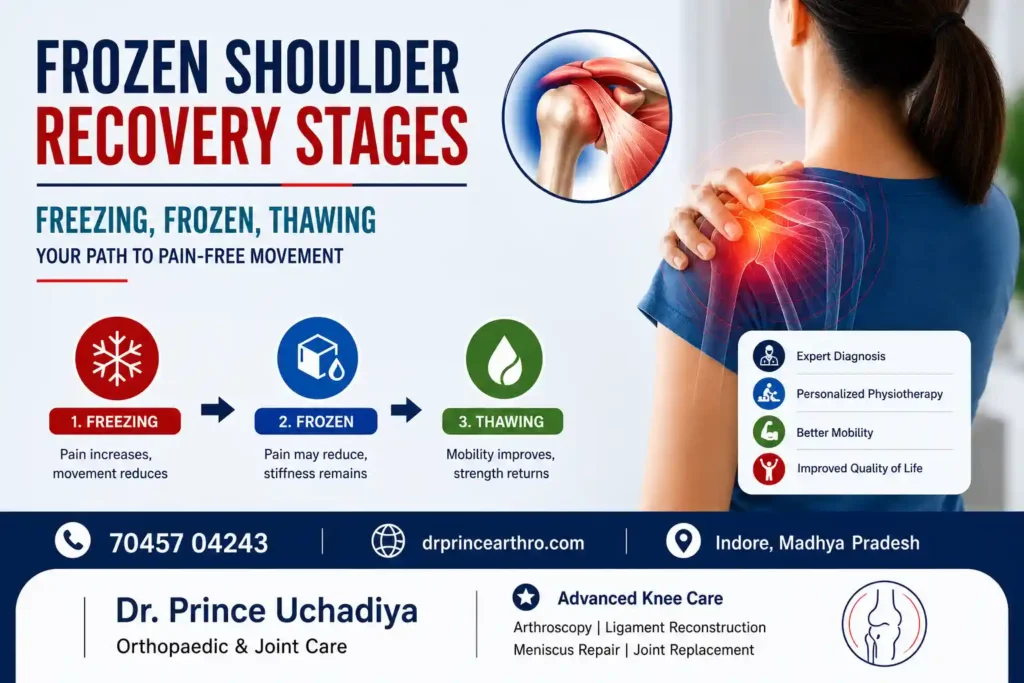
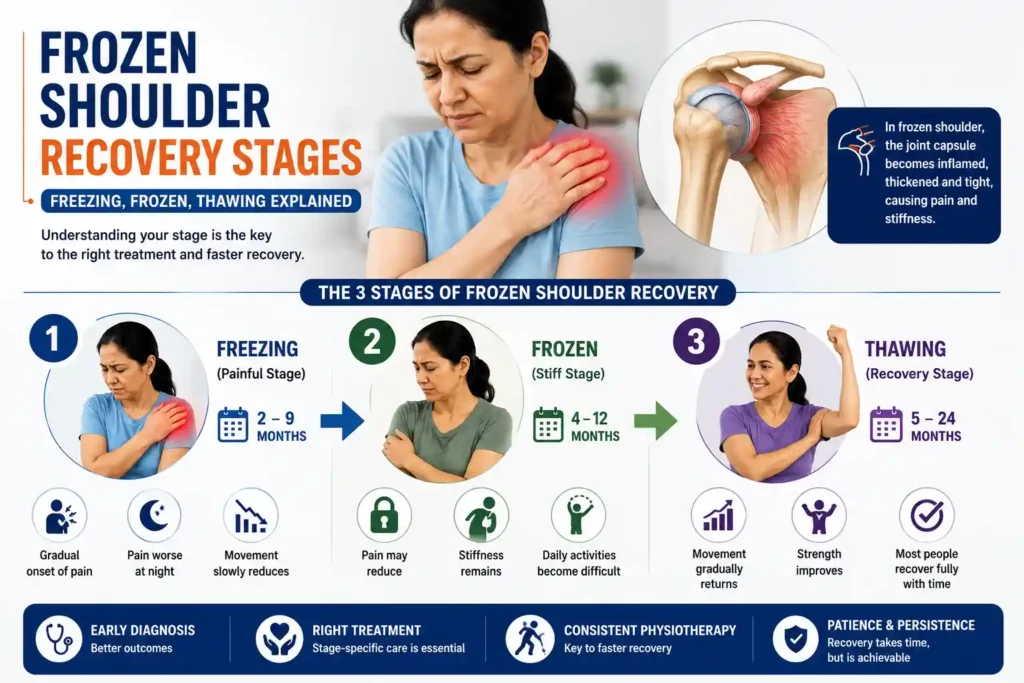
The defining characteristic of frozen shoulder is that it moves through three biologically distinct stages. Every patient passes through all three, though the duration of each stage varies considerably depending on the individual, the severity of the fibrotic process, the presence of risk factors like diabetes, and the timing and quality of treatment received. Understanding what happens biologically in each stage explains why the symptoms change over time and why the treatment approach must change with them Frozen Shoulder Recovery Stages .
Stage 1: The Freezing Stage, Pain Comes First
The freezing stage is the most painful phase of frozen shoulder. It typically lasts anywhere from six weeks to nine months, making it also potentially the longest stage. This is where most patients first seek medical attention, often because the pain becomes severe enough to significantly disrupt sleep and daily activities.
What is happening biologically during this stage is an active inflammatory process within the joint capsule. Inflammatory mediators, including cytokines and fibroblast growth factors, are flooding the capsular tissue and triggering abnormal collagen production. The capsule is beginning to thicken. Adhesions are starting to form. But the dominant clinical feature at this point is not yet stiffness. It is pain.
The pain of the freezing stage is characteristically diffuse, located over the outer shoulder and sometimes radiating into the upper arm. It is typically described as a deep, aching quality that does not respond well to simple rest. Crucially, it is frequently worst at night. Lying on the affected shoulder is often unbearable, and the pain can wake patients repeatedly through the night, leading to severe sleep disruption that compounds fatigue and reduces quality of life further.
As the freezing stage progresses, the stiffness begins to compound the pain. Range of motion starts to reduce. Reaching overhead becomes painful and then progressively limited. External rotation, the motion of rotating the arm outward as if pointing to the side, is one of the first and most reliably affected movements. Patients notice they cannot reach behind their back, cannot fasten a bra strap or tuck in a shirt, and cannot place their arm in a coat sleeve without significant discomfort.
A critical clinical point: the freezing stage is also the most difficult to treat if the approach is too aggressive. Forcing the shoulder through painful range-of-motion exercises in this inflammatory phase can aggravate the capsule and worsen both pain and the progression of scarring. Treatment in this stage prioritises pain control and gentle, non-provocative movement, not aggressive stretching.
Stage 2: The Frozen Stage- Maximum Stiffness, Easing Pain
The frozen stage typically lasts four to nine months and represents the period of maximum functional restriction. For many patients, this phase is in some ways a paradox: the pain that dominated the freezing stage often begins to settle somewhat, but the stiffness reaches its peak severity. Daily tasks that require the arm to move through any significant range become extremely difficult or impossible Frozen Shoulder Recovery Stages.
Biologically, the active inflammation of the freezing stage has largely subsided. The capsule is now thickened, contracted, and adherent. The adhesions that began forming in the previous stage have matured and become more organised, creating mechanical restrictions rather than purely pain-driven ones. The joint capsule has lost significant volume. The axillary recess, a fold in the capsule that normally allows the arm to lift away from the body, has become obliterated by scar tissue.
In clinical terms, the frozen stage is characterised by restriction in all planes of shoulder movement, not just one direction. Patients cannot raise the arm beyond a certain point regardless of how hard they try or how willing they are to push through discomfort. The limitation is structural, not just pain-protective. Examination shows that passive range of motion, meaning motion produced by an examiner moving the arm rather than the patient moving it, is similarly restricted. This distinguishes frozen shoulder from conditions where pain limits active movement but the passive range is preserved.
Despite the significant disability, patients in the frozen stage often report that the sharp, intense night pain of the freezing stage has reduced to a background ache. Some patients interpret this as improvement and stop seeking treatment. This is a mistake. The window of the frozen stage is actually when certain interventions, particularly corticosteroid injections, hydrodilatation, and structured physiotherapy, have the best evidence for meaningful improvement. Allowing the frozen stage to pass without intervention prolongs the overall recovery timeline unnecessarily.
Stage 3: The Thawing Stage – Motion Returns, Patience Required
The thawing stage is the phase of recovery, where the biological process of capsular resolution gradually restores shoulder mobility. This stage typically lasts six months to two years. It is also the stage that tests patient patience most severely, because recovery is slow, incremental, and not always linear Frozen Shoulder Recovery Stages .
During the thawing stage, the inflammatory and fibrotic processes that created the frozen shoulder have run their course. The capsule begins to gradually loosen. Adhesions soften and partially resolve. Synovial fluid production normalises. The shoulder slowly regains its capacity for motion, though this happens over months rather than weeks. Most patients notice that the directions of movement that were most restricted begin to return first, with small but perceptible gains in the range they can achieve from one month to the next.
The thawing stage is where active, progressive physiotherapy produces the most benefit. Because the acute inflammation is no longer driving pain, the shoulder can tolerate more purposeful stretching, mobilisation, and strengthening work. Range-of-motion exercises that were too provocative in the freezing stage can now be pursued more consistently. Strengthening the rotator cuff and scapular stabilisers helps restore functional movement quality alongside the return of range.
Full recovery in the thawing stage is achievable for most patients, but it is important to have realistic expectations. Some patients regain complete, symmetrical range of motion. Others are left with a small residual deficit that may or may not be clinically significant. Patients with diabetes, in particular, tend to have more incomplete recovery and higher recurrence rates. Early treatment that minimises capsular damage during the freezing stage gives the thawing stage the best possible foundation to build on.
How Frozen Shoulder Is Diagnosed at Dr. Prince Uchadiya’s Clinic in Indore
Diagnosis of frozen shoulder is primarily clinical. A careful history and physical examination, in the hands of an experienced orthopaedic surgeon, provide the information needed to identify the condition and determine which stage the patient is in. This is essential because the stage directly determines the treatment approach.
During examination, Dr. Prince Uchadiya assesses both active range of motion (what the patient can move) and passive range of motion (what the examiner can move). Global restriction in both active and passive motion, particularly in external rotation and abduction, with pain at the end of the available range, is the hallmark clinical finding. This distinguishes frozen shoulder from rotator cuff tears, where active motion is limited but passive range is relatively preserved Frozen Shoulder Recovery Stages .
Imaging is used selectively. X-rays help exclude bony causes of shoulder pain such as arthritis or calcific tendinitis. An MRI or ultrasound can identify features consistent with adhesive capsulitis, including capsular thickening and reduced joint volume, and importantly, rule out other pathology such as a rotator cuff tear, which requires a different management pathway entirely.
Treatment Options for Each Stage of Frozen Shoulder Recovery
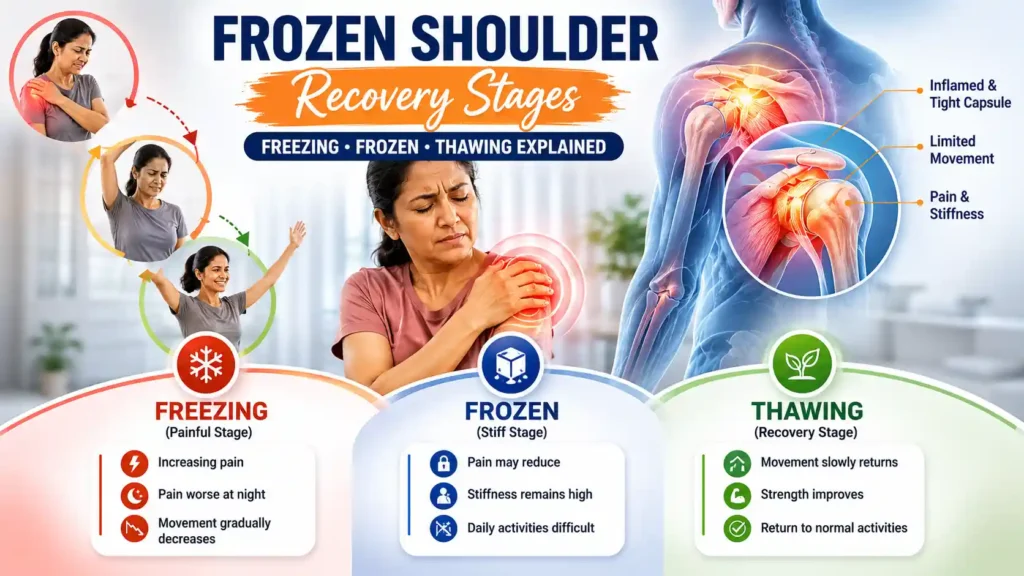
The most important principle in frozen shoulder management is matching the treatment to the stage. Applying the same approach regardless of where the patient sits in their recovery progression leads to either inadequate pain relief or unnecessary discomfort from overly aggressive therapy.
Freezing Stage Treatment: Control Pain, Protect the Joint
In the freezing stage, pain management takes priority. Anti-inflammatory medications reduce the acute inflammatory response within the capsule and provide meaningful pain relief that allows patients to function and sleep better. Corticosteroid injections, administered directly into the glenohumeral joint, are highly effective at this stage for reducing capsular inflammation and breaking the cycle of pain that prevents any meaningful rehabilitation. Evidence consistently shows that early corticosteroid injection in the freezing stage reduces pain and accelerates recovery more effectively than waiting.
Physiotherapy in the freezing stage focuses on gentle pendulum exercises, pain-free range-of-motion movements, and postural correction rather than aggressive stretching. Heat before sessions relaxes the surrounding muscles. Ice after sessions reduces any post-treatment soreness. The goal is to maintain what motion remains, prevent further rapid deterioration, and control the inflammatory cascade while the biological process progresses naturally toward the frozen stage.
Frozen Stage Treatment: Mobilise, Stretch, Inject
As pain settles into the frozen stage, the treatment focus shifts toward regaining the motion that has been lost. Structured physiotherapy with graded stretching, joint mobilisation techniques, and strengthening exercises forms the backbone of this phase. Corticosteroid injections can still provide meaningful benefit in the early frozen stage, and hydrodilatation, a procedure in which sterile fluid is injected into the joint capsule under pressure to stretch and distend it, has good evidence for improving range of motion in this phase.
If conservative treatment in the frozen stage fails to produce adequate improvement after a sustained period, surgical options become relevant. Manipulation under anaesthesia involves moving the shoulder through its full range of motion while the patient is asleep and the muscles are relaxed, physically breaking down the adhesions. Arthroscopic capsular release, performed through small incisions using a camera and precision instruments, allows the contracted capsule to be divided and released under direct vision. Both procedures are followed by intensive physiotherapy to consolidate the gains achieved during surgery.
Thawing Stage Treatment: Strengthen, Progress, Restore
In the thawing stage, the intensity and variety of physiotherapy can increase progressively. Stretching exercises can be performed with more sustained holds as the capsule becomes more pliable. Rotator cuff strengthening, scapular stabilisation exercises, and functional movement retraining are introduced progressively to restore not just range but also the quality and control of shoulder movement. Patients can engage with the post-injury rehabilitation program to ensure they complete this final phase fully rather than stopping once pain resolves but before motion and strength are fully restored.
Night Pain, Sleep, and Frozen Shoulder: What Patients in Indore Need to Know
Night pain is one of the most disruptive and least-discussed consequences of frozen shoulder, particularly in the freezing stage. Lying on the affected shoulder produces direct capsular compression and intense pain. Even lying on the opposite side can cause the affected arm to fall into a position that stretches the contracted capsule uncomfortably.
Practical sleep positioning strategies make a significant difference to quality of life during recovery. Sleeping on the back with the affected arm supported on a pillow in front of the body keeps the shoulder in a neutral, non-stressed position. A wedge pillow or semi-reclined position reduces the gravitational pull on the shoulder capsule. Sleeping on the unaffected side with a pillow hugged against the chest supports the affected arm without allowing it to drop forward or backward into a painful position. These adjustments do not accelerate recovery, but they preserve sleep quality, which is essential for overall wellbeing and pain tolerance during a long recovery process Frozen Shoulder Recovery Stages.
The Role of Diabetes in Making Frozen Shoulder Worse
Patients with diabetes who develop frozen shoulder face a more difficult recovery than non-diabetic patients, and understanding why helps motivate better glucose management during the recovery period. Elevated blood glucose levels directly affect the biology of the shoulder capsule. Chronically high glucose promotes non-enzymatic glycosylation of collagen, a process where sugar molecules attach to collagen fibres and make them stiffer, less pliable, and more resistant to the stretching that is central to recovery.
This means that a frozen shoulder in a patient with poorly controlled diabetes is not just slower to recover. It is genuinely more resistant to treatment at a tissue level. Better blood glucose control during frozen shoulder recovery is therefore a meaningful part of the management plan, not just general health advice. Patients with diabetes should discuss their shoulder symptoms and recovery alongside their diabetes management with both their orthopaedic specialist and their physician.
Can You Speed Up Frozen Shoulder Recovery?
The honest answer is that frozen shoulder has a biological course that cannot be dramatically shortened simply by working harder or stretching more aggressively. However, the timing and quality of treatment genuinely does influence recovery duration. Patients who receive a corticosteroid injection early in the freezing stage, follow a structured physiotherapy program throughout all three stages, maintain consistent home exercise compliance, and seek surgical intervention when conservative treatment is genuinely not progressing, consistently recover faster and more completely than those who wait, treat sporadically, or manage entirely on their own.
Aggressive stretching in the freezing stage, in particular, is counterproductive. Forcing a painful, inflamed shoulder through stretches that produce sharp pain does not accelerate recovery. It aggravates inflammation, worsens pain, and can provoke a reaction that sets recovery back. The right physiotherapy at the right stage, guided by an experienced practitioner who can assess where the patient sits in their recovery journey, is what makes the real difference.
Frequently Asked Questions About Frozen Shoulder Recovery Stages
1. What are the three stages of frozen shoulder recovery?
The three stages are the freezing stage, the frozen stage, and the thawing stage. The freezing stage is characterised by progressively worsening pain and the beginning of motion loss. The frozen stage follows, where pain partially settles but stiffness reaches its peak. The thawing stage is the recovery phase, where motion gradually returns over months. Every patient with frozen shoulder passes through all three stages, though the duration of each varies between individuals. Understanding which stage you are in is the most important factor in choosing the right treatment approach.
2. How long does each frozen shoulder stage last?
The freezing stage typically lasts six weeks to nine months. The frozen stage usually continues for four to nine months. The thawing stage can extend from six months to two years. In total, frozen shoulder without specialist treatment can last one to three years from onset to full or near-full recovery. These timelines vary significantly depending on individual factors, the presence of conditions like diabetes, and how early and effectively treatment begins. Patients who receive appropriate treatment at each stage consistently move through the stages faster than those who manage the condition without specialist guidance.
3. Why is frozen shoulder more painful during the freezing stage?
The freezing stage is dominated by an active inflammatory process within the joint capsule. The capsule is being infiltrated by inflammatory cells, and abnormal fibroblast activity is beginning to lay down scar tissue. This inflammatory process produces chemical mediators that sensitise the nerve endings within and around the joint capsule, creating diffuse, persistent pain that is often described as aching or burning. The inflammation is also most active at night because horizontal positioning and the natural circadian reduction in anti-inflammatory cortisol levels mean pain signals are less suppressed during sleep. As the freezing stage progresses to the frozen stage and active inflammation subsides, the pain typically decreases even as the stiffness worsens.
4. How do I know if I am in the frozen stage of frozen shoulder?
The frozen stage is characterised by maximum stiffness with relatively less severe pain compared to what preceded it. If your shoulder has been painful and progressively losing motion for several months, and you now notice that while the range of movement is severely restricted, the acute sharp pain and severe night pain are less intense than they were at the beginning, you may be in the frozen stage. The key clinical sign is that both active motion (what you can move) and passive motion (what someone else can move) are similarly restricted in all directions. A proper clinical examination is needed to confirm the stage, as other conditions can produce similar symptoms and require different management.
5. What happens during the thawing stage of frozen shoulder?
During the thawing stage, the biological process that created the frozen shoulder runs its course and the joint capsule begins to gradually loosen. The adhesions that formed during the freezing stage soften over time, the capsule becomes more pliable, and synovial fluid production recovers. Range of motion returns progressively, usually with external rotation and abduction improving first. This stage is the period where physiotherapy is most effective, as the shoulder can now tolerate more active stretching and strengthening without provoking an inflammatory flare-up. Recovery during the thawing stage is slow and incremental; gains are measured in degrees per month rather than dramatic weekly improvement.
6. Can frozen shoulder recover naturally without surgery?
Yes, frozen shoulder can resolve without surgery for the majority of patients. The condition has a self-limiting biological course and most patients achieve meaningful recovery through a combination of physiotherapy, anti-inflammatory medications, corticosteroid injections, and time. However, “naturally” does not mean “without any treatment.” Patients who manage the condition without any specialist input tend to have longer recovery durations and more incomplete restoration of motion than those who follow a structured treatment program. Surgery is reserved for patients who do not respond adequately to conservative management after a sustained period, typically three to six months, or those who have a frozen stage with severe functional restriction that is not improving.
7. Does frozen shoulder pain get worse at night?
Yes, night pain is one of the most consistent and most debilitating features of frozen shoulder, particularly in the freezing stage. The reasons are both mechanical and physiological. When lying flat, the shoulder capsule is placed in a position where its inflamed, thickened walls are in proximity with each other, increasing the local pressure and irritation of sensitised nerve endings. Additionally, the body’s natural anti-inflammatory cortisol levels follow a circadian rhythm with their lowest point in the early morning hours, meaning the inflammatory pain signals in the shoulder have less natural suppression during the night. Positioning strategies and pain medication timing, guided by your treating specialist, can significantly reduce but rarely fully eliminate night pain during the freezing stage.
8. Can frozen shoulder affect sleep quality?
Frozen shoulder has a profound effect on sleep quality, particularly in the freezing stage. The inability to find a comfortable sleeping position, the pain that wakes patients repeatedly through the night, and the difficulty turning over in bed without triggering shoulder pain all contribute to significantly disrupted sleep. Chronic sleep disruption compounds pain sensitivity, reduces mood, impairs the body’s healing processes, and diminishes the energy available for the rehabilitation exercises that are central to recovery. Addressing sleep positioning, controlling night pain with appropriately timed anti-inflammatory medication, and in some cases using a corticosteroid injection to reduce capsular inflammation enough to restore sleep are therefore important components of a complete frozen shoulder management plan.
9. Does stretching help frozen shoulder recovery?
Stretching helps in the appropriate stage and with the appropriate technique. In the thawing stage, consistent daily stretching that takes the shoulder to the edge of its comfortable range and holds for 20 to 30 seconds is one of the most effective ways to progressively reclaim lost motion. In the frozen stage, gentle stretching remains appropriate but must be guided carefully to avoid provoking pain that persists into the next day. In the freezing stage, aggressive stretching is counterproductive and can worsen inflammation and pain. The common mistake patients make is treating frozen shoulder like a muscle tightness problem and pushing aggressively through pain. The capsule is not a muscle. It responds better to sustained, gentle, consistent loading than to forceful, acute stretching.
10. Can physiotherapy improve frozen shoulder symptoms?
Physiotherapy is the primary treatment recommendation for frozen shoulder according to orthopaedic guidelines, and when appropriately staged and consistently followed, it produces meaningful improvement in both pain and range of motion across all three phases of the condition. In the freezing stage, physiotherapy focuses on maintaining motion and controlling pain. In the frozen stage, progressive stretching and mobilisation techniques target the contracted capsule. In the thawing stage, strengthening and functional retraining consolidate the regained range of motion. Patients who attend physiotherapy regularly and complete their home exercise program daily recover faster and more completely than those who treat it as an optional addition to medication.
11. What causes frozen shoulder to develop?
The precise trigger for frozen shoulder is not fully understood, which is why the medical terminology describes it as having an “idiopathic” component in many cases. What is understood is the biological mechanism: the glenohumeral joint capsule undergoes progressive fibrosis driven by abnormal collagen deposition from activated fibroblasts and myofibroblasts within the capsular tissue. Risk factors that predispose the capsule to this process include diabetes, thyroid disorders, shoulder immobilisation following injury or surgery, and demographic factors such as female sex and age between 40 and 60. In some patients, no clear precipitant is identified and the condition develops insidiously over weeks before becoming clinically apparent.
12. Can frozen shoulder happen after a shoulder injury?
Yes, and this is one of the most clinically important causes to identify and prevent. Any shoulder injury that results in a period of immobility or protected movement creates conditions where the joint capsule can begin to contract and form adhesions. Rotator cuff tears, shoulder dislocations, proximal humerus fractures, and even soft tissue injuries that cause patients to guard and restrict their arm movement for weeks can all trigger the fibrotic process of frozen shoulder. This is why early guided movement after any shoulder injury is a standard part of orthopaedic management. Waiting too long to begin shoulder rehabilitation after an injury out of fear of aggravating the original problem is one of the most common avoidable causes of secondary frozen shoulder.
13. Can frozen shoulder come back after recovery?
Frozen shoulder can recur, and patients with diabetes or thyroid disorders have a notably higher recurrence risk. Recurrence can occur in the same shoulder, though it is more common for the condition to develop in the opposite shoulder after an initial episode. Studies suggest that approximately 6 to 17 percent of patients with frozen shoulder develop the condition in the contralateral shoulder within five years. This is important information for patients who have recovered from frozen shoulder: early shoulder symptoms in the other arm should prompt prompt evaluation rather than a wait-and-see approach, because early treatment in the freezing stage consistently produces better outcomes than treatment started late.
14. When should I see a specialist for frozen shoulder?
You should see a specialist whenever shoulder pain is accompanied by progressive loss of motion, particularly if the stiffness affects multiple directions of movement and has been present for more than four to six weeks without improvement. Earlier is always better with frozen shoulder because intervention in the freezing stage, particularly with corticosteroid injection, has the strongest evidence for reducing pain and potentially shortening the overall duration of the condition. Waiting until the shoulder is severely restricted and the frozen stage is well established means entering treatment with a more contracted capsule and a longer recovery ahead. If you have diabetes and develop shoulder pain with any stiffness, seek evaluation immediately rather than waiting, given the higher severity and recurrence rates associated with diabetic frozen shoulder.
15. What is the fastest way to recover from frozen shoulder?
The fastest recovery from frozen shoulder comes from combining the right treatments at the right time across all three stages. In the freezing stage, an early corticosteroid injection to control capsular inflammation combined with gentle physiotherapy to maintain range of motion gives the best start. In the frozen stage, consistent structured physiotherapy with progressive stretching, and hydrodilatation or surgical capsular release if conservative treatment is not progressing after three to six months. In the thawing stage, disciplined daily home exercises combined with regular physiotherapy to consolidate and strengthen the regained range. Across all stages, optimising blood glucose control in diabetic patients, maintaining good sleep, avoiding the counterproductive approach of aggressive painful stretching, and staying consistent with the treatment plan rather than stopping when pain reduces, are the patient behaviours that most reliably shorten the overall recovery timeline. Complete information about shoulder treatment options available at Dr. Prince Uchadiya’s clinic in Indore is on the frozen shoulder treatment page.
If your shoulder has been painful and stiffening for weeks or months, do not assume it will resolve on its own without guidance. Frozen shoulder recovery stages are predictable, and the right intervention at the right stage makes a measurable difference to how fast you recover and how completely your motion returns. Dr. Prince Uchadiya provides specialist evaluation and a staged treatment plan designed to get you through each phase of frozen shoulder recovery as efficiently and completely as possible. Book your consultation in Indore today.