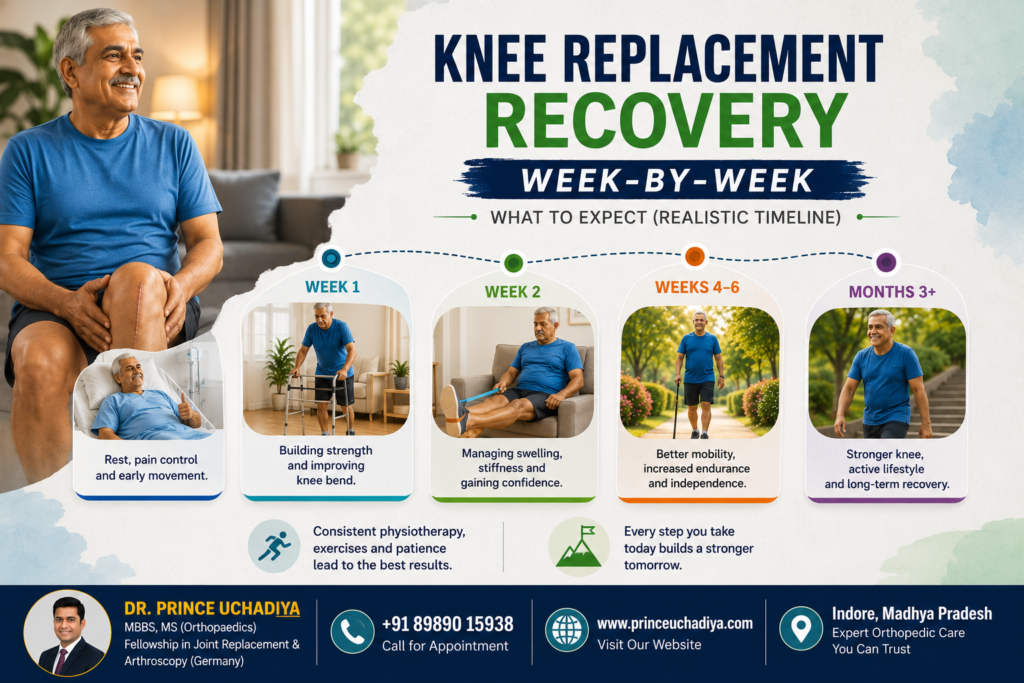
Nobody tells you about Week 3.
Week 1 is dramatic but expected.
There is pain, a hospital bed, nurses adjusting pillows, and the initial shock of what your body just went through. Week 2 is hard work, early physiotherapy, and the cautious optimism of first steps. Then comes Week 3 at home, and for many patients, this is when recovery actually becomes the hardest part. The surgical pain has settled slightly. The initial adrenaline of “I made it through surgery” has worn off. But the knee is still swollen, still stiff, still frustrating. You expected to feel better by now. Instead, every morning feels like starting from zero, and you wonder whether something has gone wrong.
Nothing has gone wrong. You are exactly where the knee replacement recovery timeline says you should be. The problem is that no one showed you the real timeline before surgery. Not the optimistic brochure version, but the honest one that tells you what Week 3 actually feels like, why Month 2 can feel harder than the first days, and what genuinely changes from Month 6 onward.
This is that guide. Dr. Prince Uchadiya’s complete, honest week-by-week knee replacement recovery timeline, based on what patients in Indore actually experience, not what the textbooks describe from a distance.
Before the Timeline Begins: What Happens During the Surgery Itself
Understanding the knee replacement recovery timeline requires a basic understanding of what the surgery does to your body, because recovery is the body’s response to that specific trauma and reconstruction.
During total knee replacement surgery, the damaged cartilage and bone surfaces of the knee joint are precisely removed, and metal and polyethylene implant components are fixed in their place. The muscles, tendons, and ligaments around the joint are carefully moved aside during the procedure and then repaired. The joint capsule is sutured closed. The entire lower leg’s muscular and soft tissue environment has been temporarily disrupted and repaired in the space of two to three hours under anaesthesia. The body now needs to heal the wound, control the inflammation triggered by the surgical trauma, gradually allow the bone to integrate with the implant surfaces, and retrain the weakened muscles to support and move the new joint. This is a months-long biological process, and the knee replacement recovery timeline reflects that reality. Detailed information about the surgical procedure itself is available on the knee replacement surgery page.
Week 1: The Surgery Week, Pain Is Expected, Movement Is Essential
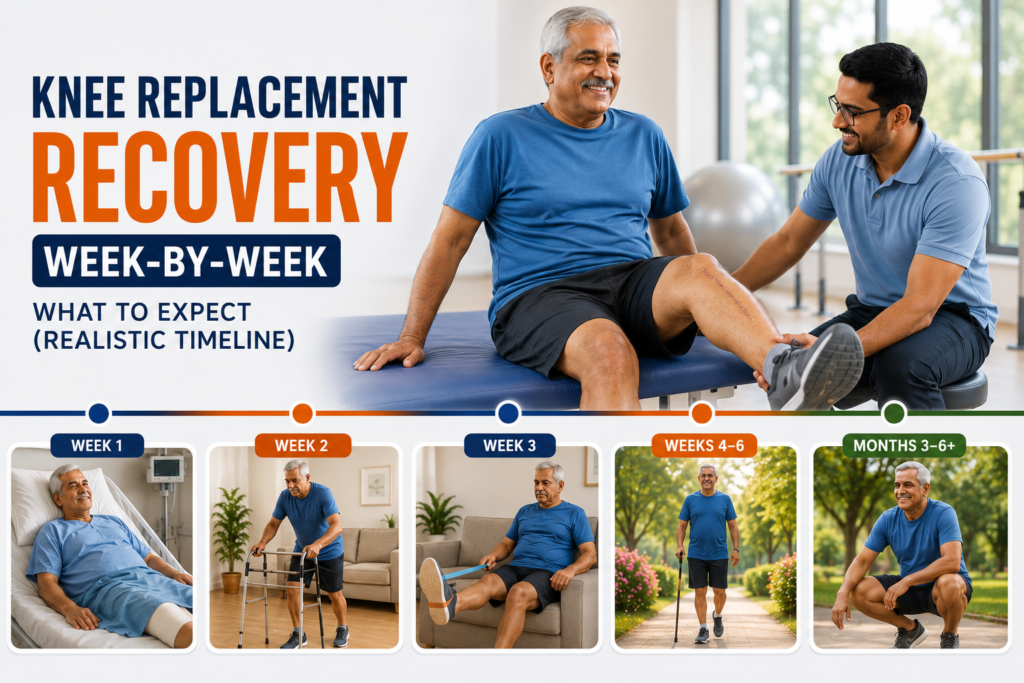
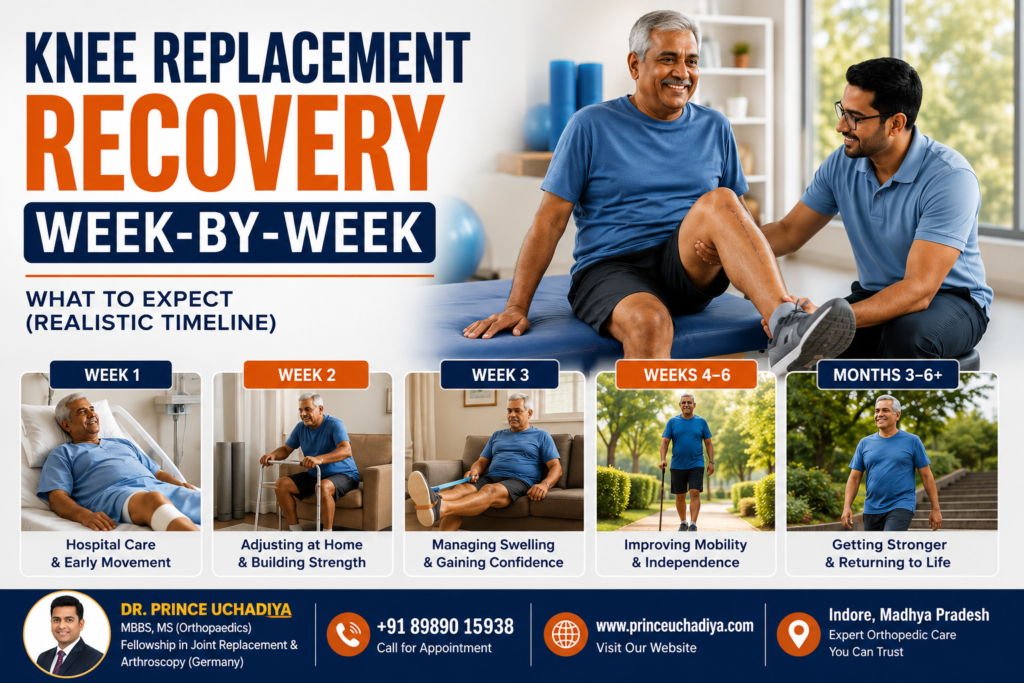
The first week of the knee replacement recovery timeline is both the most medically intense and, in some ways, the most supported. You are still in hospital, pain is managed by the clinical team, and a physiotherapist begins working with you within 24 hours of surgery. This early mobilisation is not optional or merely motivational. It is clinically critical. Early movement prevents dangerous blood clots, reduces post-operative stiffness that is much harder to reverse if allowed to establish, and stimulates circulation to support wound healing.
By the end of Day 1, most patients have sat on the edge of the bed and stood briefly with a walker. By Day 2 to 3, short walks of ten to fifteen metres within the ward are achievable. Pain during this week is significant and is managed with a combination of oral medications, nerve blocks administered during surgery that provide relief for the first twelve to twenty-four hours, and in some cases an ice machine or cryotherapy device applied to the knee. The goal for Week 1 is not comfort. It is achieving a knee bend of approximately 70 degrees, getting in and out of bed safely, and walking short distances with the walker without overloading the joint.
Swelling during Week 1 is substantial and expected. The surgical trauma triggers an inflammatory response that floods the knee with fluid, making it appear dramatically larger than normal. Elevation of the leg above heart level when resting reduces swelling. Ice applied for twenty minutes at a time provides both swelling control and pain relief. These two measures, elevation and ice, remain relevant for weeks to come.
Week 2: Home Arrives, The Real Challenge Begins
Most patients in Indore are discharged from hospital between Day 3 and Day 5 after knee replacement surgery. Coming home feels like a victory, and it is, but it also marks the point at which the structured clinical support of the hospital is replaced by the patient’s own discipline and the support of their family. The physiotherapy program, the medication schedule, the icing and elevation routine, and the home exercise program all need to continue with the same consistency that the hospital team maintained.
The physiotherapy target for Week 2 is achieving approximately 90 degrees of knee flexion, which is sufficient to allow most basic seated activities and short outdoor walks with a walker or cane. Progress in range of motion at this stage depends significantly on how consistently the home exercise program, particularly the heel slides and quadriceps sets prescribed by the physiotherapist, are performed every day.
Week 3: The Hardest Week Nobody Warned You About
Week 3 is the point in the knee replacement recovery timeline where many patients contact the clinic asking whether something is wrong, and the answer is almost always no. The first two weeks had a clear trajectory: surgery happened, acute pain was managed, early milestones were hit, and progress felt visible day by day. Week 3 often feels like recovery has stalled or even reversed.
What is actually happening biologically during this week is the transition from the acute inflammatory phase to the early proliferative healing phase. The body is beginning to lay down new tissue at the surgical site, the implant-bone interface is starting to consolidate, and the muscles are being asked to work harder in physiotherapy sessions. This creates new discomfort, particularly a deep aching during exercise sessions, and the fatigue of recovery accumulates. Patients who have been managing the pain with discipline and optimism sometimes hit an emotional low around Week 3 that catches them off guard.
This is normal. Published orthopaedic literature and clinical experience consistently identify the first week at home (days 3 to 7) and Week 3 as the most psychologically challenging periods of the knee replacement recovery timeline. The improvement from Week 3 to Week 4 is often the most encouraging jump of the entire early recovery, and patients who push through Week 3 consistently report that Week 4 feels like turning a corner.
Week 4 to Week 6: The Corner Turns
The shift from Week 3 to Week 4 is one of the most meaningful transitions in the knee replacement recovery timeline. By Week 4, the majority of patients have discontinued prescription pain medication and are managing on over-the-counter anti-inflammatory medications if anything. Walking distance increases noticeably from one day to the next. The range of motion goal of 90 degrees or more of knee bend becomes achievable for most patients, and in many, it significantly exceeds that target.
By Week 4, many patients have transitioned from a walker to a cane for walking. By Week 6, most can walk without any assistive device for short distances in familiar, safe environments. Swelling is still present, particularly after activity and toward the end of the day, but it no longer dominates the clinical picture. Stiffness in the mornings gradually reduces in duration from thirty to forty-five minutes in early Week 4 to ten to fifteen minutes by Week 6. Stairs become possible with a handrail and appropriate technique, though the knee replacement recovery timeline is honest that this is still an effort at Week 6, not yet an automatic movement.
Physiotherapy in this phase intensifies. Strengthening exercises for the quadriceps and hip muscles, balance and proprioception training, and progressive walking distances are the focus. Patients who attend their physiotherapy sessions consistently and perform their home exercises daily reach these milestones reliably. Those who attend intermittently or skip home exercises plateau and struggle to progress.
Month 2 to Month 3: The Rebuilding Phase
Months 2 and 3 of the knee replacement recovery timeline are where patients transition from managing a post-operative knee to actively rebuilding a functional one. The most acute recovery challenges are largely behind. Pain is manageable and no longer constant. Walking without assistance over meaningful distances, including outdoor walks of several hundred metres, is achievable for most patients. Driving returns during this phase, typically around six to eight weeks after surgery when the patient is off narcotic pain medications, has adequate quadriceps strength to brake safely, and has received clearance from their surgeon.
Stiffness with prolonged sitting remains a feature of this phase. Getting up after sitting for an extended period, as in a long car journey or a cinema, produces the characteristic “gelling” of the knee that gradually resolves over weeks. The key to minimising this is the advice that applies throughout the entire knee replacement recovery timeline: avoid staying in one position for more than thirty to forty minutes and break up sitting with short walking intervals.
Sleep quality improves meaningfully during this phase. By Month 2, most patients can find a comfortable sleeping position and complete a full night without the knee pain that disrupted sleep in the first weeks. This improvement in sleep is itself an accelerator of recovery, because sleep is when the body performs the most intensive tissue repair and the immune system is most active.
Some patients experience a discouraging plateau during Month 2 or 3, where range of motion and strength seem to stabilise without further progress for two to three weeks. This is a normal feature of the knee replacement recovery timeline and reflects the body consolidating its gains at one level before the next phase of progress. Consistent physiotherapy rather than reduced effort during a plateau is what breaks through it. Patients in Indore can continue their structured recovery through the post-injury rehabilitation program.
Month 3 to Month 6: Functional Independence Returns
The third to sixth month section of the knee replacement recovery timeline is when life begins to feel genuinely normal again for most patients. The knee is no longer the dominant focus of every waking hour. Walking, shopping, cooking, and light household activities are managed with increasing confidence and decreasing conscious effort. Patients in Indore who had been unable to perform Namaz comfortably, walk to the local market without stopping, or climb the stairs at home without assistance find that these activities return progressively during this phase.
Strength continues to build as the quadriceps, hamstrings, and hip abductors recover from the months of atrophy that preceded surgery, when chronic pain and inflammation had been inhibiting normal muscle recruitment. Many patients are surprised to discover that muscles that felt adequate before surgery were functionally quite compromised, and the progressive strengthening of the post-replacement rehabilitation period produces leg strength that in some cases exceeds what existed before the arthritis became severe.
Swelling at this stage is typically very mild or absent at rest. Some patients continue to notice mild swelling and warmth in the knee at the end of a particularly active day or after a more demanding physiotherapy session, which is a normal feature of the healing joint responding to load. This activity-related swelling is managed with ice, elevation, and appropriate activity modification, and it diminishes progressively through this phase.
Month 6 to Month 12: Full Recovery and Long-Term Function
The final section of the knee replacement recovery timeline is characterised by a gradual fading of the conscious awareness of the knee. In the early months, every step involved some degree of deliberate attention to the knee. By Month 6 to 9, most patients report that walking feels increasingly automatic. By Month 12, the vast majority describe their gait as natural and the knee as having become part of their body rather than a surgical site they are managing.
Patients who underwent Ayushman Bharat-funded knee replacement surgery in Indore and are managing their recovery on a limited budget should note that maintaining their physiotherapy exercise program at home is as important as formal physiotherapy sessions. The exercises taught during supervised physiotherapy are the same exercises that drive long-term function. Information about Ayushman Bharat knee replacement coverage in Indore is available on the Ayushman Bharat knee replacement page.
What Makes Some Patients Recover Faster Than Others
The knee replacement recovery timeline is a population average. Individual patients recover faster or slower depending on a set of modifiable and non-modifiable factors. Understanding these factors helps patients make the choices that give them the best chance of reaching every milestone at the earlier end of the range.
Pre-operative fitness and muscle strength are among the strongest predictors of post-operative recovery speed. Patients who have stronger quadriceps before surgery have a better foundation from which to rebuild, and those who undergo a structured pre-operative physiotherapy program consistently reach post-operative milestones faster. Age and general health comorbidities such as diabetes, heart disease, and obesity all influence recovery speed. Adherence to the physiotherapy program and home exercises is perhaps the single most modifiable determinant: patients who comply fully with their program simply do better than those who do not.
Doing too much too soon is equally problematic. Overdoing activity in the first weeks, motivated by impatience with the process, produces excess swelling and pain that sets the recovery back rather than accelerating it. The knee replacement recovery timeline is not a ladder to climb as fast as possible. It is a physiological process to be supported with the right inputs at the right time.
Frequently Asked Questions About Knee Replacement Recovery Timeline
1. How long does knee replacement recovery really take week by week?
The knee replacement recovery timeline has three broad phases. The acute phase runs from surgery through Week 6, focused on wound healing, pain management, early range of motion, and safe walking. The rebuilding phase runs from Month 2 through Month 3, during which independence returns, driving resumes, and functional activities are progressively restored. The full recovery phase runs from Month 3 through Month 12, during which strength is fully rebuilt, the knee feels increasingly natural, and low-impact activities are resumed. Most patients achieve the ability to live independently without assistive devices by 6 to 8 weeks. Full, comfortable function typically takes 6 to 12 months depending on individual factors.
2. What should patients realistically expect during the first week after knee replacement surgery?
The first week is medically supported, physically demanding, and emotionally mixed. Pain is significant but well-controlled with medication. Physiotherapy begins within 24 hours. By Day 2 to 3, most patients stand and walk short distances with a walker. Swelling is prominent and is managed with elevation and ice. The knee bend target for Week 1 is approximately 70 degrees. Sleep is disrupted. Fatigue is profound. Most patients find the first week surprisingly manageable because of the clinical support and the motivating novelty of early milestones, but the next few weeks at home are where real character is required.
3. Is severe pain normal after total knee replacement surgery?
Significant pain in the first one to two weeks is expected and normal. This is major surgery involving bone, muscle, and joint reconstruction. The pain is well managed with the prescribed pain medication protocol and should be taken as directed rather than waiting until pain becomes severe before medicating. By Week 3 to 4, most patients transition off prescription pain medication. Pain that is unexpectedly severe, not responding to medication, accompanied by fever, wound changes, or calf swelling, is not normal and requires contact with the surgical team. The distinction the knee replacement recovery timeline draws is between expected post-operative discomfort and pain that signals a complication requiring assessment.
4. Why does knee swelling continue even weeks after knee replacement?
Swelling after knee replacement is more persistent than most patients expect and is one of the most common sources of anxiety in the knee replacement recovery timeline. The reason is that the knee joint and its surrounding tissues underwent significant surgical trauma, and the body’s inflammatory response to that trauma takes months, not days, to fully resolve. Swelling is often made worse by increased activity during the day and typically peaks in the evening. It is reduced by ice application, elevation above heart level, and avoiding prolonged periods of standing or sitting without movement. Most patients have some degree of swelling for three to six months, with activity-related swelling potentially persisting up to twelve months. Persistent swelling that is increasing rather than stable or improving, or that is associated with pain and redness, warrants a call to the surgeon.
5. When can most patients start walking without a walker or cane after knee replacement?
The transition from walker to cane typically happens around Week 2 to 4 for most patients in the knee replacement recovery timeline. The transition from cane to unaided walking usually occurs around Week 4 to 8, with most patients walking independently around the house by Week 6. Walking outdoors for meaningful distances without assistance typically becomes comfortable between Week 6 and Week 12. These are population averages and individual progress varies based on pre-operative strength, physiotherapy adherence, age, and medical comorbidities. The timing of the transition should be guided by the physiotherapist’s assessment rather than calendar milestones alone.
6. How many weeks does it usually take to climb stairs comfortably after knee replacement surgery?
Stair climbing with a handrail is typically introduced in hospital or at home in the first one to two weeks after surgery. Negotiating stairs safely with a handrail, one step at a time (step-to-step pattern), is achievable for most patients by Week 2 to 3. A more natural stair-climbing pattern, alternating feet, becomes possible for many patients around Month 2. Climbing stairs without the handrail comfortably typically occurs between Month 2 and Month 3. The staircase is consistently one of the last functional milestones to feel fully automatic, with some patients in the knee replacement recovery timeline not feeling fully confident on stairs until Month 4 to 6. This is normal and reflects the ongoing strengthening of the quadriceps that stair-climbing specifically requires.
7. Why does knee replacement recovery feel different for every patient?
The knee replacement recovery timeline is shaped by a combination of biological, physical, psychological, and social factors that are unique to each patient. Pre-operative muscle strength, the degree of arthritic damage and deformity present before surgery, age, the presence of diabetes or other conditions affecting tissue healing, body weight, pain tolerance, home support availability, and most importantly the consistency of physiotherapy participation all interact to determine the individual recovery course. Two patients the same age undergoing the same procedure by the same surgeon can have recovery timelines that differ by two to three months. Understanding this is important for managing expectations and avoiding the discouragement that comes from comparing one’s own progress to another patient’s experience.
8. Is it normal to still have pain 2-3 months after knee replacement surgery?
Yes. Mild to moderate pain and discomfort at two to three months after knee replacement is within the normal knee replacement recovery timeline for many patients. The pain at this stage is typically different from the acute surgical pain of the first weeks: it tends to be more activity-related, occurring during or after physiotherapy sessions and after particularly active days, and is much improved or absent at rest. True resolution of all pain at the knee replacement site in most patients occurs between three and six months. Some patients experience mild discomfort with specific activities for up to twelve months. Pain at two to three months that is severe, constant, or accompanied by swelling, warmth, or wound changes should prompt contact with the surgeon to exclude complications including infection or implant-related issues.
9. When does stiffness and tightness improve after total knee replacement?
Morning stiffness in the knee replacement recovery timeline typically peaks in the first two to three weeks and progressively reduces from Month 1 onward. By Month 2 to 3, most patients notice that morning stiffness resolves within five to ten minutes of movement rather than the thirty to forty-five minutes of early recovery. Stiffness with prolonged sitting (getting up from a chair after sitting for more than thirty minutes) is a particularly persistent feature, often present to some degree until Month 4 to 6. The single most effective strategy for managing stiffness throughout the timeline is consistent daily physiotherapy and avoiding long static positions. Patients who sit or lie still for extended periods consistently report more stiffness than those who move regularly through the day.
10. Can doing too much exercise slow down knee replacement recovery?
Yes, and this is a more common problem than most patients anticipate. The surgical site and surrounding tissues need to heal in a controlled environment. Overdoing activity in the first weeks, whether from impatience, misplaced toughness, or following advice from non-medical sources to “work through it,” produces excess swelling, increased pain, and in some cases micro-trauma to healing tissues that genuinely sets recovery back. The knee replacement recovery timeline is guided by the principle of progressive loading: the right amount of activity for each week, gradually increased as healing allows. Too much is as counterproductive as too little. The physiotherapist’s guidance on how much to do each week is based on clinical assessment of how the knee is responding, not on a generic schedule, and it should be followed rather than exceeded.
11. How important is physiotherapy during knee replacement rehabilitation?
Physiotherapy is not supplementary to knee replacement recovery. It is the primary driver of functional outcome. The surgery creates the structural prerequisite for a functioning knee. Physiotherapy is what converts that structural potential into actual function. Patients who receive eight to twelve weeks of structured physiotherapy after total knee replacement consistently achieve better range of motion, greater strength, faster functional independence, and higher satisfaction with their surgical outcome than those who do not. The difference at twelve months between a patient who completed their full physiotherapy program and one who stopped at six weeks is measurable and clinically significant. For patients in Indore, access to structured post-operative rehabilitation through the rehabilitation program is an important part of the complete treatment plan.
12. When can patients sleep comfortably again after knee replacement surgery?
Sleep disruption is one of the most consistently underestimated quality-of-life impacts of knee replacement recovery. The first two to three weeks typically involve interrupted sleep from pain, difficulty finding a comfortable position with a stiff knee, and the discomfort of swelling. By Week 3 to 4, most patients begin to find a position, usually on the back with a pillow under the calf to keep the knee slightly elevated, that allows two to three hours of unbroken sleep. By Week 6, most patients sleep through the night with occasional waking. By Month 2 to 3, normal sleep patterns return for the vast majority. The improvement in sleep quality is closely correlated with improvement in pain and swelling, and the reduction in pain medication as recovery progresses also helps, as many pain medications themselves disrupt sleep architecture.
13. Is depression or emotional stress common during knee replacement recovery?
Yes. Published research and clinical experience consistently identify emotional difficulty as an under-addressed aspect of the knee replacement recovery timeline. The combination of chronic pain from the surgery, physical dependence on assistance for basic activities, disrupted sleep, reduced social participation, and the gap between expected and actual recovery pace creates conditions that commonly produce low mood, irritability, and in some patients a more significant depressive episode. Patients who know that emotional difficulty at Week 3 to 6 is a recognised and normal feature of recovery are better prepared to identify and manage it rather than being blindsided by it. Maintaining social connection, setting small daily goals, and speaking openly to the treating team about emotional challenges are the most effective strategies. Families can play a critical role by recognising emotional difficulty as part of the recovery rather than as a personal failing of the patient.
14. Why does knee replacement recovery sometimes take longer than expected?
Several factors reliably extend the knee replacement recovery timeline beyond average. Poorly controlled diabetes significantly impairs wound healing and increases infection risk. Significant obesity increases the mechanical load on the new implant and reduces the mobility needed for effective physiotherapy. Pre-operative severe muscle atrophy from years of pain-limited activity means there is more muscle to rebuild. Inadequate adherence to physiotherapy, whether from pain avoidance, logistical constraints, or lack of motivation, is the most common modifiable reason for extended recovery. Post-operative complications including infection, stiffness requiring manipulation under anaesthesia, or implant-related issues all extend recovery. Patients who prepare well before surgery through pre-operative physiotherapy and optimise their medical conditions beforehand consistently recover more within the expected timeline.
15. What are realistic recovery milestones from Week 1 to Month 12 after knee replacement surgery?
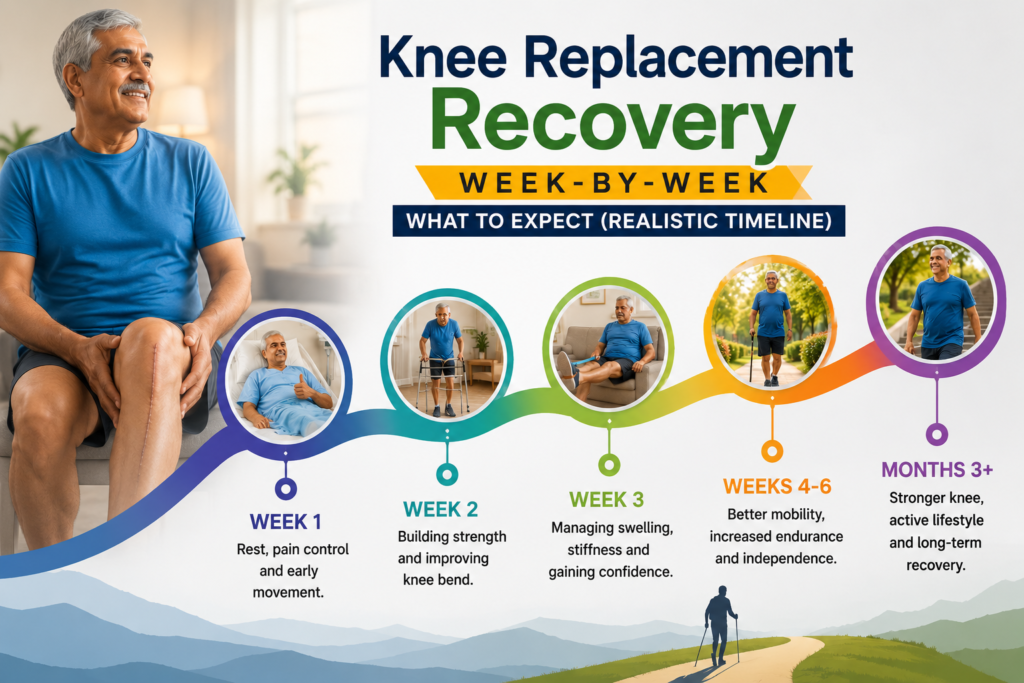
The honest knee replacement recovery timeline looks like this. Week 1: standing and walking short distances with walker, 70 degrees of knee bend, managing pain with medication. Week 2: home from hospital, walking with walker or cane, beginning home exercises consistently. Week 3 to 4: transition to cane or unaided walking for short distances, 90 degrees or more of knee bend, prescription pain medication discontinued. Week 6: walking without assistance for short distances, stairs with handrail, driving not yet returned for most. Month 2: driving resumed, walking comfortably for longer distances, stair climbing becoming more natural, light daily activities managed independently. Month 3: most daily activities managed without conscious difficulty, light social and family activities resumed, mild activity-related swelling still present. Month 6: low-impact recreational activities resumed, knee increasingly part of normal body awareness, strength and walking stamina approaching normal. Month 12: full recovery for most patients, gait automatic and natural, life quality substantially restored compared to the arthritic knee before surgery.
The knee replacement recovery timeline is a journey that requires patience, consistency, and realistic expectations. If you are preparing for knee replacement surgery in Indore, or if you or a family member is currently in recovery and wondering whether their progress is on track, Dr. Prince Uchadiya’s clinic provides a complete assessment of where you are in the timeline and what the next steps should be. Contact the clinic today to book your consultation or follow-up appointment.