Key Takeaways
- Osteomyelitis (bone infection) incidence is 90 per 100,000 adults and significantly higher in India due to open fractures, diabetes prevalence, and delayed post-operative wound management. PMC Osteomyelitis Epidemiology
- Staphylococcus aureus is responsible for 57% of bone infections in India. The rise of MRSA (methicillin-resistant strains) makes antibiotic selection critical, not guesswork.
- Bone infection treatment in Indore that relies on antibiotics alone without surgical debridement in chronic cases has a high failure rate. Biofilm-forming bacteria on dead bone are protected from antibiotics until the dead tissue is physically removed.
- From my clinic in Nipania, Indore, I regularly see patients who were treated with repeated antibiotic courses for months without any surgical clearance. By the time they arrive, there is a sequestrum (dead bone fragment) acting as a permanent infection reservoir.
- Chronic osteomyelitis, when treated correctly with debridement, dead space management, and targeted antibiotics, achieves remission in over 80% of cases.
What Bone Infection Is: Why Bone Infection Treatment in Indore Must Start Early
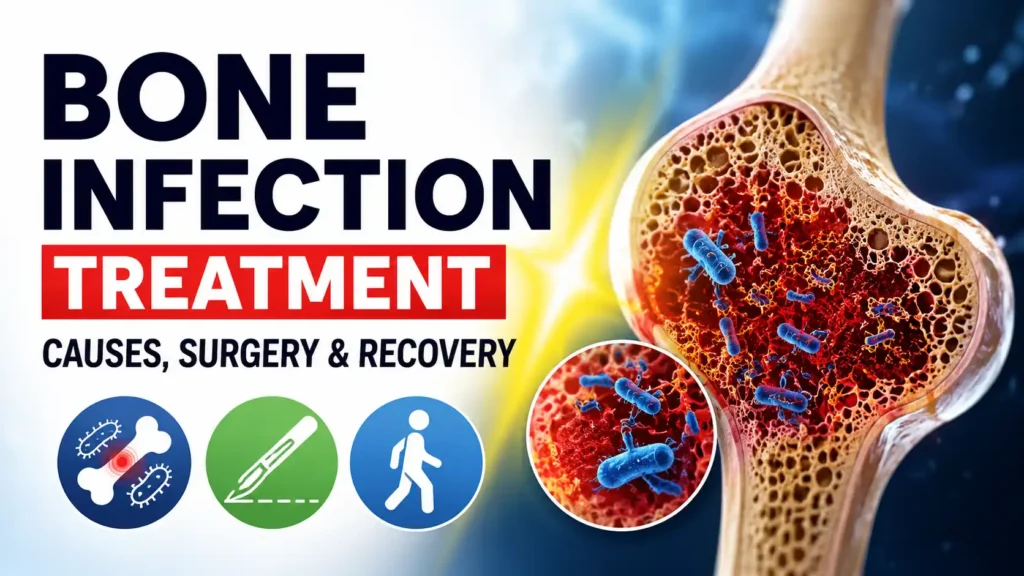
Bone infection treatment in Indore is one of the most demanding areas of orthopaedic surgery. Osteomyelitis is infection of bone by bacteria, and in some cases fungi. Bone has poor antibiotic penetration compared to soft tissue, and once bacteria form a biofilm on bone surfaces or on implanted hardware, they become highly resistant to antibiotics alone. This is why bone infection is one of the most treatment-resistant conditions in orthopaedics when managed incorrectly.
“The patients who worry me most are those who have had a fracture surgery, developed a wound problem weeks later, been given antibiotics by a GP, and arrived at my clinic six months later with a discharging sinus and dead bone inside. The window to stop that sequence from happening is early: any wound that is not healing properly after orthopaedic surgery needs specialist review immediately, not another round of oral antibiotics.”, said Dr. Prince Uchadiya.
Types of Osteomyelitis: Knowing Your Category Changes Your Bone Infection Treatment in Indore
| Type | Mechanism | Common Patient | Urgency |
|---|---|---|---|
| Haematogenous | Blood-borne bacteria seed bone | Children, immunocompromised | High: can progress in days |
| Post-traumatic | Bacteria enter through open fracture or wound | Road accident, crush injury | High: needs urgent debridement |
| Post-operative | Surgical site infection after fixation | Fracture surgery patients | High: implant at risk |
| Contiguous spread | Infection from adjacent soft tissue | Diabetic foot, pressure sores | Moderate: staged approach |
| Chronic osteomyelitis | Persistent or relapsing infection with dead bone | Any of above untreated | Surgical: antibiotics insufficient |
Recognising Bone Infection Symptoms: When to Seek Treatment in Indore Immediately
- Localised bone pain that is constant and severe, worse at rest and at night
- Swelling, redness, and warmth over the affected bone
- Fever, often spiking and recurring, with chills
- Persistent wound discharge or a sinus tract draining pus
- In children: refusal to use the affected limb, refusal to walk, unexplained high fever
- After fracture surgery: any wound breakdown, increasing redness around incision, or pain increasing after initial post-operative improvement
Diagnosis Before Bone Infection Treatment in Indore: The 5 Key Investigations
- Blood tests: WBC, CRP, ESR, blood culture (before starting antibiotics). CRP and ESR track treatment response over time.
- X-ray: Shows periosteal reaction and bone destruction, but only after 10 to 21 days of infection. Early X-ray is often normal.
- MRI: Gold standard. Detects bone marrow oedema within 24 to 48 hours of infection onset. Shows extent of involvement, soft tissue involvement, and guides surgical planning.
- Bone biopsy and culture: Definitive. Identifies the specific organism and its antibiotic sensitivity. This must be done before starting antibiotics wherever possible. Without a culture result, antibiotic selection is guesswork.
- Nuclear bone scan or PET-CT: Useful for multifocal infection or when MRI is unavailable or contraindicated.
Bone Infection Treatment in Indore: The Full Numbered Pathway
Acute Osteomyelitis: First Steps in Bone Infection Treatment in Indore
- Culture first: Blood culture and bone biopsy before antibiotics starts if the patient is stable. Starting blind antibiotics without culture is the most common avoidable error in acute osteomyelitis management.
- IV antibiotics: Empirical cover targeting Staphylococcus aureus (flucloxacillin or cloxacillin as first line; vancomycin for MRSA cover pending sensitivity) given intravenously for 4 to 6 weeks in haematogenous osteomyelitis.
- Surgical drainage: When there is a subperiosteal abscess or pus collection, surgical drainage is added to antibiotics. In children with haematogenous osteomyelitis, early surgical drainage dramatically improves outcomes.
- Monitoring: CRP tracked weekly to confirm treatment response. If CRP fails to fall within 72 hours of starting antibiotics, surgical review is mandatory.
Chronic Osteomyelitis: Why Surgery Is the Answer
- Surgical debridement: All infected, necrotic, and avascular tissue is removed. The sequestrum (dead bone fragment acting as permanent bacterial reservoir) must be completely excised. No antibiotic reaches bacteria within a sequestrum. It must come out physically. Fracture and trauma management expertise directly informs the debridement approach.
- Dead space management: Once infected tissue is removed, the resulting cavity must be managed. Options include antibiotic-impregnated calcium sulphate beads (which release high local antibiotic concentrations), antibiotic-loaded cement spacers, or biological fillers.
- Bone reconstruction: When significant bone has been removed, structural reconstruction is required. Bone grafting, bone transport using Ilizarov frames, or vascularised bone transfer are the techniques used depending on the defect size. The minimally invasive surgical approach is used wherever anatomically feasible to reduce soft tissue damage.
- Targeted antibiotics post-surgery: 6 to 12 weeks of culture-guided antibiotics after debridement. Oral switch is made once CRP normalises and the patient is clinically well.
- Soft tissue coverage: When bone has been exposed by infection or debridement, plastic surgery input for local or free flap coverage may be needed for wound closure.
After Surgery: Monitoring and Recovery Following Bone Infection Treatment in Indore
Successful bone infection treatment in Indore requires long-term follow-up because osteomyelitis has a relapse rate of 15 to 30% even after adequate treatment. Long-term monitoring is essential. Patients at Dr. Prince Uchadiya’s clinic receive a structured follow-up protocol including periodic CRP checks, X-ray surveillance for recurrence, and functional rehabilitation. The post-injury rehabilitation programme supports recovery of limb function after extensive debridement procedures. For patients with associated fractures or post-operative infections, the bone fracture operation page covers the overlap between fracture fixation and infection management.
Real Patient Questions About Bone Infection Treatment in Indore (Quora and Reddit)
1. Can bone infection heal without surgery?
Acute haematogenous osteomyelitis diagnosed early and treated with 4 to 6 weeks of appropriate IV antibiotics can resolve without surgery in many cases. Chronic osteomyelitis with a sequestrum, sinus tract, or failed antibiotic courses cannot heal without surgical debridement. Antibiotics suppress but do not eradicate infection in the presence of dead bone or biofilm.
2. I had a road accident with an open fracture. How do I know if bone infection has started?
Warning signs after an open fracture include increasing pain rather than reducing pain at the fracture site after the first few days, wound edges not healing or discharging pus, fever that returns after initial improvement, and redness spreading around the wound. Any of these after an open fracture need immediate assessment, not a “wait and see” approach with oral antibiotics.
3. My child has a fever and refuses to walk. Can this be bone infection?
Yes, and this is a paediatric orthopaedic emergency until proven otherwise. Haematogenous osteomyelitis in children spreads rapidly through the metaphyseal blood vessels and can cause septic arthritis of the adjacent joint within hours. A child who refuses to walk, has localised bone tenderness, and a fever needs urgent orthopaedic assessment and MRI, not observation at home.
4. How long does bone infection treatment take?
Acute osteomyelitis: 4 to 6 weeks of IV antibiotics followed by oral antibiotics until CRP normalises. Chronic osteomyelitis requiring surgery: the surgical procedure itself, then 6 to 12 weeks of targeted antibiotics post-operatively, then monitoring for 12 to 24 months for recurrence. Total treatment episode from surgery to discharge from follow-up is 1 to 2 years in complex cases.
5. My fracture surgery site is discharging pus two months later. What should I do?
This is implant-associated osteomyelitis until proven otherwise. See an orthopaedic specialist immediately. Do not accept oral antibiotics as the sole response without at minimum an MRI and wound culture. The implant may need to be removed or exchanged, the infected tissue debrided, and targeted antibiotics started based on sensitivity. Early intervention dramatically improves the chance of saving the bone and restoring full function.
6. Is bone infection treatment covered under Ayushman Bharat in Indore?
Surgical debridement for osteomyelitis, bone reconstruction procedures, and associated hospitalisation fall within PM-JAY package coverage for eligible patients. The specific package depends on the procedure classification. Patients with Ayushman cards are encouraged to discuss coverage at their first consultation. The Ayushman surgical process at the clinic includes guidance through eligibility and pre-authorization for these procedures.
For a second opinion on bone infection management that has not been progressing, the structured orthopaedic second opinion at Dr. Prince Uchadiya Orthopaedic And Joint Care Clinic, Nipania, Indore, reviews the clinical picture from the beginning without assumptions about prior treatment decisions.