A 38-year-old software engineer from Vijay Nagar,Indore,
came into the clinic unable to turn a door handle without wincing.
He had not played sports in years. His life was a desk, a keyboard, and a mouse.
But for the past four months, the outside of his right elbow had been producing a burning, aching pain that was now making his daily work genuinely difficult. Shaking hands with clients hurt. Pouring his morning chai hurt. Lifting his laptop bag triggered a shot of pain that radiated down into his forearm. He had convinced himself it could not be tennis elbow because he had never held a tennis racket in his life.
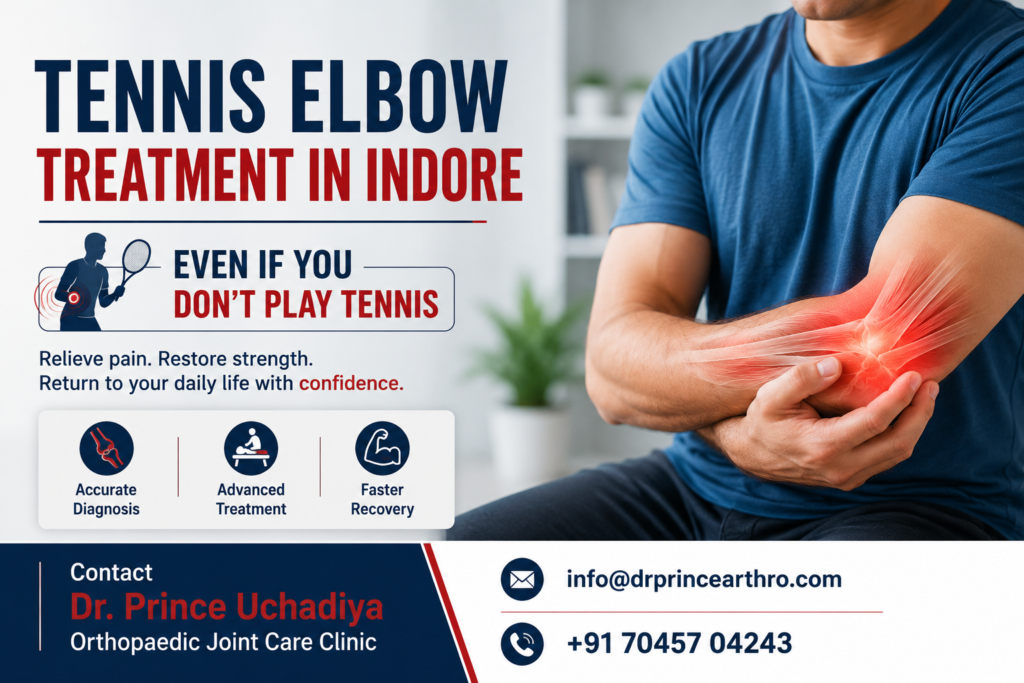
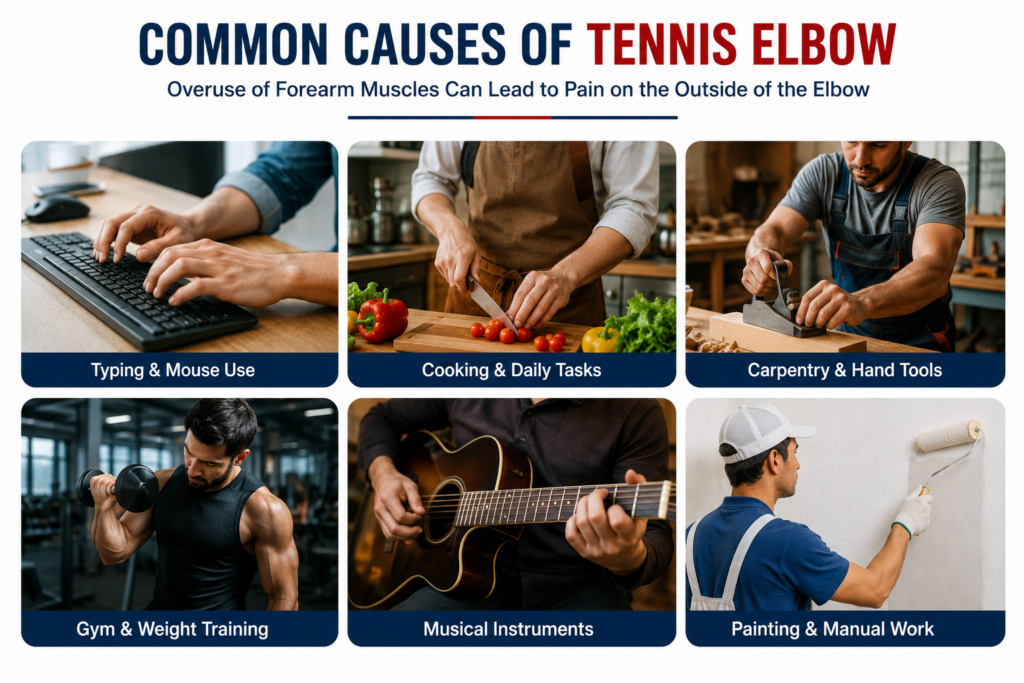
He was wrong, and in a way that almost every patient with this condition is initially wrong about. Published clinical research confirms that tennis players account for only five percent of all lateral epicondylitis cases seen in clinical practice. The other 95 percent are exactly like this patient: desk workers, cooks, carpenters, mechanics, gym enthusiasts, musicians, painters, and plumbers, anyone whose occupation or activity involves repetitive forearm and wrist movements that gradually overload the tendon at the outside of the elbow.
Tennis elbow treatment in Indore is available, effective, and in the vast majority of cases does not require surgery. But it does require an accurate diagnosis and a structured approach that addresses the real biology of the condition. This article explains everything patients in Indore need to know.
What Is Tennis Elbow and Why Does It Cause That Specific Outer Elbow Pain?
Tennis elbow, medically termed lateral epicondylitis or more accurately lateral epicondyle tendinopathy, is a degenerative condition affecting the tendons that attach the wrist and finger extensor muscles to the lateral epicondyle, the bony prominence on the outer side of the elbow. The extensor carpi radialis brevis (ECRB) is the tendon most commonly involved, and it is here, at the point where this tendon attaches to the lateral epicondyle, that the characteristic pain of tennis elbow is felt.
The condition develops through a mechanism of repetitive micro-tearing. Every time the wrist extensors contract, they pull on their tendon attachment at the elbow. When this cycle of contraction and release is repeated for hours each day, in occupations like typing, cooking, or carpentry, or during activities like gym training, racket sports, or playing musical instruments, the micro-tears accumulate at the tendon attachment faster than the body can repair them. This leads to what scientists now call angiofibroblastic degeneration and collagen disarray within the tendon: a failure of the normal tendon structure, not true inflammation, which is why the condition is technically more accurately termed a tendinopathy rather than tendinitis.
This distinction between degeneration and inflammation is clinically important for tennis elbow treatment in Indore because it explains why anti-inflammatory medications alone are insufficient for lasting recovery. The tissue is not primarily inflamed. It is degenerating and failing to repair, and treatment must address this biological reality rather than simply suppressing an inflammatory response that is not the primary pathological process.
Who Gets Tennis Elbow? The Real Patient Population in Indore
Tennis elbow affects approximately one to three percent of the general population and is most prevalent in adults aged 35 to 55 years. The dominant arm is affected in 75 percent of cases, reinforcing its nature as an overuse condition related to the activities the dominant hand performs. There is no significant difference in prevalence between men and women, though the condition tends to be more persistent and of greater symptomatic severity in women.
In Indore’s orthopaedic clinics, the patient profile for tennis elbow treatment is diverse and overwhelmingly non-athletic. IT professionals who type and use a mouse for six to nine hours daily develop ECRB overload from the sustained low-level wrist extension required by keyboard and mouse use. Construction workers including carpenters and painters perform repetitive wrist extension under load throughout their working day. Cooks and housewives who chop, stir, knead, and squeeze for extended periods, gym enthusiasts who perform barbell curls, rows, and pulldowns without adequate forearm conditioning, musicians particularly pianists and guitarists, and mechanics who use hand tools all present regularly with lateral epicondyle pain that is the same condition by a different occupational route.
The American Academy of Orthopaedic Surgeons confirms that auto workers, cooks, and butchers get tennis elbow more frequently than the general population, and that painters, plumbers, and carpenters are particularly prone. The sports connection exists but is not dominant: less than five percent of total tennis elbow cases in clinical practice come from actual tennis players.
Recognising Tennis Elbow: Symptoms That Should Prompt Action
The clinical presentation of tennis elbow is consistent enough that an experienced orthopaedic surgeon can diagnose it with high confidence from the history and clinical examination alone. Understanding the symptom pattern helps patients in Indore recognise when their elbow pain warrants evaluation rather than continued self-management.
- Outer elbow pain: The pain is located at or just below the lateral epicondyle, the bony prominence on the outer side of the elbow. Pressing on this point directly produces tenderness that patients immediately recognise as their primary pain location.
- Pain with gripping and lifting: Any activity that requires gripping an object while the wrist is in extension produces or worsens the pain. Lifting a kettle, gripping a jar lid, shaking hands, carrying a shopping bag, or picking up a child are classic provocative activities. The pain often radiates from the elbow into the forearm during these activities.
- Wrist extension weakness: The affected tendon’s capacity to transmit force is reduced, producing a sense of weakness or giving way when the wrist is extended or when gripping. Some patients describe objects slipping from their hand unexpectedly.
- Morning stiffness: Many patients notice that the elbow feels particularly stiff and achy for the first fifteen to thirty minutes after waking, improving with movement as circulation increases and the tendon warms up.
- Night aching: In moderate to severe cases, the elbow produces a background aching at night that, while not as dramatically disruptive as rotator cuff night pain, is sufficient to affect sleep quality and is a sign that the tendinopathy is progressing rather than resolving.
Why Your X-Ray Looks Normal But Your Elbow Hurts
One of the most consistent sources of confusion for patients seeking tennis elbow treatment in Indore is the apparently normal X-ray. They are told the bones look fine. They are reassured there is nothing structurally wrong. And yet the elbow continues to produce pain with every grip and lift. The explanation is straightforward once the biology is understood.
X-rays show bones. They do not show tendons, the soft tissue structures where lateral epicondylitis actually occurs. The ECRB tendon and its degenerative changes are entirely invisible on a plain X-ray. The lateral epicondyle itself, the bone to which the tendon attaches, remains structurally normal in most cases. What has changed is the tendon’s internal architecture, the loss of normal collagen organisation and the failure of the tissue’s repair processes, and this level of structural change requires ultrasound or MRI to visualise.
Ultrasound is the most practically useful imaging tool for tennis elbow. It shows the thickened, poorly organised tendon, identifies areas of increased blood flow (neovascularity) which are associated with more symptomatic and chronic cases, and can guide injections accurately to the affected area. MRI provides more detailed soft tissue information and is useful in cases where the diagnosis is uncertain or where additional pathology is suspected.
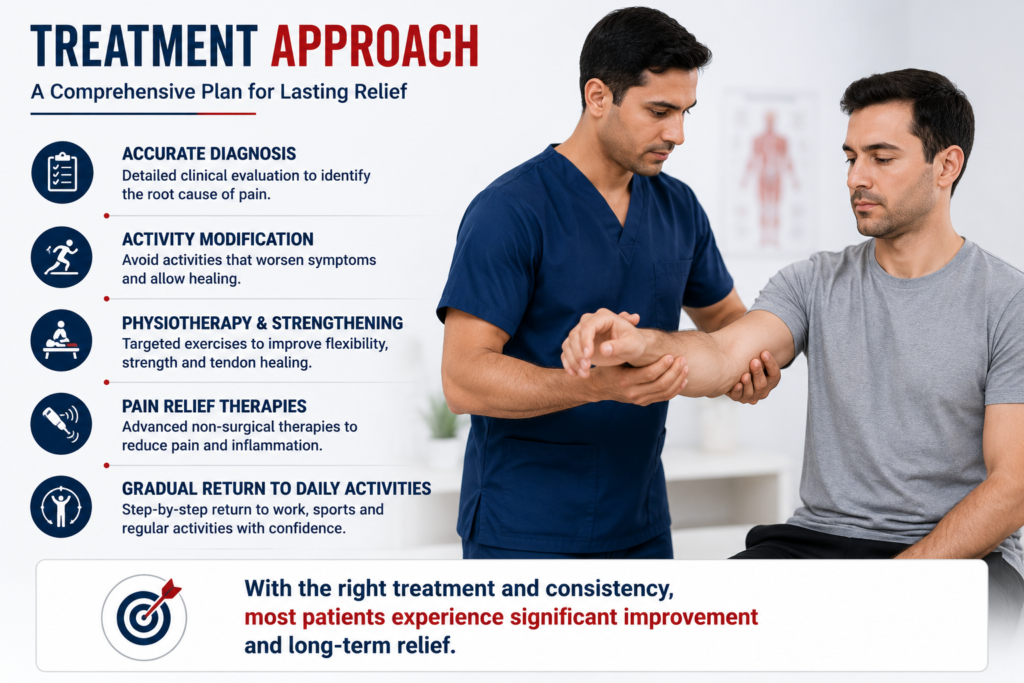
First-Line Tennis Elbow Treatment in Indore: What Every Patient Should Start With
1. Activity Modification and Load Management
The single most important first step is reducing the provocative load on the ECRB tendon without eliminating all activity. Complete rest is counterproductive because the degenerating tendon needs appropriate mechanical stimulus to trigger the repair process. The goal is to find the level of activity at which pain does not exceed a four out of ten during or after the activity, and to stay within that limit while gradually increasing tolerance over weeks.
For desk workers in Indore, this means assessing the ergonomics of the workstation. The keyboard position, mouse design, and forearm support all influence how much sustained wrist extension loading the ECRB experiences during working hours. An ergonomic mouse that keeps the wrist in a more neutral position, a wrist rest that reduces sustained wrist extension, and regular breaks from typing significantly reduce the daily provocative load without requiring time off work.
2. Eccentric and Isometric Exercise Protocol
Eccentric exercise for the wrist extensors is the most evidence-based rehabilitation approach for lateral epicondyle tendinopathy. In an eccentric exercise, the muscle and tendon lengthen under load, producing a specific type of mechanical stimulus that is particularly effective at stimulating tendon collagen remodelling and reducing the neovascularity associated with chronic tendinopathy.
The most commonly prescribed eccentric exercise for tennis elbow is the Tyler Twist or Theraband Flexbar exercise, in which a flexible resistance band is twisted with both hands and the wrist of the affected arm is slowly and eccentrically released. This exercise, performed consistently over six to eight weeks, has strong evidence for reducing pain and improving function in lateral epicondyle tendinopathy. Isometric wrist extension exercises, where the wrist pushes against resistance without moving, provide early pain relief and are often used as the initial exercise when pain is too severe for full eccentric loading.
A physiotherapy program that progresses from isometric to eccentric to progressive loading over eight to twelve weeks, tailored to the patient’s specific occupation and activity goals, is the backbone of tennis elbow treatment in Indore for most patients. Patients in Indore can access structured post-injury rehabilitation through the post-injury rehabilitation program.
3. Elbow Brace and Counterforce Strap
A counterforce brace, also called a tennis elbow strap or forearm band, is worn two to three centimetres below the lateral epicondyle during activities that provoke pain. By compressing the muscle belly of the wrist extensors, it reduces the tensile load transmitted to the tendon insertion at the lateral epicondyle, effectively partially offloading the degenerating attachment point during provocative activities. The brace does not treat the underlying tendinopathy but allows patients to continue necessary activities with less pain while rehabilitation is pursued.
For desk workers in Indore, wearing the brace during computer work. For gym users, wearing it during any pulling or gripping exercises. For carpenters and mechanics, wearing it throughout the working day while the rehabilitation program progresses. The brace is a management tool, not a solution, and should always be combined with the exercise program and activity modification.
4. Ice Therapy
Applying ice or a cold pack to the lateral epicondyle for fifteen to twenty minutes after provocative activities reduces local vascular response and provides short-term pain relief. It is most useful in the early weeks of treatment when pain is most acute and after any activity that has provoked the condition beyond its current tolerance level. Like the brace, ice manages symptoms without addressing the underlying tendinopathy, but it meaningfully improves daily comfort and is easy to incorporate into any routine.
When Specialist Tennis Elbow Treatment in Indore Becomes Necessary
Patients who have consistently applied the first-line measures described above for six to eight weeks without adequate improvement require specialist evaluation. Published data shows that most cases of lateral epicondyle tendinopathy last between six and twenty-four months on average, and while the majority resolve with conservative management, a subset requires more targeted intervention to break through a recovery plateau.
1. Corticosteroid Injection
Corticosteroid injection into the area of maximal tendon tenderness at the lateral epicondyle provides rapid and significant short-term pain reduction. The injection temporarily suppresses the pain-generating biological activity at the tendon insertion and can provide a meaningful window of reduced pain during which the rehabilitation exercises can be performed more effectively and more aggressively. However, published evidence consistently shows that while corticosteroid injections produce better short-term outcomes than physiotherapy alone at six weeks, physiotherapy produces significantly better outcomes at twelve months. Steroid injection is a bridge treatment, not a standalone cure, and it should always be combined with a structured rehabilitation program.
2. Platelet-Rich Plasma Injection
PRP injection for lateral epicondyle tendinopathy delivers concentrated growth factors from the patient’s own blood directly into the degenerating tendon, stimulating the biological repair process that the tissue has failed to complete spontaneously. Multiple randomised controlled trials comparing PRP to corticosteroid injection show that PRP produces superior outcomes at twelve months, while corticosteroid produces faster initial relief at six weeks. For patients with chronic tennis elbow lasting more than three to six months who have not responded adequately to physiotherapy, PRP injection at Dr. Prince Uchadiya’s clinic in Indore is a highly appropriate intervention. Information about PRP and regenerative treatment options in Indore is available on the PRP versus stem cell treatment page.
3. Extracorporeal Shockwave Therapy
Extracorporeal shockwave therapy delivers focused mechanical energy pulses to the degenerating tendon tissue, stimulating repair processes and reducing the neovascularity associated with chronic tendinopathy. It is a non-invasive clinic procedure requiring no anaesthesia and is well-supported by randomised controlled trial evidence for chronic tennis elbow that has not responded to conservative management. For patients who prefer to avoid injections or have not responded to other measures, shockwave therapy is a valuable intermediate intervention before surgery is considered.
4. Arthroscopic Release for Refractory Cases
Surgery for tennis elbow is reserved for the small minority of patients who have genuinely failed all conservative and minimally invasive treatments over six to twelve months. The arthroscopic procedure involves releasing or debriding the degenerated portion of the ECRB tendon attachment from the lateral epicondyle, removing the pathological tissue and allowing healing to occur. Published evidence shows that surgical treatment for refractory tennis elbow produces excellent outcomes in appropriately selected patients, with success rates exceeding 85 percent in most series. It is indicated only after conservative and interventional treatments have been adequately trialled. Details about the arthroscopic procedures available in Indore are on the arthroscopy surgery page.
Returning to Gym and Sport After Tennis Elbow
One of the most common concerns for patients seeking tennis elbow treatment in Indore, particularly gym enthusiasts and athletes, is when and how they can return to full training. The answer depends on the severity of the condition and the current phase of recovery, but the principle is consistent: return to loading should be gradual, structured, and guided by pain response rather than by calendar dates.
The general progression moves from pain-free isometric exercises, to eccentric tendon loading, to concentric loading with progressive resistance, to full sport-specific or occupation-specific loading. Any exercise that provokes more than four out of ten pain during the session, or any increase in baseline pain the morning after a session, indicates that the current load exceeds the tendon’s capacity and needs to be reduced. The most common mistake is returning to barbell rows, dumbbell curls, and pulldowns too quickly and too heavily after a period of pain reduction, which provokes a relapse that sets the recovery back by weeks.
Frequently Asked Questions About Tennis Elbow Treatment Indore
1. What is tennis elbow and can it happen without playing tennis?
Tennis elbow, medically called lateral epicondylitis or lateral epicondyle tendinopathy, is a degenerative condition of the tendon that attaches the wrist extensor muscles to the outer elbow. It develops through repetitive micro-tearing at the tendon insertion that accumulates faster than the tissue can repair. Tennis players account for only five percent of all cases seen in clinical practice. The vast majority of patients with tennis elbow are non-athletes who develop the condition from occupational or recreational activities involving repetitive forearm and wrist movements, including desk work, cooking, carpentry, painting, gym training, and playing musical instruments. If your outer elbow hurts with gripping and lifting, it can absolutely be tennis elbow, and you have never needed to pick up a racket for it to happen.
2. Why does elbow pain increase during lifting, gripping, or gym workouts?
The degenerating ECRB tendon at the lateral epicondyle is under tensile load whenever the wrist extensors contract. During lifting, gripping, pulling, and especially during exercises like barbell rows, dumbbell curls, cable pulldowns, and deadlifts, the wrist extensors work to maintain wrist stability throughout the movement. This produces repetitive high-load cycling of the already compromised tendon attachment, generating and amplifying the pain signal at the lateral epicondyle. The more gripping, wrist extension, and forearm rotation a movement involves, the more it provokes lateral epicondyle tendinopathy. This is why tennis elbow treatment in Indore for gym users always involves a temporary modification of training rather than complete cessation, focusing on identifying which specific exercises are most provocative and substituting less provocative alternatives while the tendon rehabilitates.
3. Can tennis elbow happen because of weight training or repetitive arm movements?
Yes, absolutely. Weight training is one of the most common precipitating activities for lateral epicondyle tendinopathy in Indore patients under 40. The combination of heavy grip loads during pulling exercises, the high repetition volumes typical of gym training, and the common beginner error of rapidly increasing training volume without adequate tendon conditioning creates the conditions for ECRB overload that produces tennis elbow. Movements involving supinated grip pulling (barbell and dumbbell rows, cable rows, lat pulldowns), repetitive forearm rotation under load, and sustained gripping during compound movements are the most common gym-related precipitants. Any repetitive arm movement performed with sufficient volume and load relative to the tendon’s current capacity can cause this condition.
4. What are the early symptoms of tennis elbow?
Early tennis elbow often presents as a mild, occasional ache on the outside of the elbow that appears after specific activities and resolves with rest. Patients may notice the elbow is tender to touch at the lateral epicondyle when pressure is applied. A slight sense of forearm fatigue or weakness when gripping for extended periods, and occasional shooting pain into the forearm during a specific movement like lifting a heavy object or turning a key, are early manifestations. These symptoms are frequently dismissed as general post-workout soreness or minor muscle fatigue. The diagnostic clue is that the pain consistently comes from the same location, worsens with the same provocative activities, and does not resolve with one or two days of rest as simple muscle soreness would.
5. Why does tennis elbow pain sometimes become worse at night?
Night aching in tennis elbow reflects the degree of tendinopathy severity. In mild cases, pain is activity-related and resolves entirely with rest. As the condition progresses and the tendon degeneration becomes more extensive, background pain at the lateral epicondyle becomes present at rest and at night. The same circadian pattern that affects other musculoskeletal conditions applies here: the body’s natural anti-inflammatory cortisol production drops to its lowest point in the early morning hours, reducing the hormonal suppression of pain signals and allowing the aching of the irritated tendon to become more perceptible. Night pain in tennis elbow is a sign that the condition has moved beyond a mild early stage and warrants proper medical assessment rather than continued self-management.
6. Can stretching exercises really help tennis elbow pain?
Yes, when performed correctly and as part of a comprehensive program. The most effective stretches for tennis elbow are wrist extensor stretches, where the affected arm is extended forward with the palm down and the wrist gently flexed downward using the other hand until a stretch is felt along the outer forearm. This stretch reduces the resting tension in the ECRB and can meaningfully reduce pain when performed consistently multiple times per day. However, stretching alone is insufficient for most cases. The evidence-based treatment combines stretching with eccentric loading exercises that specifically stimulate tendon remodelling, activity modification that reduces the provocative load, and in persistent cases, specialist interventions. Stretching provides symptom management and supports the repair environment; it does not alone address the underlying tendon degeneration.
7. How long does tennis elbow usually take to heal?
Published clinical data shows that the typical episode of lateral epicondyle tendinopathy lasts between six and twenty-four months on average. Most patients who follow appropriate treatment improve significantly within six to nine months. Patients who pursue structured rehabilitation early and consistently, modify the provocative activities, and use a brace appropriately reach the earlier end of this range. Those who self-manage with rest and over-the-counter painkillers without addressing the underlying biomechanical cause, or who return to full loading prematurely during apparent improvement, are more likely to experience the longer end of the range or recurrence. Tennis elbow treatment in Indore with structured specialist guidance consistently shortens the overall recovery duration compared to unmanaged self-care.
8. Is it normal for tennis elbow pain to return again after improvement?
Yes, and this is one of the most common and most frustrating features of lateral epicondyle tendinopathy. The pain reduces as the tendon’s adaptation to the current load level improves, creating a window that feels like recovery. When the patient returns to the full activity level that originally caused the condition without adequate preparation of the tendon through progressive loading, the tendon is again overloaded and the pain returns. This cycle of improvement and relapse is extremely common in tennis elbow and accounts for the long average episode duration. Breaking the cycle requires not just treating the current episode but systematically building the tendon’s load capacity to the level required for the target activity, which is achieved through the eccentric and progressive loading program under physiotherapy guidance.
9. Should I stop gym workouts completely if I have tennis elbow?
Complete cessation of gym activity is generally not necessary and is not recommended. The degenerating tendon needs appropriate mechanical loading to stimulate repair. What it does not need is the specific loading pattern that caused the condition. For most gym-going patients with tennis elbow treatment in Indore, the practical approach is to identify and temporarily eliminate the most provocative exercises (typically heavy pulling with a supinated grip), substitute less provocative alternatives (cable face pulls, neutral grip exercises, machine-based variations with lighter loads), continue lower body and other training as normal, and begin the specific eccentric tendon rehabilitation exercises for the ECRB under physiotherapy guidance. This keeps overall fitness intact while giving the tendon the specific stimulus and rest it needs to recover.
10. Can elbow braces or supports help reduce tennis elbow pain?
Yes, a counterforce brace positioned two to three centimetres below the lateral epicondyle provides meaningful pain reduction during provocative activities by reducing the tensile load transmitted to the tendon insertion. Clinical trial evidence supports the use of forearm counterforce bracing as an adjunct to rehabilitation. The brace is most effective when worn consistently during activities that previously provoked pain, not just during sport or exercise. However, the brace manages symptoms by partially offloading the tendon; it does not treat the underlying degeneration. Wearing a brace alone without pursuing the rehabilitation exercises and activity modifications that address the root cause will not resolve the condition. Think of the brace as what allows you to maintain necessary daily activities while the real treatment, the exercise program, does its work.
11. What daily activities can worsen tennis elbow symptoms?
Several common daily activities are reliably provocative for lateral epicondyle tendinopathy. Turning a key or doorknob with the elbow extended. Lifting a full kettle or heavy pot. Carrying a shopping bag or laptop bag by the handle. Prolonged keyboard and mouse use without forearm support. Wringing out a cloth or towel. Shaking hands. Opening jar lids. Using a screwdriver with repetitive rotation. Picking up objects with the palm facing down. Chopping or kneading during cooking. Any activity that requires the wrist extensors to work against load while the elbow is near full extension will provoke the degenerated ECRB tendon. Awareness of this list allows patients to make small modifications to how they perform daily tasks that meaningfully reduce the cumulative daily load on the tendon during recovery.
12. When should I see an orthopedic doctor in Indore for elbow pain?
You should seek tennis elbow treatment in Indore from a specialist when the outer elbow pain has been present for more than four to six weeks without meaningful improvement despite self-care, when pain is interfering with your work, daily activities, or gym training, when night aching is disrupting sleep, when you notice progressive weakness in the grip or forearm, or when you have tried a brace and stretching exercises consistently but without adequate relief. Earlier specialist evaluation produces better outcomes because chronic tendinopathy that has been present for more than six months becomes increasingly resistant to conservative treatment alone and may require PRP or shockwave therapy. Waiting until the condition becomes severely established before seeking care extends the overall recovery timeline significantly.
13. Can tennis elbow heal without surgery?
Yes. The vast majority of tennis elbow cases, including many that have been present for a year or more, resolve without surgery. Published evidence shows that over 80 percent of patients achieve satisfactory recovery with conservative and minimally invasive treatment. Surgery is reserved for patients who have genuinely failed all appropriate conservative measures including physiotherapy, bracing, corticosteroid injection, and in appropriate cases PRP or shockwave therapy, over a minimum of six months. Less than 10 percent of tennis elbow patients ultimately require surgery, and the surgical outcomes in this carefully selected group are excellent. The key is that “conservative treatment” must be comprehensive and consistently pursued, not a few weeks of rest followed by a painkiller.
14. What treatment options are available for tennis elbow in Indore?
Tennis elbow treatment in Indore at Dr. Prince Uchadiya’s clinic covers the full evidence-based spectrum. First-line treatment includes activity modification guidance, eccentric and isometric forearm exercise prescription, counterforce brace recommendation, and ergonomic assessment for desk workers. For patients who do not achieve adequate improvement, physiotherapy with a structured progressive loading program is prescribed. For persistent cases, ultrasound-guided corticosteroid injection provides rapid short-term relief. For chronic cases beyond six months, PRP injection offers superior long-term outcomes over corticosteroid treatment. Extracorporeal shockwave therapy is available for patients who prefer non-injection interventions or have not responded to injections. Arthroscopic ECRB release is reserved for the small minority of refractory cases. Every treatment plan begins with a clinical examination and ultrasound assessment to confirm the diagnosis and severity.
15. Why does elbow pain continue even when X-rays look normal?
X-rays show bones and cannot visualise tendons. Lateral epicondyle tendinopathy is a condition of tendon degeneration, not bone pathology. The lateral epicondyle bone itself remains structurally normal in most cases, which is why the X-ray appears normal while the tendon at its surface has developed significant degenerative change. Ultrasound imaging reliably identifies the thickened, poorly organised ECRB tendon, shows the presence of neovascularity associated with chronic tendinopathy, and can guide injections accurately to the affected tissue. MRI provides additional detail when the diagnosis is uncertain or when other pathology is suspected. A normal X-ray does not mean there is nothing wrong with your elbow. It means the problem is in the soft tissue rather than the bone, and appropriate imaging for the suspected soft tissue condition has not yet been performed.
If outer elbow pain is limiting your work, your gym sessions, or your daily routine, tennis elbow treatment in Indore at Dr. Prince Uchadiya’s clinic begins with an accurate diagnosis and a structured treatment plan designed for your specific activities and severity. You do not need to have played a single game of tennis for this condition to be your problem, and you do not need to accept months of pain as inevitable. Book your consultation today.