
A 24-year-old football player in Indore lands awkwardly after a jump, hears a pop, and feels his knee give way completely. By the time he reaches the clinic, the joint is swollen to nearly double its normal size, he cannot straighten the leg fully, and any attempt to pivot causes the knee to buckle. When the MRI comes back, it shows exactly what an experienced orthopaedic surgeon would suspect: a complete ACL tear combined with a meniscus tear. This is not an unusual finding. When someone tears their ACL, there is a roughly 50 to 60 percent chance they have simultaneously torn their meniscus. An ACL and meniscus combined injury is among the most complex knee injuries seen in orthopaedic practice, and managing it well requires far more than simply repairing two structures. It requires a specialist who understands how these two structures interact, how their injuries compound each other, and how surgical and rehabilitation decisions made on day one will determine knee health for the next 30 years.
Why the ACL and Meniscus Work as a Team in Your Knee
To understand why an ACL and meniscus combined injury is so serious, you first need to understand what each structure does and why losing both simultaneously destabilizes the knee in a way that neither injury does alone.
The anterior cruciate ligament runs diagonally through the center of the knee joint, connecting the femur above to the tibia below. Its primary job is to prevent the tibia from sliding forward on the femur and to control the rotational stability of the knee during pivoting, cutting, and landing. Without a functioning ACL, the knee becomes mechanically unstable. Every step, every turn, and every sport-specific movement involves an abnormal sliding and rotating motion between the two bones that the knee was not designed to tolerate.
The menisci are two crescent-shaped pads of cartilage, one on the inner side of the knee (medial meniscus) and one on the outer side (lateral meniscus), that sit between the femur and tibia. They distribute load across the joint evenly, absorb shock on every step, stabilize the joint during movement, and nourish the articular cartilage by distributing joint fluid. When the meniscus is intact and functioning, it absorbs up to 70 percent of the load passing through the knee during weight-bearing activity.
These two structures support each other. The ACL prevents abnormal knee motion that would otherwise cause the meniscus to be repeatedly pinched and torn by the bones. The meniscus, in turn, provides secondary stability to the knee that partially compensates when the ACL is under load. When both are torn at the same time, neither can provide its compensatory function. The result is a joint that is unstable, under-cushioned, and at serious risk of accelerated cartilage damage if left untreated.
How an ACL and Meniscus Combined Injury Happens: Mechanisms and At-Risk Groups
The same mechanism that tears the ACL frequently damages the meniscus as well. High-energy twisting or pivoting of the knee, such as a sudden change of direction with the foot planted, a landing from height with the knee in a valgus position (collapsing inward), or a direct contact blow to the lateral knee, generates rotational forces that simultaneously stress the ACL and trap and compress the meniscus between the bones.
Patients most commonly presenting with this combined injury in Indore include football players, kabaddi players, recreational badminton and cricket players, and individuals involved in road accidents where the knee sustains a twisting force. Age plays a role in the pattern of injury: younger athletes tend to suffer more acute traumatic tears, while older patients may have pre-existing degenerative changes in the meniscus that make it more vulnerable to tearing at lower force levels.
The lateral meniscus is more commonly torn alongside the ACL in acute high-energy injuries, while the medial meniscus is more frequently involved in chronic ACL-deficient knees where the instability has been present for some time, repeatedly stressing the medial compartment.
Recognising the Symptoms of an ACL and Meniscus Combined Injury
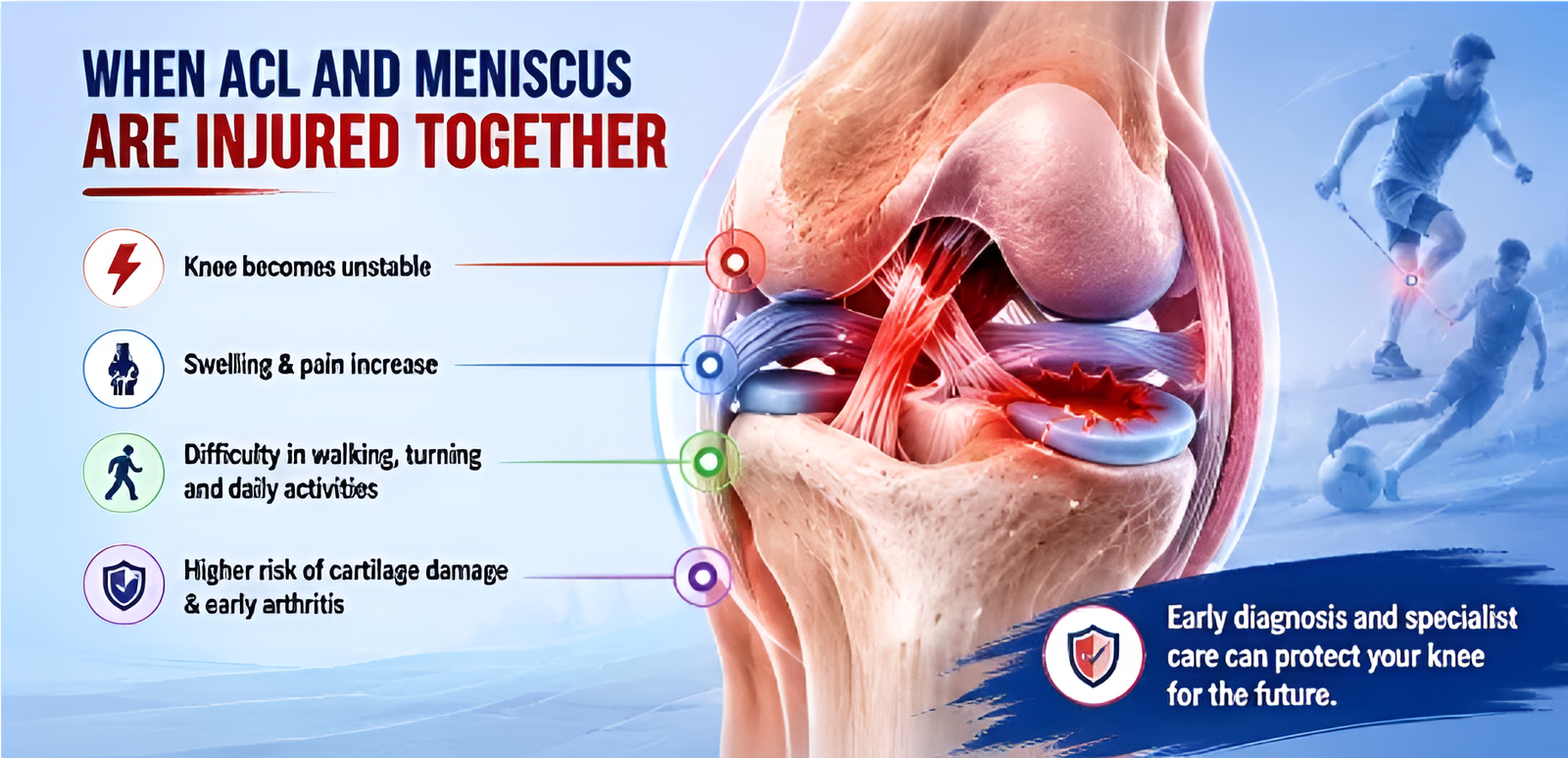
The symptom picture of a combined ACL and meniscus injury is more complex than either injury produces alone. Patients typically describe several of the following, though the precise combination depends on the severity and location of each tear.
- The pop at the moment of injury: Many patients report hearing or feeling a distinct pop when the ACL tears. This is the ligament snapping under force. The meniscus tear may happen simultaneously without a separate sound.
- Rapid, severe knee swelling: An ACL tear causes immediate bleeding into the joint (hemarthrosis). This swelling develops within hours, is often dramatic, and distinguishes ACL injuries from most muscle strains. Meniscus tears can add additional joint effusion.
- Complete inability to bear weight: The combination of joint instability from the ACL tear and pain from the meniscus injury makes it extremely difficult or impossible to stand or walk normally immediately after the injury.
- Knee giving way or buckling: Without ACL integrity, the knee feels unstable, particularly during any rotational or pivoting movement. Patients describe the knee “going out” beneath them.
- Knee locking or catching: A torn meniscus fragment can flip into the joint space and mechanically block full extension or flexion. If the knee locks and cannot be straightened, it is a strong indicator of a significant meniscus tear.
- Joint line pain: Tenderness specifically along the inner or outer edge of the knee joint, corresponding to the location of the torn meniscus, is a consistent physical finding on examination.
- Stiffness and reduced range of motion: Swelling and pain restrict how far the knee can bend and straighten. This is particularly pronounced in the first few days after a combined injury.
Why an ACL and Meniscus Combined Injury Cannot Be Managed Like Two Separate Injuries
This is the core reason why specialist care is not optional for this combination. Many patients, and even some general practitioners, make the mistake of treating these injuries as two independent problems. They are not. An ACL and meniscus combined injury creates a specific physiological and mechanical environment in the knee where the treatment of each structure directly affects the outcome of the other.
An unstabilized ACL-deficient knee produces repeated abnormal sliding and rotation between the femur and tibia. Every episode of instability, every giving-way event, subjects the torn meniscus to additional mechanical stress. A meniscus tear that might have been repairable at the time of injury can become irreparable if the knee is left unstable for months before surgery. Conversely, repairing a meniscus tear without reconstructing the ACL places the repair under ongoing abnormal stress, significantly increasing the risk of re-tear. The healing environment of a meniscus repair is only safe when the knee is mechanically stable, which requires a functioning ACL.
Surgical planning for a combined injury must account for which structures to repair or reconstruct, in what sequence, using which techniques, and how these decisions will affect the rehabilitation timeline. This requires a surgeon who performs these combined procedures regularly and understands the biomechanical interdependencies involved.
How Dr. Prince Uchadiya Diagnoses an ACL and Meniscus Combined Injury in Indore
Accurate diagnosis is the starting point of every treatment decision. When a patient presents with a suspected combined knee injury, the diagnostic process at Dr. Prince Uchadiya’s clinic in Indore follows a structured pathway that combines clinical assessment with imaging to build a complete picture of the damage.
The physical examination includes specific clinical tests for ACL integrity, primarily the Lachman test and the anterior drawer test, which assess abnormal forward translation of the tibia. The pivot shift test evaluates rotational instability. For the meniscus, McMurray’s test and Thessaly’s test assess whether joint line pain, clicking, or blocking is produced by meniscal provocation maneuvers. These tests, performed carefully, provide strong diagnostic information before imaging is even obtained.
An MRI scan is the essential imaging investigation for a confirmed or suspected combined injury. MRI visualizes the ACL, both menisci, articular cartilage, collateral ligaments, and bone in a single examination without radiation. It confirms the diagnosis, shows the specific location and pattern of the meniscus tear (important for determining repairability), and identifies any additional structures injured that may not have been apparent on clinical examination alone. X-rays are used to exclude bony injuries such as avulsion fractures and to assess joint space for chronic degenerative changes.
This complete diagnostic picture, rather than a partial assessment based on symptoms alone, is what allows a treatment plan to be designed that addresses every element of the injury rather than only the most obvious one.
Surgical Treatment for ACL and Meniscus Combined Injury: What Happens During the Procedure
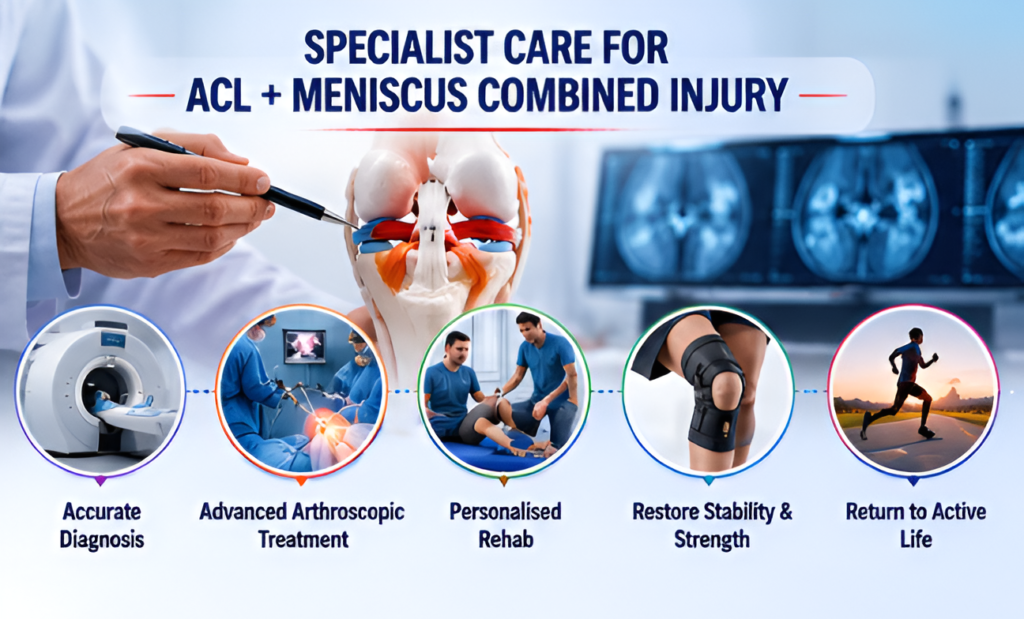
When surgery is indicated for a combined ACL and meniscus injury, Dr. Prince Uchadiya performs both procedures arthroscopically in a single operation. Arthroscopic surgery uses small incisions, a camera, and precision instruments to work inside the joint without opening it. This approach reduces tissue disruption, minimises infection risk, and speeds recovery compared to open surgery.
The ACL is reconstructed using a graft, most commonly from the patient’s own hamstring tendons (autograft), which is harvested, prepared, and tunneled through the bone in a position that replicates the original ACL. The graft is fixed under appropriate tension to restore the mechanical stability of the joint. Over the following months, a biological process called ligamentization transforms the graft tissue into a structure with properties increasingly similar to the original ACL.
The meniscus is addressed based on the tear type and its repairability. The principle that guides Dr. Prince Uchadiya’s approach is to preserve as much meniscal tissue as possible. The meniscus does not regenerate once tissue is removed. A partial meniscectomy, removing the torn fragment, provides faster pain relief but sacrifices tissue permanently. Meniscus repair, suturing the tear back together, takes longer to heal but preserves the full shock-absorbing and load-distributing function of the meniscus, which protects the knee against early-onset arthritis. Whenever the tear pattern, blood supply to the tear site, and patient factors allow it, repair is preferred over removal.
Patients in Indore can review detailed information about the ACL surgery procedure and the meniscus tear treatment approach on Dr. Prince Uchadiya’s website before their consultation.
When Surgery Is the Right Choice and When It Can Wait
Not every combined ACL and meniscus injury requires immediate surgery. The decision depends on the severity of each tear, the patient’s age and activity level, whether the knee is locking (which is a more urgent surgical indication), and the presence of any additional injuries.
Surgery is clearly indicated when the ACL is completely torn in a young or active patient who wishes to return to sport, when the meniscus tear is causing mechanical symptoms such as locking or has a pattern where repair is feasible, when the patient cannot function adequately with conservative management, or when there is evidence of progressive joint damage from repeated instability episodes.
In some cases, particularly in older patients with lower activity demands or when swelling needs to settle before surgery is technically optimal, a period of prehabilitation, focused on reducing swelling and regaining range of motion, is recommended before the procedure. This pre-surgical preparation has been shown to improve postoperative outcomes. Operating on a stiff, swollen knee is technically more difficult and produces worse results than operating on a knee that has recovered some mobility.
Isolated partial ACL tears with minimal instability and small stable meniscus tears in patients with low activity demands may be suitable for non-surgical management with structured physiotherapy and functional bracing. However, any combined injury with significant instability, locking, or involvement in an active patient should be evaluated by a specialist before a non-surgical path is chosen.
Recovery After ACL Reconstruction and Meniscus Repair: A Realistic Timeline
Recovery from a combined ACL and meniscus surgery is longer than recovery from either procedure performed in isolation. When both structures are reconstructed and repaired, the rehabilitation program must protect the healing meniscus repair while simultaneously progressing ACL graft strength. These two requirements can conflict, because the exercises that best strengthen the graft can overload the meniscus repair if introduced too early.
The recovery timeline for a combined procedure generally follows this progression, though it is adjusted based on each patient’s specific anatomy, repair type, and progress:
- Weeks 1 to 2: Focus on reducing swelling, controlling pain, and regaining passive range of motion. Protected weight-bearing with crutches. Quadriceps activation exercises begin.
- Weeks 3 to 6: Progressive weight-bearing, stationary cycling with low resistance, and continued range of motion work. Swelling management remains a priority. Deep squatting is avoided to protect the meniscus repair.
- Weeks 6 to 12: Strengthening of the quadriceps, hamstrings, gluteal muscles, and hip stabilizers. Proprioception and balance training begins. Swimming may be permitted. Return to driving is typically possible during this phase.
- Months 3 to 6: Progressive gym-based strengthening. Light jogging may begin around the 4-month mark if strength and graft healing milestones are met. Sport-specific movement patterns begin to be introduced.
- Months 8 to 11: Return to full sport training and competition, contingent on passing objective strength and functional testing criteria. Returning before meeting these criteria significantly increases re-injury risk.
Every patient completing surgery with Dr. Prince Uchadiya has a structured recovery plan through the post-injury rehabilitation program, which is designed to progress recovery safely and systematically.
What Happens If an ACL and Meniscus Combined Injury Is Left Untreated
The consequences of leaving a combined ACL and meniscus injury untreated are well-documented in orthopaedic research and represent one of the strongest arguments for timely specialist evaluation. A PubMed study found that at 10 to 20 years after diagnosis, on average 50 percent of patients with an ACL or meniscus tear develop osteoarthritis with associated pain and functional impairment. When both structures are injured together, this risk is significantly higher than for either injury in isolation.
An untreated ACL-deficient knee experiences repeated instability episodes with every pivoting movement, sport, or even everyday activity like descending stairs. Each episode of giving-way generates abnormal shear forces on the articular cartilage and subjects the damaged meniscus to further mechanical stress. Over months and years, this leads to progressive meniscus degeneration, cartilage wear, early-onset knee osteoarthritis, and ultimately a joint that may require knee replacement surgery years earlier than it otherwise would have.
The specific addition of an untreated meniscus tear accelerates this process further. Without meniscal function, load concentrates in a smaller area of the articular cartilage surface rather than being distributed evenly. This concentration of force wears down the cartilage at a rate that the joint was not designed to sustain. Patients with untreated combined injuries frequently present years later with bone-on-bone arthritis in their 40s or early 50s, facing a far more complex surgical situation than the original injury would have required.
The Role of Arthroscopy in Treating Combined Knee Injuries in Indore
Arthroscopic surgery has transformed the treatment of combined ACL and meniscus injuries. Before arthroscopy became standard practice, these surgeries required large open incisions with significantly greater tissue disruption, longer hospital stays, and extended recovery. Modern arthroscopic technique allows the entire procedure to be performed through two or three small incisions, each less than a centimetre in size, through which the camera and precision instruments are inserted.
This minimally invasive approach means less post-operative pain, lower infection risk, faster return of range of motion, and a recovery that can begin effectively within days rather than weeks. Dr. Prince Uchadiya performs ACL reconstruction and meniscus repair arthroscopically as a combined single-session procedure, avoiding the need for two separate surgical interventions and two separate recovery periods. Detailed information about the arthroscopic approach available in Indore is available on the arthroscopy surgery page.
Returning to Sport After ACL and Meniscus Surgery: What Athletes in Indore Need to Know
Return to sport after a combined ACL and meniscus injury is one of the most important and most frequently mismanaged aspects of recovery. Many athletes, eager to return to football, kabaddi, cricket, or running, attempt to resume activity as soon as they feel pain-free. Pain-free does not mean structurally ready. The ACL graft goes through a process of remodeling that takes months, and the meniscus repair requires protected loading during healing. Re-tearing the graft or re-injuring the repaired meniscus through premature return is a genuine and serious risk.
A systematic review cited in orthopaedic literature found that patients undergoing meniscal repair combined with ACL reconstruction achieved a 90 percent return-to-sport rate. This is an excellent outcome that reflects what is achievable with appropriate surgical technique and disciplined rehabilitation. The key word is “disciplined.” Return-to-sport clearance is based on objective criteria including symmetry in quadriceps and hamstring strength, single-leg hop tests, and functional movement assessments, not simply on how the knee feels subjectively.
Athletes in Indore who follow the complete recovery program and meet return-to-sport criteria before resuming competitive activity have the best outcomes both in the short term and the long term.
Frequently Asked Questions About ACL and Meniscus Combined Injury
1. What happens when both the ACL and meniscus are injured together?
When the ACL and meniscus are injured together, the knee loses two critical components of its stability and function simultaneously. The ACL provides the primary restraint against forward tibial movement and rotational instability. The meniscus provides shock absorption, load distribution, and secondary joint stability. With both structures damaged, the knee becomes mechanically unstable and loses its ability to cushion impact. Every movement that would normally be controlled by either structure now produces abnormal bone-on-bone contact and joint stress. This combination progresses to early cartilage damage and osteoarthritis significantly faster than either injury alone if left untreated or managed inadequately.
2. Why does an ACL and meniscus combined injury need specialist care?
Because the treatment of each structure directly affects the outcome of the other, these injuries cannot be managed as two independent problems. Repairing the meniscus without reconstructing the ACL places the repair under ongoing abnormal stress from joint instability, dramatically increasing re-tear rates. Reconstructing the ACL without addressing a repairable meniscus tear leaves the knee without its shock absorber, accelerating cartilage wear and arthritis development. A specialist who performs combined procedures regularly understands how to sequence the surgical steps, choose the correct graft and repair technique for each patient, and design a rehabilitation program that protects both healing structures simultaneously.
3. What are the common symptoms of an ACL and meniscus injury?
The combined injury typically presents with a pop or snap at the moment of injury, followed by immediate severe swelling of the entire knee within hours. Patients find it difficult or impossible to bear full weight. The knee feels unstable or gives way during any attempt at pivoting or direction change. There is often tenderness along the joint line corresponding to the torn meniscus. In cases where the meniscus tear is large and has created a loose fragment, the knee may lock and cannot be fully straightened. Burning or aching pain worsens with activity and improves with rest, though complete resolution is unlikely without treatment.
4. Can you walk normally with an ACL and meniscus tear?
In the acute phase, walking normally is usually impossible due to pain, swelling, and instability. In the days and weeks following the initial injury, swelling reduces and many patients find they can walk on flat ground with a relatively normal gait. This misleads some patients into believing the injury is minor. However, the structural damage remains. Activities that challenge rotational stability, such as changing direction, climbing stairs, or returning to sport, will reveal the instability. Attempting to function normally on an untreated combined injury repeatedly stresses the damaged meniscus and accelerates cartilage wear, compounding the damage with every passing week.
5. How do doctors diagnose an ACL and meniscus combined injury?
Diagnosis combines a detailed injury history, a structured clinical examination, and MRI imaging. During examination, the Lachman test and anterior drawer test assess ACL integrity by testing forward tibial movement. The pivot shift test assesses rotational instability. McMurray’s and Thessaly’s tests specifically provoke the meniscus to assess tear location and mechanical symptoms. MRI confirms both diagnoses, reveals the exact tear pattern of the meniscus (critical for determining whether repair is feasible), identifies additional injuries, and provides the information needed for precise surgical planning. X-rays exclude bony injuries and assess chronic joint space changes.
6. Is MRI necessary for ACL and meniscus injury diagnosis?
An experienced orthopaedic surgeon can strongly suspect a combined ACL and meniscus injury from clinical examination alone, but MRI is essential before making definitive surgical decisions. Clinical tests tell you that the ACL is torn and that the meniscus is involved, but they cannot tell you the exact location, extent, and pattern of the meniscus tear, whether the tear is repairable or requires partial removal, whether the articular cartilage has been damaged, or whether other structures such as the PCL or collateral ligaments are also involved. All of these factors change the surgical approach. MRI provides this complete picture and is a non-negotiable step in proper management.
7. Can an ACL and meniscus tear heal without surgery?
Complete ACL tears in active patients do not heal on their own. The ACL has very limited blood supply and, once completely ruptured, the torn ends retract and cannot re-attach without surgical reconstruction. Some partial ACL tears in low-activity patients may be managed non-surgically with structured physiotherapy and bracing, but the knee remains at elevated risk of re-injury and progressive instability. Meniscus tears vary: peripheral tears in the vascular outer zone have some capacity for healing with conservative management, but central tears and complex patterns require surgical repair or debridement. In a combined injury in an active patient, conservative management almost always results in progressive damage and early arthritis.
8. When is surgery needed for ACL and meniscus combined injury?
Surgery is needed when the ACL is completely torn in a patient who wants to return to sport or has an active lifestyle, when the meniscus tear is causing mechanical symptoms such as locking or catching, when the tear pattern makes repair feasible and tissue preservation is possible, or when conservative management has failed to restore adequate function. In young and active patients, early surgical reconstruction with simultaneous meniscus repair provides the best long-term outcomes for both knee function and protection against arthritis. The decision is always individualized based on age, activity goals, tear severity, and the specific patterns found on MRI.
9. How long does ACL reconstruction and meniscus repair recovery take?
Recovery from a combined ACL reconstruction and meniscus repair takes 8 to 11 months on average before return to full competitive sport. This is longer than isolated ACL reconstruction, which typically takes 6 to 9 months, because the meniscus repair requires a period of protected loading while healing. The extended timeline is not wasted time. It reflects the biological reality of how these structures heal and the consequences of rushing the process. Patients who return to sport before passing objective strength and function testing criteria have significantly higher rates of re-injury. Completing the full recovery program is as important as the surgery itself.
10. Why does knee stiffness happen after ACL and meniscus surgery?
Knee stiffness after combined surgery results from a combination of factors: post-operative swelling within the joint, inflammation during the healing response, protective muscle guarding around the knee, and in some cases, scar tissue formation. If range of motion exercises are not started early and progressed consistently, scar tissue can accumulate around the joint and in the graft tunnel, creating stiffness that becomes progressively harder to reverse. This is why early physiotherapy beginning within days of surgery is a standard part of the recovery protocol, even though the patient is still sore. Regaining full extension is the priority in the first two weeks, as a knee that heals in slight flexion is far more difficult to correct later.
11. When can you bend your knee normally after ACL and meniscus treatment?
The timeline for regaining normal knee bending varies by the type of meniscus repair performed and how it heals. Full extension is typically recovered within the first two to four weeks. Regaining full flexion takes longer, particularly when a meniscus repair was performed, because deep flexion puts significant stress on the repaired tissue. Most patients reach 90 degrees of flexion by 4 to 6 weeks and approach full flexion by 10 to 12 weeks. Deep squatting and kneeling are restricted for longer, typically until 3 to 4 months post-surgery, to protect the healing repair. Every patient’s progress is monitored at follow-up appointments and physiotherapy milestones drive the progression of these movements.
12. Can sports players return to football or running after ACL and meniscus surgery?
Yes. With appropriate surgical treatment, complete rehabilitation, and adherence to return-to-sport criteria, the majority of patients can return to competitive football, kabaddi, running, and other sports after combined ACL and meniscus surgery. Research shows a 90 percent return-to-sport rate for patients undergoing combined ACL reconstruction and meniscus repair. However, return is not simply about time passing. It requires meeting objective strength symmetry and functional hop test criteria, completing sport-specific movement retraining, and receiving clearance from both the surgeon and physiotherapist. Athletes who rush this process face a significantly elevated risk of re-injury to the same knee.
13. What happens if an ACL and meniscus injury is left untreated?
Leaving a combined ACL and meniscus injury untreated causes a predictable progression of joint deterioration. The unstable ACL-deficient knee experiences repeated giving-way episodes, each of which inflicts additional damage on the meniscus, articular cartilage, and joint capsule. Without meniscal shock absorption, load concentrates on increasingly small areas of the articular cartilage surface, wearing it down at an accelerated rate. Published research indicates that 50 percent of patients with combined ACL and meniscus injuries develop osteoarthritis within 10 to 20 years, frequently presenting with severe arthritis in their 40s and requiring knee replacement surgery decades earlier than their peers. Early treatment significantly reduces though does not eliminate this risk.
14. Are there any risks or complications of ACL reconstruction and meniscus repair surgery?
As with any surgical procedure, ACL reconstruction and meniscus repair carry defined risks. These include infection (rare with arthroscopic technique), deep vein thrombosis, post-operative stiffness if early physiotherapy is not diligently pursued, graft failure requiring revision surgery (the rate of which is higher in patients who return to sport prematurely), and the possibility that a meniscus repair does not heal fully, requiring further intervention. Anaesthetic risks are present as with any surgery. The decision to operate accounts for these risks against the well-established consequences of leaving the injury untreated. In the hands of a specialist performing these procedures regularly, complication rates are low and outcomes are consistently good.
15. Does health insurance or PMJAY cover ACL and meniscus surgery treatment?
ACL reconstruction and meniscus repair surgery can be covered under various health insurance policies in India, though the extent of coverage depends on the specific policy terms, the insurer, and whether the procedure is classified as an accident-related or elective surgery. Under the Pradhan Mantri Jan Arogya Yojana (PMJAY / Ayushman Bharat) scheme, certain orthopaedic procedures are covered for eligible beneficiaries. Dr. Prince Uchadiya’s clinic in Indore assists patients in navigating insurance pre-authorization processes and Ayushman Bharat eligibility. It is recommended that patients bring their insurance documents or Ayushman card at the time of consultation so that coverage and paperwork can be explored before treatment begins. Detailed information about government orthopaedic schemes in Madhya Pradesh is available at MP government orthopaedic schemes.
An ACL and meniscus combined injury is one of the most consequential knee injuries a patient can sustain, and the decisions made in the first weeks after the injury will shape the health of that knee for decades. If you have sustained a knee injury with swelling, instability, or locking, or if you have been told you have an ACL or meniscus tear and are uncertain about next steps, consult Dr. Prince Uchadiya in Indore for a comprehensive evaluation. The right specialist care at the right time is what turns a complex injury into a complete recovery.