Most patients who arrive at the clinic in Nipania with back pain or neck pain have already been through some version of the same experience. They got an MRI. The report came back with words like “disc desiccation,” “disc space narrowing,” or “loss of disc signal intensity.” The doctor had five minutes. Nobody explained what any of it meant in plain terms. And now they are searching for degenerative disc disease treatment in Indore because the pain has been there long enough that it is affecting their work, their sleep, and their day.
This page is written to change that experience. Dr. Prince Uchadiya, DNB Orthopaedics Gold Medalist, trained at KEM Hospital Mumbai and practicing at Dr. Prince Uchadiya Orthopaedic And Joint Care Clinic in Indore, sees this pattern consistently. The goal here is to explain what degenerative disc disease actually is, why it happens, how it is accurately diagnosed, and what a structured treatment plan in Indore looks like, from first consultation through to recovery.
What Degenerative Disc Disease Actually Is
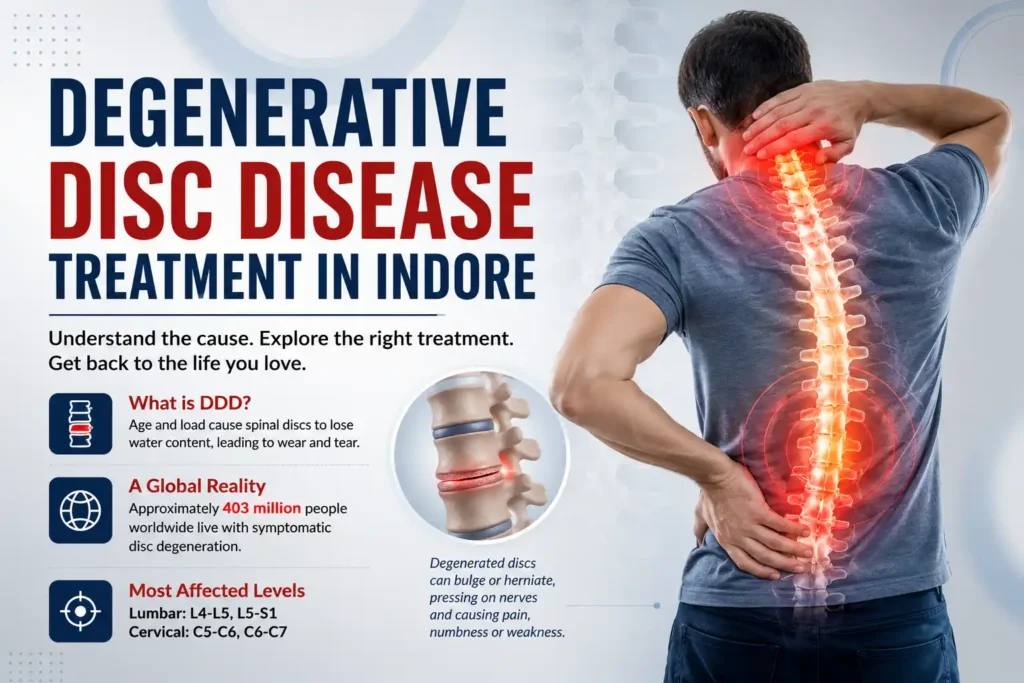
Intervertebral discs are the cushions that sit between each pair of vertebrae in your spine. They absorb load, distribute pressure evenly, and allow the spine to flex, extend, and rotate. When you are young, these discs are roughly 80% water. They are plump, resilient, and do their job quietly. With age and load accumulation, they lose that water content. They become flatter, stiffer, and less effective as shock absorbers. This process is called degenerative disc disease, or DDD.
The name sounds more catastrophic than it is. “Disease” is a clinical term used here to describe a well-defined pathological process, not an infection or a progressive illness in the traditional sense. Global burden data shows that approximately 403 million people worldwide live with symptomatic disc degeneration. The vast majority manage it successfully without surgery.
The discs most commonly affected in the lumbar spine are L4-L5 and L5-S1, because these two levels carry the most load and undergo the most movement in daily activity. In the cervical spine, C5-C6 and C6-C7 are most vulnerable for the same reason. When a disc degenerates significantly, several things happen. The disc space narrows, the vertebrae above and below move closer together, bone spurs can form along the edges of vertebrae, and the facet joints at the back of the spine begin to carry load they were not designed for. In some cases, the degenerated disc bulges or herniates, pressing on adjacent nerve roots and producing radicular symptoms into the arm or leg.
Why So Many Patients in Indore Are Presenting Younger Than Expected
Degenerative disc disease used to be almost exclusively a condition of middle-age and beyond. That has changed. In a busy orthopaedic practice in Indore, it is now common to see patients in their late 20s and 30s presenting with significant lumbar disc degeneration on MRI.
The drivers are familiar: sedentary desk work without ergonomic support, sustained forward-bent postures from screen and phone use, physically demanding jobs in Indore’s industrial and construction sectors that involve repetitive lifting and bending, and a widespread lack of core conditioning. Genetics plays a role, disc degeneration has a strong hereditary component, but lifestyle and loading patterns determine how fast that genetic predisposition becomes a clinical problem.
Smoking is a factor that patients rarely connect to their spine. Nicotine reduces blood supply to the discs, accelerating desiccation and degeneration. Obesity adds compressive load to lumbar discs with every step. Vitamin D deficiency, which is extremely common across Madhya Pradesh, impairs the musculature that protects and stabilizes the spine. These are all modifiable factors that sit within any complete degenerative disc disease treatment plan in Indore.
Recognizing the Symptoms: What DDD Feels Like in Daily Life
Degenerative disc disease does not present the same way in every patient. The symptom pattern depends on which disc is affected, how far the degeneration has progressed, and whether nerve roots are involved.
The most common presentation is axial pain, a deep, often dull ache localized to the lower back or neck, without significant radiation into the limbs. This pain is typically worse with prolonged sitting, standing, or forward bending, and often improves briefly with movement before returning. It tends to be worst in the morning and after periods of sustained posture.
When degeneration has caused a disc to bulge or herniate with nerve root contact, the picture changes. Lumbar nerve root compression from L4-L5 or L5-S1 disc pathology produces pain, tingling, or numbness that travels from the lower back through the buttock and into the leg, commonly called sciatica. Patients from across Indore, Vijay Nagar, Scheme 78, and the surrounding areas frequently present with this pattern after months of lower back pain that progressively spread downward.
Muscle weakness in the leg, difficulty holding a standing position, and a sensation of the leg “giving way” are signs of more significant nerve compromise that need prompt clinical assessment. These are not symptoms to wait out.
How Degenerative Disc Disease Is Diagnosed in Indore
Diagnosis begins with a thorough clinical history and physical examination. No imaging replaces a proper examination. Dr. Prince Uchadiya assesses posture, range of motion, neurological signs including reflexes and dermatomal sensation, and specific provocation tests that identify whether nerve root irritation is present and at which level.
Imaging follows based on clinical findings:
- X-ray: Shows disc space narrowing, bone spur formation, and alignment. Useful as a first step but does not visualize the disc itself or nerve structures.
- MRI: The gold standard for degenerative disc disease. Shows disc hydration loss (dark discs on T2 sequences), disc height, presence of herniation or bulge, nerve root contact, and canal dimensions. Patients in Indore have access to good quality MRI facilities, and bringing existing imaging to the first consultation significantly improves the efficiency of diagnosis.
- CT scan: Used when bone detail is needed, particularly when surgery is being planned or when MRI cannot be performed.
One important clinical fact: MRI findings do not always correlate with symptom severity. Research consistently shows that degenerative disc changes are present on MRI in a significant proportion of asymptomatic people of all ages. The clinical picture, what the patient feels, where it radiates, what makes it worse, what neurological signs are present, must lead the interpretation of imaging, not the other way around.
Degenerative Disc Disease Treatment in Indore: The Non-Surgical Path
The clear majority of patients with degenerative disc disease, including those with significant disc changes on MRI, are successfully managed without surgery. This is the first point Dr. Prince Uchadiya establishes with every patient at the initial consultation: an MRI report that looks alarming does not automatically mean an operation. The question is always whether the clinical picture warrants surgical intervention, and in most cases it does not.
Structured Physiotherapy and Rehabilitation
This is the foundation of degenerative disc disease treatment in Indore, and it is not the same as generic back exercises from a leaflet. A proper rehabilitation programme for disc degeneration addresses core stabilization, which is the activation of the deep abdominal and lumbar muscles that reduce load on the disc spaces. It includes postural correction, movement retraining, and a progressive return to full activity. Patients who train with a physiotherapist experienced in spine rehabilitation see meaningfully better outcomes than those who simply rest and take pain relief.
For patients whose disc degeneration is compounded by poor workplace ergonomics, which is a significant issue for Indore’s large software and BPO workforce sitting at desks for 8 to 10 hours daily, workstation modification advice is part of the rehabilitation process, not an optional extra. For those interested in the post-rehabilitation maintenance phase, the post-injury rehabilitation programme at the clinic provides structured ongoing guidance.
Pain Management and Anti-Inflammatory Treatment
In the acute phase, NSAIDs reduce disc and nerve root inflammation and allow the patient to engage with rehabilitation. Muscle relaxants are useful when significant paraspinal spasm is limiting movement. These are short-term tools, not long-term solutions. Dependence on pain medication without addressing the mechanical cause is one of the most common reasons patients continue to present to the clinic with recurring episodes.
For patients with significant radicular symptoms from nerve root compression, a selective nerve root block or epidural steroid injection targeted to the affected level provides faster relief and allows earlier engagement with physiotherapy. These are performed under imaging guidance for accuracy.
Lifestyle Modification: The Part Patients Often Underestimate
Weight reduction in overweight patients significantly reduces the compressive load on lumbar discs. Smoking cessation improves disc nutrition and slows degeneration. Vitamin D supplementation in deficient patients, which is the majority in central India due to limited sun exposure and dietary factors, supports the musculoskeletal system overall. These modifications do not reverse existing degeneration, but they meaningfully slow its progression and improve the response to other treatments.
When Surgery Becomes the Right Option for Degenerative Disc Disease in Indore
Surgery is considered when conservative management has been genuinely and adequately tried and failed, or when neurological compromise requires urgent intervention. The indications are specific:
- Progressive motor weakness in the limb despite conservative treatment
- Cauda equina syndrome, loss of bladder or bowel control from central canal compression, which is a surgical emergency
- Severe radicular pain that has not responded to 6 to 12 weeks of structured conservative management including physiotherapy and targeted injections
- Significant functional disability that has not improved despite all appropriate non-surgical measures
The surgical options Dr. Prince Uchadiya discusses with patients depending on their specific anatomy and clinical picture:
Microdiscectomy: For lumbar disc herniation causing significant nerve root compression. A small portion of the herniated disc is removed through a minimally invasive approach to relieve nerve pressure. Recovery is faster than open discectomy and outcomes for appropriately selected patients are excellent.
Minimally Invasive Spine Surgery: For patients who require decompression of the spinal canal or nerve roots, a minimally invasive approach reduces muscle damage, blood loss, and recovery time compared to traditional open surgery. The clinic’s focus on minimally invasive techniques, as outlined on the minimally invasive surgery page, directly applies to spine decompression procedures.
Spinal Fusion: Reserved for cases where instability is the primary driver of pain, where multiple levels are affected with demonstrated mechanical instability, or where decompression alone would leave the spine structurally compromised. Fusion stops movement at the affected segment and transfers load to adjacent levels. The decision to fuse is made carefully because adjacent segment disease is a real consideration in younger patients.
What Patients From Indore Should Expect at Their First Consultation
The first consultation at Dr. Prince Uchadiya Orthopaedic And Joint Care Clinic, Nipania, Indore, is a clinical examination and conversation, not a prescription pad and a referral. Patients are asked to bring any imaging they have, including MRI films and reports. The history of how the pain started, what makes it better or worse, whether there are any leg or arm symptoms, and what has already been tried forms the basis for the examination that follows.
After examination and review of imaging, the clinical picture is explained clearly: which disc or discs are involved, whether nerve roots are implicated, what the realistic treatment trajectory looks like, and specifically what the patient needs to do as their part of the management plan. Patients from Vijay Nagar, Scheme 54, Palasia, Mahalaxmi Nagar, and surrounding areas regularly attend the Nipania clinic for this structured approach to spine evaluation.
For patients who have already seen another specialist and remain uncertain about the management plan offered, a structured second opinion is available and welcomed. Disc disease, particularly when surgery has been suggested, deserves a thorough second look before any decision is finalized.
Frequently Asked Questions: Degenerative Disc Disease Treatment in Indore
1. Can degenerative disc disease be cured completely?
Structural reversal is not possible. Discs that have lost hydration and height do not regenerate to their original state. However, the overwhelming majority of patients achieve complete or near-complete symptom resolution through structured conservative management. Living well with degenerative disc changes on an MRI is entirely achievable and is the outcome most patients reach.
2. Is degenerative disc disease the same as a slipped disc or herniated disc?
They are related but different. Degenerative disc disease refers to the underlying process of disc breakdown. A herniated or slipped disc is one specific complication where the inner disc material pushes through the outer fibrous ring and contacts a nerve root. Herniation can happen in a degenerated disc but not all degenerated discs herniate.
3. How long does it take to feel better with non-surgical treatment?
Most patients with axial back pain from disc degeneration see meaningful improvement within 6 to 12 weeks of structured physiotherapy combined with appropriate pain management. Radicular symptoms from nerve root compression may take longer, sometimes 3 to 6 months. Progressive improvement, not complete sudden recovery, is the expected trajectory.
4. Is bed rest the right approach for a disc problem?
Brief relative rest during an acute flare is reasonable for a few days. Prolonged bed rest is not. Prolonged inactivity weakens the paraspinal and core muscles that support the spine, worsens deconditioning, and increases the risk of chronicity. Guided, graded activity resumption is consistently better than prolonged rest for disc-related back pain.
5. Does degenerative disc disease in the lower back always lead to sciatica?
No. Many patients have significant disc degeneration at L4-L5 or L5-S1 with purely local back pain and no leg symptoms at all. Sciatica occurs when the degenerating disc herniates or the resulting bone spur contacts the exiting nerve root. The two conditions often coexist but are not the same thing and do not always progress from one to the other.
6. Can young people in their 20s or 30s develop degenerative disc disease in Indore?
Yes, and increasingly so. Genetics, sedentary desk work in Indore’s growing IT and services sector, poor ergonomics, physically demanding manual labour, and widespread Vitamin D deficiency in central India all contribute to earlier-than-expected disc degeneration in younger patients. This does not mean surgery is needed in young patients. It means the lifestyle factors need addressing earlier than they used to.
7. What is the role of injections in degenerative disc disease treatment?
Targeted injections, including epidural steroid injections and selective nerve root blocks, are effective at reducing acute inflammation around the nerve root and providing a window of relief during which physiotherapy can be undertaken more comfortably. They are not a permanent solution and are most useful as part of a broader management plan rather than as standalone treatment.
8. How do I find the right orthopaedic specialist for disc disease treatment in Indore?
Look for a specialist who takes time to explain your imaging, confirms the diagnosis through clinical examination rather than relying solely on MRI findings, and proposes a structured non-surgical management plan before discussing surgery. A specialist who immediately suggests surgery for a first presentation of disc disease without a conservative trial warrants a second opinion. Dr. Prince Uchadiya’s approach at the Nipania clinic follows this sequence for every patient presenting with degenerative disc disease treatment needs in Indore.
9. Can the disc pain come back after treatment?
Disc degeneration is a structural reality that does not disappear after symptoms resolve. Recurrence is possible, particularly if the mechanical loading patterns and lifestyle factors that drove the original problem are not permanently modified. Patients who maintain their core strengthening exercises, correct their workstation ergonomics, and stay within a healthy weight range have significantly lower recurrence rates than those who return to the same patterns after symptom resolution.
10. Is surgery for degenerative disc disease covered under Ayushman Bharat in Indore?
Certain surgical procedures for disc disease are covered under the PM-JAY Ayushman Bharat scheme for eligible patients. The specific procedures and coverage depend on the package classification. Patients with Ayushman cards who require surgical evaluation for disc disease are encouraged to discuss coverage at the time of consultation. The clinic’s experience with Ayushman Bharat surgical procedures includes guiding patients through the eligibility and pre-authorization process.