Key Takeaways: What You Need to Know Before Reading Further
- Snapping hip syndrome affects 5 to 10% of the general population and up to 90% of competitive ballet dancers. NCBI StatPearls
- The snap comes from a tendon or band flicking over a bony prominence, not from the joint itself cracking or breaking.
- Three distinct types exist: external (IT band over greater trochanter), internal (iliopsoas tendon over iliopectineal eminence), and intra-articular (labral tear or loose body inside the joint).
- The majority of cases are painless and require no treatment beyond awareness and activity modification.
- When pain is present, conservative management resolves most cases including physiotherapy, stretching, anti-inflammatory treatment, and activity modification.
- Corticosteroid injection into the affected bursa is effective for cases where bursitis has developed alongside the snapping.
- Surgery is reserved for cases that fail 3 to 6 months of structured conservative management and involves minimally invasive tendon lengthening or release, typically arthroscopic.
- Intra-articular causes must be ruled out with MRI and dynamic ultrasound before treatment begins, as labral tears require a different management pathway.
- Dr. Prince Uchadiya, DNB Orthopaedics Gold Medalist trained at KEM Hospital Mumbai, provides clinical assessment and full management of snapping hip syndrome at his orthopaedic clinic in Nipania, Indore.
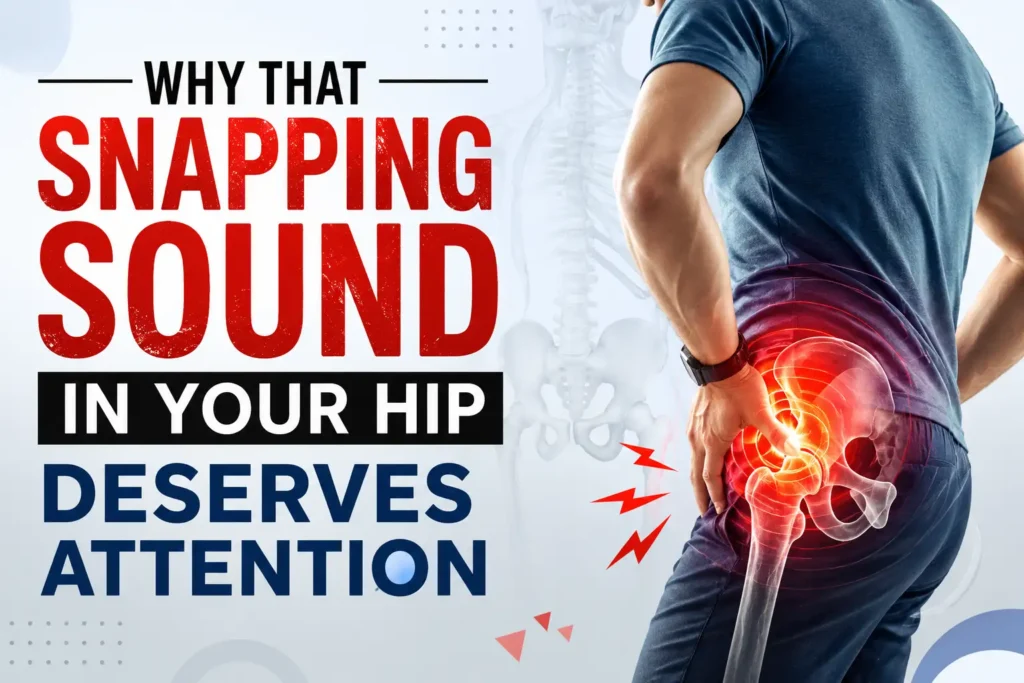
Why That Snapping Sound in Your Hip Deserves Attention
A click or pop from the hip during movement is something many people notice and immediately dismiss. For most, it is painless and intermittent, so it gets filed away as one of those things the body does. But for a significant group of patients, particularly those who are physically active, the snap becomes consistent, gets louder, and eventually starts to hurt. By the time patients visit Dr. Prince Uchadiya Orthopaedic And Joint Care Clinic in Nipania, Indore, the snapping hip syndrome has often been present for months without a clear explanation of what is causing it or what to do about it.
Understanding snapping hip syndrome properly starts with one clarification: this is almost never the joint itself making noise. The snap is a tendon or a thick band of connective tissue flicking over a bony landmark as the hip moves. That mechanical event is the source of every click, pop, and snap associated with this condition. Which tendon or band is involved determines the type of snapping hip, the symptoms it produces, and the treatment approach that works.
The Three Types of Snapping Hip Syndrome Explained
Type 1: External Snapping Hip (Most Common)
The iliotibial band is a thick fibrous band running along the outer thigh from the pelvis to just below the knee. During hip flexion and extension, the posterior border of this band slides over the greater trochanter, the bony prominence on the outer side of the upper femur. When the band is tight, it snaps back and forth over the trochanter with each hip movement, producing an audible click or thud felt and heard on the outer hip. This is the type most commonly seen in runners, cyclists, and athletes who perform repetitive hip flexion and extension movements.
When this snapping is repeated over time under significant load, the trochanteric bursa beneath the IT band becomes inflamed, producing trochanteric bursitis. The condition then progresses from a painless snap to a painful outer hip that worsens with walking, stairs, and lying on that side. Patients in Indore who run regularly along the river road stretch in Vijay Nagar or cycle through Scheme 78 present with this pattern frequently after increasing their training volume without adequate hip flexibility work.
Type 2: Internal Snapping Hip
The iliopsoas is the primary hip flexor muscle, with its tendon passing over the iliopectineal eminence, a bony ridge on the front of the pelvis, before attaching to the lesser trochanter of the femur. When the hip moves from a flexed, abducted, externally rotated position back to neutral, this tendon can snap across the eminence, producing a snap felt deep in the front of the groin. Patients often describe it as something “catching” inside the hip rather than snapping on the surface.
This type is particularly common in dancers and those who practise yoga, gymnastics, or martial arts, movements that involve extremes of hip rotation and flexion. It is also seen after hip replacement surgery when the prosthetic hardware alters the mechanics of the iliopsoas path. The groin snap is frequently accompanied by a sharp catching pain if bursitis develops around the iliopsoas tendon.
Type 3: Intra-Articular Snapping Hip
When the snap originates from inside the joint itself, the cause is either a labral tear or a loose body within the hip joint, such as a fragment of cartilage or bone from synovial chondromatosis. This type is qualitatively different from the other two. The snap is often associated with a feeling of the hip giving way or locking, and may be accompanied by deep groin pain that is reproduced by specific movements. This is the type that most frequently indicates significant intra-articular pathology and requires MRI and sometimes hip arthroscopy for definitive management. Hip joint conditions of this nature need careful assessment to distinguish them from the extra-articular types before any treatment decision is made.
Recognizing the Symptoms: What Snapping Hip Syndrome Feels Like
The defining feature is a snap, click, or thud that can be heard or felt during specific hip movements. In external snapping hip, this occurs on the outer hip during walking, climbing stairs, or transitioning from sitting to standing. In internal snapping hip, it is felt deep in the groin during hip rotation or when rising from a low chair. The snap may occur with every step or only with certain movements at specific ranges of motion.
In the painless majority, the snap is simply an inconvenience. When pain develops, its location reflects the type. Outer hip and lateral thigh pain points to the external type. Deep anterior groin pain that catches with certain movements indicates the internal type. A deep, diffuse hip pain with episodes of the hip feeling as though it is about to give way suggests intra-articular pathology.
Weakness in hip abduction, a tendency for the knee to cave inward during single-leg activities, and tightness in the outer hip or groin are associated physical findings that guide the examination. These are assessed clinically at the initial consultation rather than inferred from imaging alone.
How Snapping Hip Syndrome Is Diagnosed in Indore
Diagnosis begins with a structured clinical examination. Dr. Prince Uchadiya reproduces the snap with specific provocation tests during examination, palpates the relevant tendons and bursae to identify tenderness, and assesses hip range of motion, strength, and flexibility. In many cases, the type and source of the snapping can be confirmed on examination alone.
When imaging is needed, the sequence is as follows. X-ray identifies bony abnormalities, loose bodies, and the overall hip joint architecture. Dynamic ultrasound is the most useful investigation for extra-articular snapping hip because it can visualize the tendon actually snapping over the bony landmark in real time during a provocative movement, something static MRI cannot show. MRI is essential when intra-articular pathology is suspected, particularly labral tears, cartilage damage, or loose bodies. It is also used to assess the degree of bursitis present and to plan surgical intervention when conservative management has been exhausted.
Non-Surgical Snapping Hip Syndrome Treatment in Indore
Conservative management successfully resolves the majority of painful snapping hip cases. The pathway follows a clear numbered sequence:
- Activity modification: Identifying and temporarily reducing the specific activities that provoke the snapping and pain is the immediate first step. For a runner, this means reducing weekly mileage and avoiding hills. For a gym-goer in Indore, this means avoiding deep squats, leg raises, and resistance band exercises that load the hip flexor at extremes of range until the acute inflammation settles. This is not permanent rest; it is a deliberate reduction while treatment takes effect.
- Pain and inflammation management: NSAIDs such as ibuprofen or diclofenac are used for 2 to 3 weeks to reduce the peritendinous and bursal inflammation that is driving the pain. Ice applied to the outer hip or anterior groin for 15 to 20 minutes after activity further reduces inflammation in the acute phase. These are short-term tools that create a window for rehabilitation to begin.
- Targeted stretching programme: For external snapping hip, structured IT band and hip abductor stretching directly addresses the tightness causing the band to snap. Standing crossover stretches, lateral lunges, and pigeon pose variations all target this region. For internal snapping hip, targeted iliopsoas stretching including hip flexor lunges and anterior hip capsule mobilization reduces the tension in the tendon responsible for the snap. These stretches must be done consistently, typically twice daily, for 4 to 6 weeks to produce lasting change in tissue length.
- Physiotherapy and strengthening rehabilitation: Stretching alone is insufficient in most cases. Strengthening the hip abductors, gluteus medius, and deep hip external rotators reduces the abnormal mechanics that cause the tendon or band to snap in the first place. A physiotherapist experienced in hip conditions will design a progressive programme that moves from isolated muscle activation in the early phase to functional movement patterns that replicate the patient’s sport or activity. Patients connected to the post-injury rehabilitation programme at the clinic benefit from supervised progression through this phase.
- Corticosteroid injection: When bursitis has developed alongside the snapping, a precisely placed corticosteroid injection into the trochanteric bursa for external type or the iliopsoas bursa for internal type provides rapid anti-inflammatory relief that is difficult to achieve with oral medication alone. This injection is most effective when combined with the rehabilitation programme rather than used as a standalone treatment. Ultrasound-guided injection improves accuracy significantly over landmark-based technique.
- Gait and biomechanics retraining: In runners and athletes presenting at the clinic in Indore, a movement assessment of their running gait, landing mechanics, or sport-specific technique often reveals the biomechanical contributor to the snapping. Excessive hip adduction during the stance phase, anterior pelvic tilt during loading, and collapsed arch mechanics in the foot all create conditions that overload the IT band or iliopsoas. Correcting these through movement retraining is what prevents recurrence after symptoms resolve.
When Surgery Is Needed for Snapping Hip Syndrome in Indore
Surgery is considered when structured conservative management over 3 to 6 months has not resolved painful snapping, or when intra-articular pathology such as a labral tear requires direct repair. The surgical approach depends on the type.
For external snapping hip, the procedure involves lengthening or releasing the posterior portion of the IT band at the level of the greater trochanter. This can be performed arthroscopically, with small camera portals rather than an open incision, reducing recovery time and postoperative pain significantly compared to older open techniques.
For internal snapping hip from the iliopsoas tendon, arthroscopic iliopsoas tendon release at the level of the hip joint allows the tendon to be lengthened without disrupting the full muscle belly. This is a technically demanding procedure that requires specific arthroscopic hip surgery expertise. The minimally invasive approach used at Dr. Prince Uchadiya’s clinic, detailed further on the minimally invasive surgery page, applies directly to these hip arthroscopic procedures.
For intra-articular causes involving labral tears, hip arthroscopy allows direct visualization, debridement, and repair of the labrum. Associated loose bodies are removed during the same procedure. Recovery after arthroscopic hip surgery for snapping hip syndrome is typically 4 to 8 weeks to return to normal daily activity, with sport-specific return at 3 to 6 months depending on the extent of intra-articular work performed.
Snapping Hip Syndrome in Indore: Who Presents at the Clinic
The patient profile seen at Dr. Prince Uchadiya Orthopaedic And Joint Care Clinic reflects Indore’s active and diverse population. Runners from Vijay Nagar and Scheme No. 54 who have increased their mileage for the Indore Marathon present with classic external snapping hip from IT band tightness. Young women training in classical dance or Bharatanatyam present with bilateral internal snapping hip from iliopsoas overload during extreme hip rotation positions. Football and kabaddi players from the youth sports academies across the city present with groin-side snapping that has become painful during pre-season training intensification. Gym-goers who have dramatically increased their hip flexor loading through leg raises, cable work, and deep squat training present with anterior groin snapping that progressively worsened as training volume rose.
For patients who have already seen another specialist or been told only to “rest and avoid exercise,” a structured orthopaedic second opinion clarifies the type, confirms whether imaging is needed, and builds a specific treatment plan rather than a generic instruction to stop all activity.
Frequently Asked Questions: Snapping Hip Syndrome Treatment in Indore
1. Is the snapping sound in my hip dangerous?
In the majority of cases, no. Most people with snapping hip syndrome have a painless mechanical snap that represents nothing more than a tendon flicking over bone. There is no structural damage, no joint disease, and no increased risk of arthritis from the snap itself. The concern arises when pain accompanies the snap, when the hip feels like it is giving way, or when the snap suddenly changes character. These warrant clinical assessment to exclude labral tears or intra-articular pathology.
2. Can snapping hip syndrome go away on its own?
Painless snapping often remains unchanged for years without causing problems. Painful snapping that has been present for less than 6 to 8 weeks frequently resolves with activity modification and targeted stretching alone. When pain has been present for longer and bursitis has developed, a structured rehabilitation programme combined with anti-inflammatory treatment is needed. Without addressing the underlying mechanical cause, symptoms typically recur even if they temporarily improve.
3. How do I know if it is a tendon snap or something inside the joint?
Location and character give the first clues. An outer hip snap that occurs during walking and is visible as a visible jump of tissue beneath the skin is almost certainly the IT band. A deep groin snap that catches during hip rotation and feels like something inside is snagging suggests either the iliopsoas or an intra-articular cause. A sense of the hip giving way or locking momentarily, especially with deep groin pain, raises concern for a labral tear. Dynamic ultrasound and MRI, ordered selectively based on clinical findings, provide the definitive answer.
4. Can snapping hip be treated without stopping sport or activity?
In many cases, yes. The goal of activity modification is to reduce the specific movements that are provoking the inflammatory response while maintaining overall fitness. For a runner, this typically means reduced mileage and avoiding hills temporarily, with cycling or swimming maintained as lower-impact alternatives. For a dancer, certain extreme hip rotation positions are avoided during the acute phase. Complete rest is rarely the correct instruction and often delays recovery by preventing the rehabilitation exercises that address the underlying mechanical cause.
5. How long does snapping hip syndrome treatment take?
Most patients with painful external or internal snapping hip see significant improvement within 6 to 12 weeks of consistent conservative management. Complete resolution, including return to full sport without symptoms, takes 3 to 4 months in most cases. Cases complicated by significant bursitis or intra-articular pathology take longer. Surgical cases have their own recovery timelines as described above. The single most important predictor of recovery speed is consistency with the rehabilitation programme between clinic visits.
6. Does a corticosteroid injection cure snapping hip syndrome?
No. Injection controls the bursitis and inflammation, which reduces pain and allows rehabilitation to proceed more comfortably. But the underlying mechanical cause, the tight IT band or the stiff iliopsoas, remains until stretching and strengthening address it. Injection without subsequent rehabilitation typically produces temporary relief followed by recurrence within a few months. It is a tool within a treatment plan, not a standalone solution.
7. What is the recovery like after hip arthroscopy for snapping hip syndrome?
Hip arthroscopy for snapping hip is a day procedure in most cases. Patients go home the same day and are weight-bearing with crutches within 24 to 48 hours. The crutches are typically needed for 1 to 2 weeks. Return to desk work and normal daily activity is usually achieved by 4 to 6 weeks. Return to sport, depending on the extent of intra-articular work and the demands of the sport, takes 3 to 6 months with supervised rehabilitation.
8. Is snapping hip syndrome covered under Ayushman Bharat in Indore?
Specific hip arthroscopy and tendon procedures may fall within PM-JAY coverage for eligible patients depending on the package classification applicable to the procedure. Patients with Ayushman cards are encouraged to discuss eligibility and procedure coverage during their consultation. The Ayushman Bharat surgical process is one the clinic is experienced in navigating with patients, from eligibility confirmation through to pre-authorization.