A 26-year-old software engineer from Vijay Nagar, Indore,
walked into the clinic with knee pain that had been building for three months.
He had not had any injury. He sat at his desk for nine hours a day, took the stairs occasionally, and had recently joined a gym where he was doing squats and leg press for the first time. The pain was at the front of his knee, worst when going down stairs and when getting up after long sitting. His family had dismissed it as growing pains.
His gym trainer told him to push through it. Neither suggestion was helpful, and by the time he came in, the pain was affecting his sleep. He was diagnosed with patellofemoral pain syndrome, the single most common cause of knee pain in young adults globally, and one of the most frequently mismanaged. His story is repeated dozens of times a week in orthopaedic clinics across Indore, and understanding why knee pain in young adults in Indore is rising, what causes it, and when it needs medical attention rather than reassurance is exactly what this article addresses.
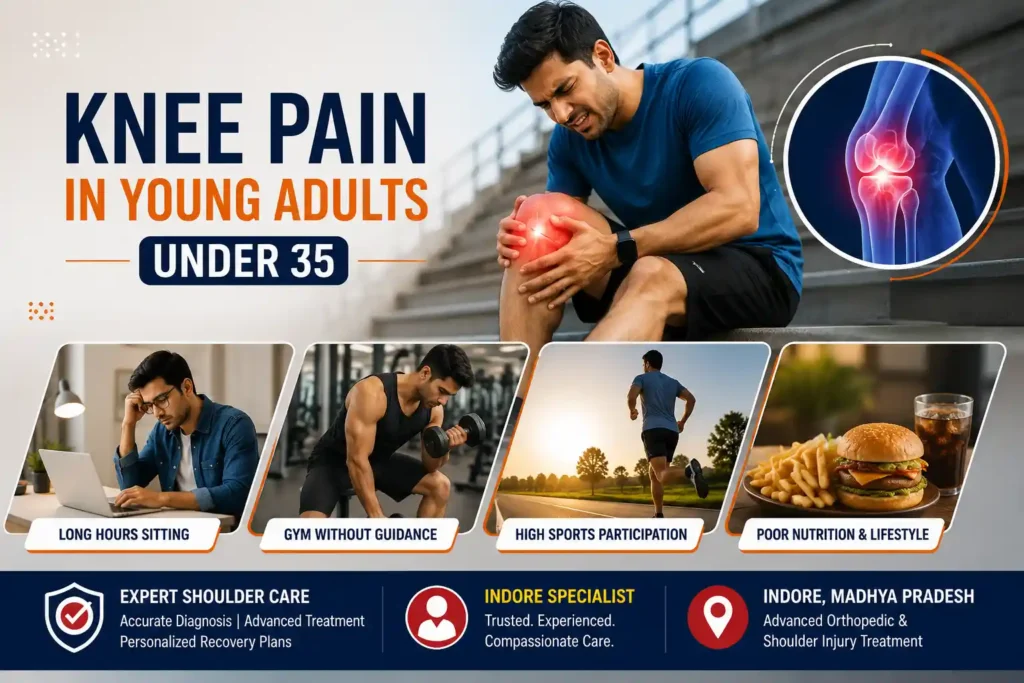
Knee pain in young adults under 35 is no longer a condition confined to elite athletes or accident victims. Changing lifestyles, longer sitting hours, increased gym participation without proper guidance, nutritional deficiencies common in the Indian population, and rising rates of sports participation are driving a significant increase in the number of patients under 35 presenting with genuine, sometimes serious, knee pathology to orthopaedic clinics in Indore.
Cause 1: Patellofemoral Pain Syndrome, The Most Common Knee Pain in Young Adults Indore Doctors Diagnose
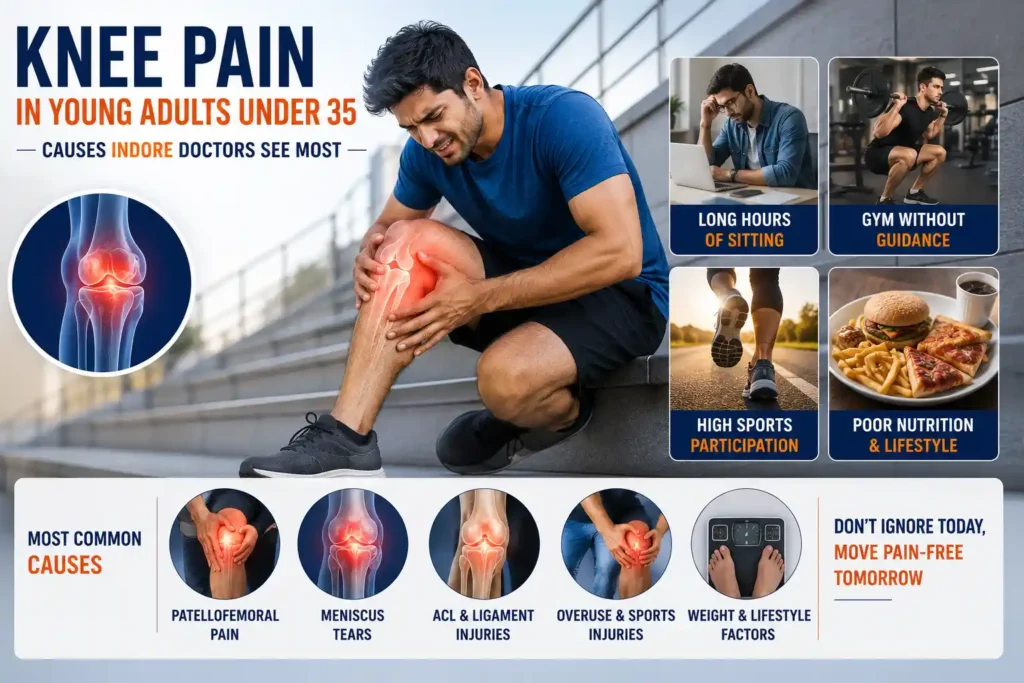
Patellofemoral pain syndrome, often abbreviated as PFPS and also known as runner’s knee or anterior knee pain, is the single most common cause of knee pain in young adults globally. Research published in peer-reviewed orthopaedic literature places the annual prevalence of patellofemoral pain at 22.7 percent in the general population and 28.9 percent in adolescents. Among the 16 to 25 age group, it is particularly prevalent, accounting for approximately 50 percent of all non-specific knee pain presentations.
The condition arises from abnormal loading and tracking of the patella (kneecap) as it moves within the femoral groove during knee flexion and extension. When the patella does not track centrally, it creates friction and abnormal pressure on the cartilage of its undersurface and the femoral groove, producing the characteristic anterior knee pain that is worst with squatting, going down stairs, prolonged sitting with a bent knee (the theatre sign), and running. In Indore, the combination of increasing gym participation by young adults unfamiliar with proper squatting form and long hours of sitting with the knee flexed creates the ideal conditions for PFPS to develop.
We cover the condition in full in our guide to patellofemoral pain syndrome, including the loading programme that settles most cases without surgery.
Cause 2: Meniscus Tears, Increasingly Common in Young Adults Before Age 35
The meniscus, the two crescent-shaped cartilage pads inside the knee joint, is designed to absorb load, distribute force across the joint, and provide secondary stability. In younger adults, meniscus tears typically occur through an acute traumatic mechanism: a sudden rotational force on a planted foot, as happens in football, kabaddi, badminton, and cricket. The classic history is a young player who plants and pivots, feels a pop or gives way at the knee, develops significant swelling within hours, and cannot fully straighten the leg.
Ignoring a meniscus tear and continuing to load the knee leads to progressive tear extension, secondary cartilage damage, and significantly higher rates of early-onset knee arthritis. Information about the full range of meniscus tear grades and their treatment in Indore is available on the meniscus tear treatment page. Grade 3 meniscus tears specifically, which involve full-thickness disruption, are explained in detail at the Grade 3 meniscus tear page.
Cause 3: ACL and Ligament Injuries, High Impact, High Stakes in Young Indore Patients
The anterior cruciate ligament is the primary stabiliser of the knee against anterior translation and rotational forces. ACL tears are one of the most devastating injuries seen in young athletes in Indore, occurring most commonly between the ages of 15 and 30 during high-intensity pivoting sports. Football, kabaddi, basketball, and cricket are the most common precipitating sports in the patient population seen at Dr. Prince Uchadiya’s clinic.
Young patients under 35 who wish to remain active in sport almost universally require ACL reconstruction rather than conservative management. The consequences of an ACL-deficient knee in a young active person, specifically progressive cartilage and meniscus damage from instability, are among the strongest evidence-based arguments for surgical intervention. PCL injuries, though less common than ACL tears, present similarly and are discussed on the PCL ligament tear treatment page.
For patients weighing up whether surgery is needed at all, ACL tear without surgery sets out the criteria.
Cause 4: Patellar Tendinitis: The Overuse Injury Young Gym Goers and Athletes Miss
The patellar tendon connects the kneecap to the tibial tuberosity, transmitting the force of the quadriceps muscle through the kneecap to produce knee extension. In young adults who engage in sports or gym activities involving repeated jumping, running, or heavy squatting, the patellar tendon develops micro-tears from cumulative overuse that exceed the tendon’s capacity for recovery. The result is patellar tendinitis, or more accurately jumper’s knee, characterised by localised pain at the lower pole of the patella that is worst with activity and gradually worsens if training load is not reduced.
Young Indore patients presenting with patellar tendinitis typically describe an aching at the front of the knee just below the kneecap, worse at the beginning of activity when the tendon is stiff, temporarily better during the warm-up period, and then worsening again after intense sessions or the following day. The condition is frequently misdiagnosed as general knee pain or attributed to weak quadriceps, which leads to training approaches that worsen rather than resolve it. Proper management requires load reduction, specific eccentric tendon loading exercises, correction of biomechanical factors contributing to tendon overload, and in chronic cases, physiotherapy-guided tendon rehabilitation over several months.
Cause 5: Iliotibial Band Syndrome, A Running and Cycling Problem Increasingly Seen in Indore
The iliotibial band (IT band) is a thick band of connective tissue running from the hip to the outer knee. In runners, cyclists, and young adults who significantly increase their exercise volume rapidly, the IT band repeatedly slides over the lateral femoral epicondyle during knee flexion and extension, producing friction and inflammation that causes lateral knee pain. The characteristic feature is lateral knee pain that begins after a predictable running distance and does not resolve with continuing to run, often forcing the patient to stop.
IT band syndrome is the most common cause of lateral knee pain in runners and has become increasingly common among young Indore adults who take up running or cycling through fitness apps without proper guidance on training load progression. It is not a structural injury in the same category as a meniscus tear or ACL rupture, and it does not require surgery. However, it does not resolve with simply resting and returning to the same training load that caused it. Addressing hip abductor weakness, correcting running form, adjusting training volume, and targeted stretching and physiotherapy are the cornerstones of effective management.
Cause 6: Early-Onset Knee Arthritis, Not Just a Condition of Old Age
The assumption that arthritis is exclusively a condition of older patients is clinically incorrect. Post-traumatic knee arthritis, occurring after ACL tears, meniscus injuries, or significant cartilage damage, can develop in patients in their late 20s and early 30s, particularly if the original injury was not properly managed. Early cartilage damage from conditions like osteochondritis dissecans, a condition where a fragment of cartilage and bone separates from the joint surface, can develop in teenage and young adult athletes and progress to arthritis if not identified and treated.
Patients with early arthritis under 35 typically present with knee pain that is diffuse rather than localised to one spot, worsened by activity and partially improved by rest, accompanied by morning stiffness that takes more than 30 minutes to resolve, and associated with swelling that develops after activity. Young patients in Indore with a history of previous knee injury, recurrent swelling, or progressively declining exercise tolerance should be evaluated for early cartilage pathology before the changes become irreversible. Information about early cartilage damage signs is available at Early Cartilage Damage Signs.
Why Knee Pain in Young Adults Indore Patients Experience Is Rising: The Lifestyle Factor
Beyond the specific conditions described above, a set of broader lifestyle changes is driving the overall increase in knee pain in young adults across Indore that orthopaedic clinics are seeing. Understanding these drivers helps young adults make informed decisions about their activity patterns, body weight, nutrition, and training approach before a reversible condition becomes a structural problem.
Prolonged daily sitting, which compresses the patellofemoral joint for hours continuously and weakens the hip and gluteal muscles that protect the knee during activity, is the single most widespread predisposing factor in young desk workers and students. The sharp contrast between a predominantly sedentary week and a high-intensity weekend of sport or gym sessions creates the conditions for overuse injury and acute ligament injury that would not occur in someone with a more balanced activity distribution.
Body weight plays a role even in young adults. Even a modest excess body weight increases the compressive force on the knee joint during everyday activities. Research consistently shows that each kilogram of excess body weight adds approximately three to four kilograms of load to the knee during walking. In young adults who are already loading their knees with sport and gym activity, this compounding effect accelerates the development of patellofemoral symptoms, IT band issues, and early cartilage stress. The relationship between obesity and knee pain in Indore patients is explored at Obesity Knee Pain.
Warning Signs: When Knee Pain in Young Adults Needs Specialist Attention in Indore
Not every episode of knee pain in a young adult requires an orthopaedic consultation. Mild discomfort after an unusually long run or a heavy gym session that resolves within 48 hours with rest and ice is the normal adaptation response of a musculoskeletal system being challenged. But certain patterns of knee pain in young adults under 35 in Indore should prompt prompt specialist evaluation rather than watchful waiting or self-management.
- Sudden severe swelling of the entire knee joint developing within hours of an injury: this suggests a haemarthrosis from an ACL tear, patellar dislocation, or osteochondral fracture requiring same-day assessment.
- A pop or snap felt or heard at the moment of injury: the hallmark of an ACL tear or patellar dislocation, both of which require imaging and specialist management.
- A knee that locks and cannot be fully straightened: indicates a displaced meniscus fragment blocking extension, requiring urgent evaluation.
- Persistent swelling that returns repeatedly after activity: suggests an intra-articular structural problem, not simply muscle soreness.
- Knee pain that has been present for more than four weeks without improvement despite rest: warrants investigation to identify the cause before treatment is directed at the wrong structure.
- Progressive knee weakness making stairs, rising from sitting, or sport increasingly difficult.
- Night pain that wakes the patient from sleep: in the context of knee pathology in a young adult, this warrants investigation to exclude inflammatory arthritis or osteochondral pathology.
How Knee Pain in Young Adults Is Diagnosed in Indore
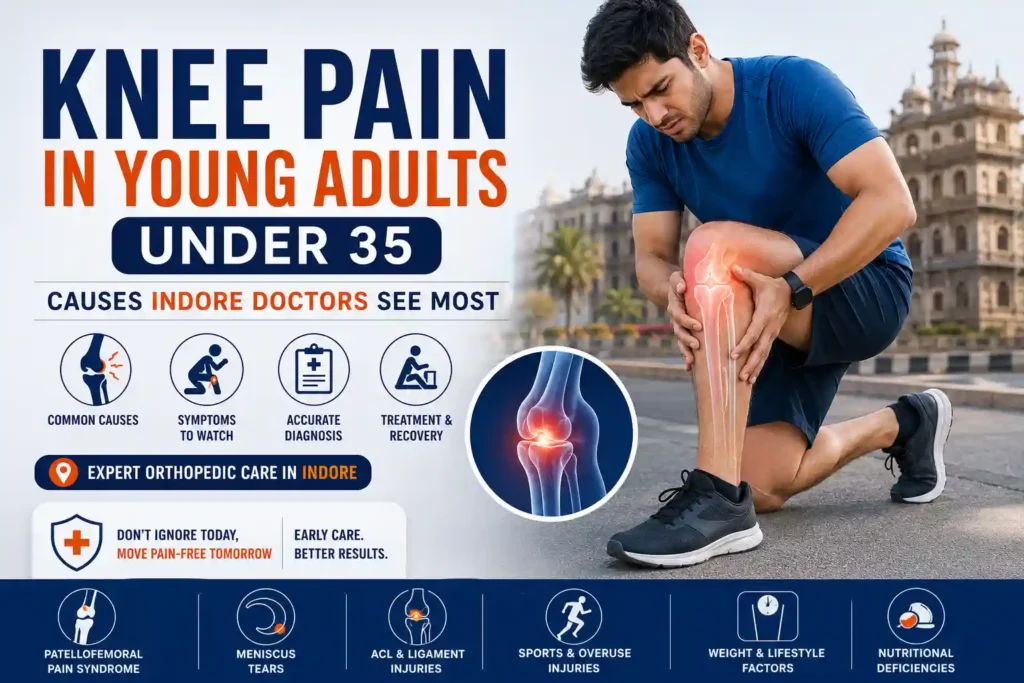
Dr. Prince Uchadiya’s approach to knee pain in young adults in Indore begins with a thorough history of symptom onset, activity level, injury mechanism if applicable, and specific aggravating and relieving factors. The physical examination assesses joint alignment, patella tracking, quadriceps and hip strength, specific ligament integrity tests, meniscal provocation tests, and the presence of effusion in the joint.
Imaging is requested based on clinical findings. X-rays assess bone alignment, patella height, and any bony abnormalities. MRI provides the most comprehensive assessment of soft tissue structures including the ACL, menisci, articular cartilage, patellofemoral cartilage, and patellar tendon. Blood tests are ordered when inflammatory arthritis, vitamin D deficiency, or other systemic causes are clinically suspected. Ultrasound is useful for dynamic patellar tracking assessment and for guided injections when indicated.
Treatment Options for Knee Pain Young Adults Indore Patients Can Access
The treatment of knee pain in young adults in Indore is highly condition-specific. For patellofemoral pain syndrome and IT band syndrome, structured physiotherapy addressing muscle imbalances and training load management, combined with activity modification and biomechanical correction, produces excellent outcomes without surgery in the vast majority of patients. For meniscus tears, the treatment depends on the tear pattern and severity: smaller stable tears may be managed conservatively, while locked knees and unstable peripheral tears require arthroscopic intervention. For ACL tears in active young patients, surgical reconstruction followed by nine to twelve months of structured rehabilitation is the evidence-based standard of care. For patellar tendinitis, an eccentric tendon loading program under physiotherapy guidance produces the best evidence-based outcomes. For early cartilage damage, treatment ranges from conservative management and nutritional optimisation to cartilage restoration procedures for more significant lesions.
Patients completing surgery or structured physiotherapy for knee conditions can access the post-injury rehabilitation program at Dr. Prince Uchadiya’s clinic in Indore, which provides a structured return-to-activity program designed for each patient’s specific condition and goals.
Frequently Asked Questions About Knee Pain Young Adults Indore
1. What are the most common causes of knee pain in young adults under 35?
The six most common causes of knee pain in young adults under 35 seen at orthopaedic clinics in Indore are patellofemoral pain syndrome, meniscus tears, ACL and ligament injuries, patellar tendinitis, IT band syndrome, and early cartilage damage or post-traumatic arthritis. Patellofemoral pain syndrome is the single most prevalent, affecting over 20 percent of young adults globally. The relative frequency of each condition in a specific patient depends on their activity level, sport involvement, posture, body weight, and whether they have had a previous knee injury. An accurate diagnosis is essential because each condition requires a different treatment approach.
2. Why do some young people get knee pain without an injury?
Knee pain without a clear injury event is extremely common in young adults and occurs for several reasons. Patellofemoral pain syndrome develops from cumulative abnormal loading of the kneecap due to muscle weakness, poor hip alignment, or sudden increases in activity volume. IT band syndrome develops from repetitive friction during running or cycling. Patellar tendinitis develops from excessive jumping or squatting load on the tendon. Vitamin D deficiency reduces the resilience of musculoskeletal tissues and can contribute to diffuse, poorly-localised knee discomfort. Even early cartilage damage can develop insidiously in young athletes from repetitive micro-trauma without a single dramatic injury. Non-traumatic knee pain that persists for more than four weeks deserves clinical assessment rather than the assumption that it will resolve on its own.
3. Can long sitting hours cause knee pain in young adults?
Yes, and this is one of the most significant contributors to knee pain in young adults in Indore’s growing working population. Prolonged sitting with the knee held at approximately 90 degrees of flexion places sustained compressive load on the patellofemoral joint. The quadriceps and hip muscles weaken progressively with sustained inactivity. When the same young person who sits for eight to nine hours then squats, runs, or climbs stairs, the weakened muscles and compressed patellofemoral joint cannot tolerate the sudden mechanical demand, and pain results. Breaking up prolonged sitting every 30 to 40 minutes, performing brief standing and walking breaks, and incorporating regular hip and quadriceps strengthening into the daily routine significantly reduces the cumulative risk.
4. Why does knee pain become worse after running, sports, or exercise?
Knee pain that worsens after running or sports reflects increased mechanical loading of whatever structure within the knee is already compromised. In patellofemoral pain syndrome, running increases the compressive load on the kneecap progressively, reaching its maximum during downhill running and stair descent. In patellar tendinitis, repetitive tendon loading during jumping and running produces micro-tears faster than the tendon can recover. In a meniscus tear, the repetitive compression and rotation of running repeatedly stresses the torn cartilage edges. In early cartilage damage, increased impact loading during running produces swelling and pain from the inflamed cartilage surface. Activity-related knee pain that requires progressively more rest to settle or is trending in a worsening direction over weeks warrants evaluation rather than continued load.
5. Can knee pain in young adults happen because of vitamin D deficiency?
Vitamin D deficiency, which is extremely prevalent in India including among young adults in Indore, can contribute to diffuse musculoskeletal pain including knee pain. Vitamin D plays an essential role in calcium absorption, bone mineralisation, and muscle function. Deficiency leads to reduced bone density, impaired muscle strength, and generalised musculoskeletal discomfort that is not attributable to a specific structural knee lesion on imaging. Young adults who present with vague knee aching, generalised muscle weakness, fatigue, and normal or near-normal MRI findings should have their vitamin D and calcium levels checked as a routine part of the diagnostic workup. Correction of deficiency through appropriate supplementation, combined with resistance exercise and sun exposure guidance, can meaningfully reduce symptoms in this subgroup.
6. Why do knees make clicking or cracking sounds with pain?
Knee clicking or cracking that is painless and occurs without swelling or functional limitation is usually benign, arising from gas bubbles forming in the joint fluid during movement or from normal tendon snapping over bony prominences. This type of clicking does not require medical attention. Clicking that is accompanied by pain, swelling, or a sense of the knee catching or locking is a different matter entirely. In young adults, painful clicking is most commonly associated with a meniscus tear, where the torn edge catches within the joint during movement; with patellofemoral dysfunction, where the kneecap scrapes against the femoral groove; or with loose cartilage fragments within the joint that intermittently impede smooth movement. Clicking that began after an injury or that is associated with any other symptom warrants assessment.
7. Can stress or mental health issues contribute to knee pain?
Yes, and this connection is supported by pain science research. The experience of pain is not purely mechanical; it is modulated by the nervous system, which is profoundly influenced by psychological state. Chronic stress elevates cortisol levels, which affects musculoskeletal tissue repair and increases the sensitisation of pain pathways. Central sensitisation, where the nervous system becomes hypersensitive to pain signals from joints that may have only mild mechanical provocation, is increasingly recognised as a contributing factor in persistent musculoskeletal pain including knee pain in young adults. Patients who experience significant life stress, anxiety, or depression alongside their knee symptoms often find that a purely biomechanical treatment approach produces incomplete relief, while a more comprehensive approach that also addresses sleep, stress management, and psychological wellbeing produces better outcomes.
8. Why does knee pain happen after pregnancy in some young adults?
Knee pain following pregnancy is a specific and underrecognised presentation of knee pain in young adults. During pregnancy, the hormone relaxin increases joint laxity throughout the body, including the knee. Weight gain alters the biomechanics of the knee, increasing patellofemoral compressive load and placing greater stress on the medial compartment. After delivery, reduced physical conditioning from the pregnancy period combined with rapid return to activity can strain tendons and ligaments that are still affected by hormonal laxity. New mothers who carry infants frequently and adopt sustained bending, squatting, and floor-sitting postures develop patellofemoral symptoms and patellar tendinitis at higher rates. These symptoms are highly responsive to targeted physiotherapy addressing the hip and quadriceps weakness that developed during and after pregnancy.
9. Can sports activities during teenage years lead to long-term knee problems?
Yes, and this is an important consideration for patients in Indore seeking to understand the origin of their knee pain as young adults. High-volume impact sports during the teenage years without adequate rest, recovery, and coaching on proper movement mechanics can cause osteochondritis dissecans (a cartilage and bone lesion), patellar tendinitis that becomes chronic, repetitive stress injuries to the growth plates, and accelerated patellar tracking problems from muscle imbalances developed during rapid growth. Former teenage athletes who now have knee pain as adults in their late 20s and early 30s often have a history of adolescent knee symptoms that were dismissed as growing pains. These historical injuries may have left residual structural changes that are now becoming symptomatic under adult activity demands.
10. Why does knee pain increase while climbing stairs or squatting?
Stair climbing and squatting both require the knee to flex under load, which significantly increases the compression force between the kneecap and the femoral groove. During a single squat, the compressive force on the patellofemoral joint can reach several times the body’s weight. In patients with patellofemoral pain syndrome, patellar tendinitis, or anterior knee cartilage damage, this compressive load exceeds the tolerance of the affected tissue and produces pain. In patients with medial compartment meniscus tears, the deep knee flexion required to squat fully compresses the posterior horn of the meniscus, which is where tears most commonly occur. Knee pain specifically provoked by stairs and squatting, without significant pain during flat walking, is a valuable clinical clue that focuses the diagnostic assessment on the patellofemoral and posterior meniscal structures.
11. Can young adults develop arthritis-related knee pain?
Absolutely. While primary osteoarthritis is far more common in older adults, post-traumatic arthritis from previous ACL tears, meniscus injuries, or significant cartilage damage can develop in young adults under 35. Inflammatory arthritis conditions, including rheumatoid arthritis, psoriatic arthritis, and reactive arthritis, can also begin in young adults and produce significant knee pain and swelling that is not related to mechanical causes. Young adults with bilateral knee swelling, morning stiffness lasting more than an hour, joint symptoms involving other joints alongside the knees, or a family history of inflammatory arthritis should be evaluated for inflammatory causes alongside the more common mechanical ones.
12. Why does knee pain feel worse after sitting for a long time?
This symptom is called the theatre sign and is particularly characteristic of patellofemoral pain syndrome. After prolonged sitting with the knee bent, the pressure within the patellofemoral joint increases, the synovial fluid distribution around the kneecap changes, and the cartilage surface becomes temporarily compressed. When the young adult stands up after a long meeting, cinema session, or car journey, the first few steps are particularly painful as the kneecap transitions from the compressed, static position to dynamic loading. This pain typically eases after the joint warms up and normal fluid distribution is restored through movement. While the theatre sign is most associated with PFPS, it can also occur with early cartilage pathology, meniscus tears, and in some patients with inflammatory arthritis.
13. When should young adults in Indore see an orthopedic doctor for knee pain?
Young adults with knee pain in Indore should see Dr. Prince Uchadiya or another orthopaedic specialist when: knee pain has persisted for more than four weeks without meaningful improvement despite rest and basic self-care; the knee swells significantly after activity or appears swollen at rest; the knee locked or buckled after an injury accompanied by a pop; clicking in the knee is associated with pain or a catching sensation; the ability to climb stairs, squat, or play sport is progressively declining; pain is affecting sleep; or any of the red flag symptoms described in this article are present. Early specialist evaluation for knee pain in young adults in Indore consistently produces better outcomes than delayed presentation because treatable structural problems are identified and managed before they cause permanent joint damage.
14. What tests help diagnose knee pain in young adults?
The diagnostic process for knee pain in young adults in Indore begins with a structured clinical examination. Specific tests for ligament integrity, meniscal provocation, patellofemoral tracking, and patellar tendon tenderness allow an experienced orthopaedic surgeon to identify the most likely cause from the history and examination alone in many cases. X-rays assess bone alignment, patella height, and joint space. MRI of the knee is the most important imaging investigation for confirming the diagnosis of soft tissue conditions including ACL and PCL tears, meniscus tears, cartilage damage, and patellar tendinitis. Blood tests including inflammatory markers, vitamin D, calcium, and in some cases rheumatoid factor and uric acid are ordered when metabolic or inflammatory causes are suspected. Ultrasound is used for dynamic assessment and guided procedures.
15. Can knee pain in young adults improve without surgery?
The majority of knee pain presentations in young adults in Indore do not require surgery. Patellofemoral pain syndrome, IT band syndrome, patellar tendinitis, and mild to moderate meniscal irritation without mechanical symptoms all respond well to structured physiotherapy, activity modification, and in some cases, appropriate nutritional support. Even certain partial meniscus tears and mild cartilage lesions can be managed conservatively in the right patient. Surgery is needed for ACL tears in active young patients, locked knees from displaced meniscal fragments, large full-thickness meniscal tears causing mechanical symptoms, and significant osteochondral lesions. The decision between conservative and surgical management is made based on the specific diagnosis, the severity of findings on MRI, the patient’s activity goals, and how they have responded to prior treatment. No young adult with knee pain should accept the assumption that surgery is inevitable without a thorough specialist assessment of all their options.
If you are a young adult in Indore under 35 dealing with knee pain that is affecting your activity, your work, or your sleep, the most important step you can take is to get an accurate diagnosis before assuming it will resolve on its own or before accepting treatment directed at the wrong cause. Dr. Prince Uchadiya’s orthopaedic clinic in Indore provides comprehensive assessment and the full range of conservative and surgical treatment options for knee pain in young adults, giving you the best possible chance of returning to full activity without long-term consequences.