You twisted your knee. Something popped. The MRI comes back and says “grade 3 meniscus tear” and suddenly your doctor is talking about surgery, braces, and months of physiotherapy.
That is a lot to take in.
The good news is that a grade 3 meniscus tear is not a life sentence. People recover from this every day and get back to doing what they love, whether that is playing cricket on weekends, walking to work, or just climbing stairs without wincing.
But the recovery is real. It takes time. And the more honestly you understand what is ahead, the better you will handle it.
So here is everything you need to know about grade 3 meniscus tear recovery time, written for people in Indore dealing with exactly this situation right now.
What Is a Grade 3 Meniscus Tear, and Why Is It Different?
The meniscus is a C-shaped cartilage cushion sitting inside your knee, one on the inner side and one on the outer side. It absorbs shock and keeps your knee stable during movement.
Meniscus tears are graded 1 through 3 on MRI.
Grades 1 and 2 are internal signal changes that do not fully break through the cartilage surface. If you want the full picture on those, read our earlier piece on grade 2 meniscus tear recovery time and treatment in Indore.
Grade 3 is different.
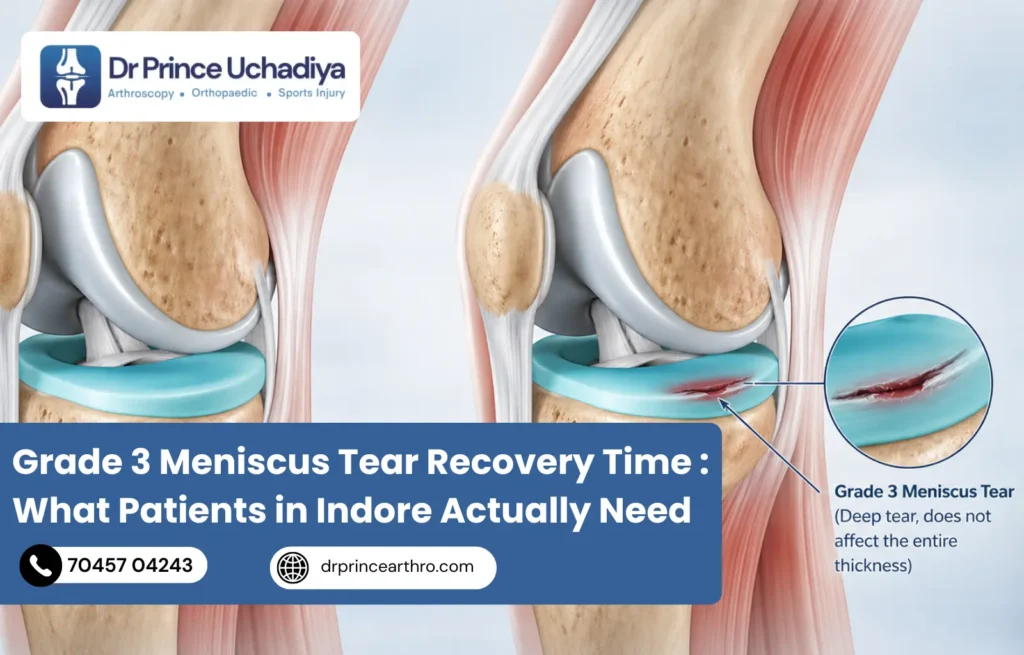
This is a complete tear that goes all the way through the meniscus to the articular surface. A surgeon looking inside the knee during arthroscopy can see it clearly, feel it with a probe, and confirm it is not going to heal on its own.
That last part matters.
Grade 3 tears almost never heal without some form of surgical treatment. The inner two-thirds of the meniscus has no meaningful blood supply, so there is no natural healing mechanism available. Waiting and hoping is not really a strategy here.
The Symptoms That Usually Bring People In
Most patients with a grade 3 tear know something is seriously wrong. The symptoms are hard to ignore.
- Sharp pain along the inner or outer joint line of the knee
- Significant swelling that appears within hours of the injury
- A popping or tearing sensation at the time of injury
- The knee locking or getting stuck, where you cannot fully straighten or bend it
- A catching sensation with certain movements
- Feeling like the knee might give way when you stand or walk
The locking symptom is particularly characteristic of grade 3 tears, especially the bucket-handle type where a flap of torn meniscus gets lodged between the joint surfaces. When that happens, you literally cannot straighten the knee. It is painful and alarming, and it is the kind of thing that tells us immediately that surgery is needed.
That said, not every grade 3 tear locks. Some patients walk into clinic in Indore with persistent pain, swelling that keeps coming back, and an MRI report they do not fully understand. The symptoms vary depending on the tear pattern and location.
Types of Grade 3 Meniscus Tears (Because Not All Are Equal)
One thing most articles online miss is that grade 3 is a broad category. The specific tear pattern affects everything from whether repair is possible to how long recovery takes.
The common grade 3 tear patterns include:
- Longitudinal tear: A vertical split along the length of the meniscus. This type, especially if it is peripheral, can sometimes be repaired with sutures.
- Bucket-handle tear: A large longitudinal tear where the inner fragment displaces into the joint like a bucket handle flipping over. This is what causes true knee locking and usually needs urgent surgery.
- Radial tear: A horizontal split going from the inner edge toward the outer edge. These cut through the circumferential fibers and are very difficult to repair. Partial meniscectomy is usually the answer here.
- Horizontal tear: Splits the meniscus into upper and lower layers. More common in older patients with degeneration.
- Complex tear: A combination of two or more patterns. More common in people over 45 where the cartilage has started degenerating.
Why does this matter? Because the type of tear determines whether you are a candidate for repair (where the torn piece is stitched back together) or meniscectomy (where the torn piece is trimmed away). And that decision has a direct impact on your recovery timeline.
Grade 3 Meniscus Tear Recovery Time: The Real Numbers
Let us get specific. Here is what recovery actually looks like depending on the treatment route.
After Partial Meniscectomy (Trimming)
This is the most common surgical approach for grade 3 tears. The damaged piece of meniscus is trimmed away arthroscopically, leaving the healthy tissue in place.
Recovery is relatively fast compared to repair surgery.
- Day 1 to 3: You go home the same day. There is pain and swelling. RICE protocol starts immediately.
- Week 1 to 2: Most patients can walk with minimal support. Crutches may be used briefly for comfort. Light activity around the house is fine.
- Week 2 to 4: Physiotherapy begins. Focus is on range of motion and gentle quad strengthening.
- Week 4 to 6: Walking normally, driving (for most patients), returning to desk work.
- Week 6 to 8: Return to light physical activity. More demanding exercise under supervision.
- Week 8 to 12: Return to sport or physically demanding work for most people.
According to the Cleveland Clinic, meniscectomy recovery typically allows return to full activity in 4 to 6 weeks for most patients. Athletes doing high-demand sports may take 8 to 12 weeks.
After Meniscal Repair (Suturing)
When the tear is in the outer vascular zone and the tissue is healthy enough to hold sutures, repair is preferred. It preserves more meniscal tissue, which protects the knee long-term.
But the recovery is longer. The repaired tissue needs time to knit together, and loading it too early can pull the sutures apart.
- Week 1 to 4: Non-weight-bearing or toe-touch weight-bearing only. Crutches required. Hinged brace worn.
- Week 4 to 6: Gradual progression to full weight-bearing begins. Physiotherapy intensifies.
- Week 6 to 8: Walking more normally. Still in brace for certain activities.
- Month 2 to 3: Light jogging, swimming, stationary cycling, progressive strength work.
- Month 4 to 6: Return to most physical activities and sports.
- Month 6 to 9: Full return to high-demand sport for athletes.
Research published in PMC (National Center for Biotechnology Information) shows meniscal repair has excellent long-term outcomes, with studies reporting up to 89% of young competitive athletes returning to their sport after repair surgery. The longer road is worth it when the tear is repairable.
Real Patient Stories: What We See in Indore
Numbers and timelines are useful. But they mean more when you see them in context of real people dealing with real situations. Here are three anonymized cases from our clinic in Indore.
Case 1: The Cricket Player from Vijay Nagar
A 24-year-old recreational cricket player came in after twisting his knee diving for a catch. He could barely walk and his knee was visibly swollen by the next morning. MRI confirmed a bucket-handle grade 3 medial meniscus tear with the fragment displaced into the joint.
He needed urgent surgery. The fragment was repositioned and sutured back during arthroscopic repair.
He was on crutches for 5 weeks. Physiotherapy started in week 2. By month 3 he was jogging. By month 5 he was back on the cricket field, first in practice sessions, then full match play.
Total recovery: just under 6 months from surgery to sport.
Case 2: The Working Woman from Palasia
A 48-year-old woman came in with knee pain that had been bothering her for months. No specific injury. Just gradual worsening after long days of walking at work. Her MRI showed a complex grade 3 medial meniscus tear with early degenerative changes in the joint.
Given her age and tear pattern, partial meniscectomy was the right choice. She had the procedure done arthroscopically and was walking without support within 10 days.
By week 6 she was back at work full-time. Her pain was gone. The knee felt stable for the first time in over a year.
Total recovery: 6 weeks to return to normal daily activity.
Case 3: The Young Professional from Nipania
A 32-year-old IT professional had a road accident that caused a combined ACL and lateral meniscus tear (grade 3). He had been told at another clinic he would need two separate surgeries.
We addressed both in the same arthroscopic session. The meniscus was repaired and the ACL reconstructed simultaneously.
Recovery was understandably longer given the combined procedure, approximately 8 months to full activity. But he avoided a second surgery and avoided re-injury.
His case is a reminder that grade 3 tears do not always come alone, and that when they are accompanied by ligament injuries, the treatment plan needs to account for both.
What the Arthroscopic Procedure Actually Involves
A lot of patients in Indore feel anxious about surgery because they imagine a large incision and a long hospital stay. Arthroscopic meniscus surgery is nothing like that.
Two to three small cuts are made around the knee, each just a few millimetres wide. A tiny camera goes in through one. Surgical instruments go in through the others. The surgeon watches the inside of the knee on a screen in real time.
The whole procedure takes 30 to 45 minutes for most grade 3 tears. You go home the same day.
You can learn more about how arthroscopy is performed at our Indore clinic, including what to expect before and after the procedure.
Week-by-Week Recovery Guide After Grade 3 Meniscus Surgery
Whether you had a meniscectomy or a repair, here is a practical guide to what to expect in each phase of recovery.
Week 1: Rest, Ice, Elevation
Pain and swelling are at their highest. Keep the leg elevated as much as possible. Ice for 15 minutes every 3 to 4 hours. Take prescribed anti-inflammatories regularly. Ankle pumps and straight leg raises can begin on day 1 to keep blood moving and prevent muscle wasting.
Do not skip this phase. Many patients make the mistake of overdoing it in week 1 because the arthroscopic cuts are small and they feel okay. The internal tissue still needs time.
Week 2 to 4: Starting Physiotherapy
This is when structured rehabilitation begins. A good physiotherapist in Indore will guide you through range-of-motion exercises, gentle quad activation, and progressively more demanding movements as the knee tolerates them.
For meniscectomy patients, walking is usually comfortable by now. For repair patients, crutches are still required during this period.
Week 4 to 8: Building Strength
Mini squats to 45 degrees, step-ups, stationary cycling, lateral band walks. The goal here is rebuilding the muscle support around the knee so the cartilage is protected.
Swelling should be reducing week by week. If it is not, come back in for assessment. Persistent swelling after week 4 is a signal that something needs to be checked.
Month 2 to 4: Progressive Loading
Deeper squats, light jogging on flat ground, pool running, functional movement patterns. The knee should be feeling much more like itself by now.
Most meniscectomy patients can return to sport-specific training around this time. Repair patients are building toward this phase.
Month 4 to 6: Return to Activity
For repair patients, this is when return to sport becomes realistic. A functional assessment checks strength symmetry, balance, and movement quality before clearance is given.
Do not skip the functional assessment just because the knee feels fine. Feeling fine is necessary but not sufficient. The knee needs to be tested before being trusted in high-demand situations.
Things That Slow Down Grade 3 Meniscus Recovery
Recovery is not purely linear. These are the factors that consistently cause setbacks in our Indore patients.
- Doing too much too soon. The most common. The knee feels better, so the patient goes back to the gym at week 3 and re-injures.
- Skipping physiotherapy sessions. Surgery fixes the tear. Physio builds the strength and movement quality that prevents re-injury. Skipping physio means going back to the surgeon earlier than expected.
- Uncontrolled swelling. Persistent swelling inhibits muscle activation and slows every other phase of recovery.
- Age and pre-existing arthritis. Older patients with degeneration in the joint take longer to recover and may have ongoing low-grade discomfort even after successful surgery.
- Combined injuries. A grade 3 meniscus tear with a simultaneous ACL or MCL injury means a longer and more carefully managed recovery program.
- Ignoring pain signals. Pain during recovery that keeps returning is your knee asking for attention. Do not push through it and assume it will sort itself out.
Can a Grade 3 Meniscus Tear Heal Without Surgery?
This is the question every patient asks. And the honest answer is: very rarely, and only in a very specific scenario.
A grade 3 tear in the outer red zone of the meniscus, in a young patient with no other joint damage, might stabilize with aggressive conservative management. These cases are uncommon. Most grade 3 tears require surgery because the inner portions of the meniscus simply do not have the blood supply to repair themselves.
What happens if you leave a grade 3 tear untreated?
- The torn fragment can continue to irritate the joint, causing pain and repeated swelling episodes
- A loose or displaced fragment can damage the articular cartilage, accelerating the development of knee osteoarthritis
- The knee becomes progressively less stable, increasing the risk of falls and secondary injuries
- Over time, what might have been a straightforward arthroscopic procedure becomes a much more complex surgical problem
Early treatment protects your long-term knee health. Waiting does not.
Why the Choice of Surgeon Matters for Grade 3 Tears
Not every grade 3 tear is handled the same way. The decision between repair and meniscectomy is a nuanced one that depends on your age, the tear pattern, the vascularity of the tissue, and your activity goals.
A surgeon who defaults to meniscectomy for every grade 3 tear is not giving you the most conservative, knee-preserving option. Equally, a surgeon who attempts repair on tissue that cannot hold sutures is setting you up for a failed repair and a second surgery.
The right surgeon assesses each case individually, explains the options clearly, and makes a decision that serves your knee health over the long term, not just the short term.
Dr. Prince Uchadiya is a gold medalist orthopedic surgeon trained at KEM Hospital, Mumbai, with subspecialty expertise in arthroscopy and knee cartilage management. Patients from across Indore, including Vijay Nagar, Nipania, Bengali Square, Mahalaxmi Nagar, and Palasia, consult him for both conservative and surgical knee management.
Dr. Prince Uchadiya’s Take on Grade 3 Tears
- Grade 3 tears are the ones that genuinely need attention. When I see one on an MRI, the first question I ask is not “do we operate” but “what type of tear is this, and what does this patient need for the next 20 years of their knee?”
- For a 25-year-old with a bucket-handle tear, repair is almost always worth attempting. Preserving the meniscal tissue at that age protects the cartilage underneath and significantly delays or prevents osteoarthritis. The 6-month recovery feels long in the moment, but the alternative, progressive joint degeneration, is far worse.
- For a 55-year-old with a complex degenerative tear and early arthritic changes, partial meniscectomy is usually the better call. Faster recovery, less downtime, and realistic expectations about the underlying joint condition.
- What I see too often in patients from Indore is delay. People wait two, three, sometimes six months before coming in, hoping the knee will sort itself out. By that point, a tear that might have been repairable is now beyond repair. A torn meniscal flap has been grinding against cartilage for months. The treatment options narrow, and the outcomes are less predictable.
If your MRI says grade 3, come in. Get a proper clinical evaluation alongside that MRI. The sooner we know what type of tear you have and where it sits, the sooner we can make a plan that actually serves you.
10 Most-Asked Questions About Grade 3 Meniscus Tear Recovery
1. How long does grade 3 meniscus tear recovery take after surgery?
For partial meniscectomy, most patients return to full activity in 4 to 8 weeks. For meniscal repair surgery, recovery takes 4 to 6 months. High-demand athletes returning to sport after repair may take 6 to 9 months.
2. Will I need surgery for a grade 3 meniscus tear?
In most cases, yes. Grade 3 tears extend fully through the cartilage surface and typically cannot heal on their own, particularly tears in the inner two-thirds of the meniscus which have no blood supply. Surgery is the reliable treatment for grade 3 tears.
3. Can I walk normally with a grade 3 meniscus tear?
Some patients can walk with discomfort, especially if the tear is not displaced. Others, particularly those with a bucket-handle tear causing locking, cannot walk normally at all. Either way, you should not be loading the knee heavily before getting an assessment.
4. What is the difference between meniscal repair and meniscectomy for a grade 3 tear?
Repair stitches the torn meniscus back together. Recovery is longer (4 to 6 months) but preserves more tissue and better protects long-term joint health. Meniscectomy trims the torn piece away. Recovery is faster (4 to 8 weeks) but removes cartilage that cannot regenerate. The right option depends on the tear type, location, and the patient’s age and activity level.
5. What happens if I leave a grade 3 meniscus tear untreated?
The torn fragment continues to irritate the joint, damages the articular cartilage over time, and accelerates knee arthritis. A knee that might have been well-managed with straightforward arthroscopy can become a much more difficult problem if left too long.
6. How soon can I drive after grade 3 meniscus surgery?
After meniscectomy, most patients are driving within 1 to 2 weeks once off strong pain medication, sooner for the left knee if driving an automatic vehicle. After repair, driving typically takes 2 to 4 weeks depending on which knee was operated on.
7. How do I know if I need repair or meniscectomy?
This decision is made based on the tear pattern, location within the meniscus, and the quality of the tissue observed during arthroscopy. Your surgeon assesses all of this at the time of surgery. Tears in the vascular outer zone with healthy tissue are more likely to be repaired. Tears in the inner avascular zone typically require meniscectomy.
8. Can a grade 3 meniscus tear come back after surgery?
Re-tears are possible, especially if you return to high-demand activity too early. After meniscectomy, the remaining meniscal tissue is smaller and slightly more vulnerable. After repair, the healed tissue is generally strong but returning to sport before full functional clearance increases re-injury risk.
9. What exercises can I do during grade 3 meniscus tear recovery?
In the early weeks: straight leg raises, ankle pumps, heel slides. Weeks 2 to 6: gentle cycling, step-ups, mini squats. Months 2 to 4: progressive strength work, balance training, light jogging. All exercise should be supervised or at least guided by a physiotherapist, especially in the first 3 months after repair surgery.
10. When should I see a doctor if I think I have a grade 3 meniscus tear?
Immediately if your knee is locked and you cannot straighten it. Within a few days if you have significant pain, swelling, catching, or giving-way. Do not wait weeks or months hoping it resolves. A grade 3 tear does not improve on its own, and every week of delay narrows your treatment options.