Key Takeaways
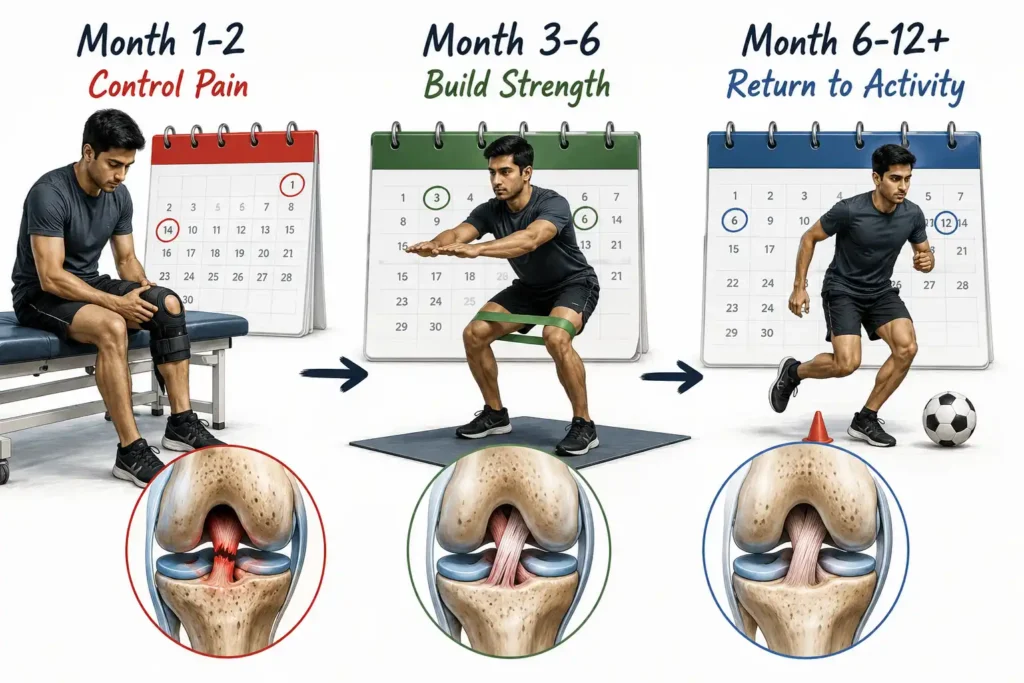
- Most websites say “3 to 6 months” for ACL tear recovery time without surgery. That range hides more than it reveals. Month 3 and month 6 are vastly different stages with different capabilities and different risks.
- Conservative ACL recovery reaches a biological ceiling at approximately 6 months. After that point, the knee does not get more stable. It either holds steady with ongoing maintenance or slowly declines.
- According to a Journal of Orthopaedic and Sports Physical Therapy study, neuromuscular training is the single most important predictor of successful non-surgical ACL outcomes. Skipping this phase leads to early plateau.
- Surgical reconstruction follows a different trajectory. Instead of reaching a ceiling at month 6, the graft continues maturing and the knee continues gaining strength through month 12 and beyond.
- British Journal of Sports Medicine criteria confirm that return-to-sport decisions should be based on functional milestones, not calendar dates. Feeling “ready” is not the same as being ready.
“How long until I am back to normal?”
That is the first question. Always. Before “do I need surgery,” before “what went wrong,” sometimes before the patient has even sat down in the chair. How long?
And every website gives the same frustratingly vague answer: 3 to 6 months.
That range means almost nothing to a person sitting in a clinic with a swollen knee and a work deadline next week. So instead of a range, here is a month-by-month breakdown of what ACL tear recovery time without surgery actually looks like. What you can do, what you cannot, and, most importantly, when the recovery stops improving.
Month 1: Swelling Goes Down. Hope Goes Up. Both Are Misleading.
The first month after an ACL tear feels like progress. Swelling reduces. Pain fades. Walking gets easier. Most patients start feeling optimistic around week 3.
Here is what is actually happening inside your knee:
- The bone bruise from the initial injury is still healing. MRI would show it clearly even though you cannot feel it anymore.
- The torn ACL stump may scar onto the PCL, creating a false sense of stability. Your Lachman test might even feel slightly firmer. But that scar has zero mechanical strength.
- Your quadriceps have already lost 15 to 25% of their strength from disuse inhibition. Even if you have been doing exercises, the nervous system has partially shut down the quad on the injured side. That shutdown is automatic and involuntary.
The emotional high of “feeling better” at month 1 is real. The structural reality underneath it is not as encouraging. ACL tear recovery time without surgery begins with understanding that pain reduction is not healing. Whether the knee is actually stable is tested objectively, which is what the Lachman test for ACL measures.
Month 2: Quad Activation Becomes Everything
By week 5 to 8, most patients have full range of motion back and can walk without a visible limp. Good. But the real work starts here, not ends.
Your VMO (the teardrop muscle on the inner thigh) is the key player. When it fires properly, the kneecap tracks correctly and the knee feels stable during single-leg activities. When it does not fire, the knee feels vaguely “off” even during simple tasks.
What should be happening in month 2:
- Terminal knee extensions with a resistance band, 3 sets of 15, daily
- Stationary cycling with the seat raised high to reduce patellofemoral pressure
- Side-lying hip abduction to wake up the gluteus medius, which controls knee alignment from above
- Single-leg standing for 30-second holds, eyes open first, then eyes closed
Most online rehab guides stop at “do physio for 6 weeks.” That instruction is so vague it borders on useless. The specific exercises, the order, the progression criteria matter far more than the duration itself.
Month 3: The First Real Checkpoint
Three months in, your orthopaedic surgeon or physiotherapist should be testing two things objectively:
- Quadriceps strength symmetry. How does the injured side compare to the healthy side? Below 60%? Rehabilitation needs to intensify. Between 60 and 80%? On track. Above 80%? Genuinely positive sign.
- Giving-way events. How many times has the knee buckled or shifted since rehab started? Zero? Good. Even once? That is a significant data point suggesting muscular compensation alone may not be enough.
Month 3 is where ACL tear recovery time without surgery stops being theoretical and starts being measurable. Numbers replace feelings. And those numbers determine whether conservative management has a future.
Dr. Prince Uchadiya, DNB Orthopaedics Gold Medalist, Orthopaedic and Arthroscopic Surgeon: “Month 3 is when I ask the patient to be brutally honest. Not about pain. Pain is usually gone by now. About function. Has the knee given way? Even once? Even a small stumble? Because each of those episodes is a moment when the meniscus absorbed a force it was never designed to handle alone.”
Months 4 to 5: Neuromuscular Training or Nothing Changes
Most conservative ACL protocols focus heavily on strength. Quad sets, squats, leg presses, hamstring curls. All necessary. None sufficient.
Strength without neuromuscular control is a strong leg that does not know how to react when the ground shifts. Neuromuscular training teaches the nervous system to protect the knee in milliseconds, automatically, without conscious thought.
What this phase looks like in practice:
- Perturbation training. Standing on a wobble board while a therapist pushes the knee gently from different angles. The goal: train your reflexive muscle firing speed.
- Deceleration drills. Walking quickly and stopping suddenly on command. Then jogging and stopping. Then lateral stepping and stopping. Each progression challenges the protective reflexes differently.
- Single-leg mini squats on unstable surfaces. Balance pads, foam rollers, uneven mats. The brain must coordinate quad, hamstring, and hip muscles simultaneously to keep the knee centred.
Those who complete neuromuscular training consistently outperform those who only do strength work. The difference is measurable on functional testing and visible in real-world stability.
Month 6: The Ceiling Arrives
Here is the part most articles never say plainly: ACL tear recovery time without surgery hits a ceiling around month 6.
By this point, your muscles are as strong as structured physiotherapy can make them. Your neuromuscular patterns are trained. Your daily function is probably close to normal. Many patients feel like they have “recovered.”
But the ACL itself has not changed. It is still torn. The compensation is muscular and neurological, not structural. And compensation has limits that show up under three specific conditions:
- Fatigue during prolonged activity
- Unexpected perturbation (a child bumping into you, stepping on uneven ground)
- Any movement requiring rapid deceleration and pivot
After month 6, the conservative trajectory flattens. Continued strength training maintains what you have built. It does not add new stability. Surgical reconstruction, by contrast, continues producing gains through month 12 as the graft tissue matures and integrates.
The broader picture of what an ACL-deficient knee looks like at year 5, 10, and 15 is covered in the pillar guide on long-term effects of ACL tear without surgery. Patients at the 6-month mark should read it before deciding whether to continue conservative management or pursue reconstruction.
Month 6 vs Month 12: The Two Trajectories Diverge
| Marker | Month 6 (Conservative) | Month 12 (Post-Reconstruction) |
|---|---|---|
| Knee stability | Muscular compensation (variable, fatigue-dependent) | Structural graft stability (consistent) |
| Quad strength | 70-85% symmetry typical | 85-95% symmetry achievable |
| Hop test | 70-85% of uninjured side | 85-95% of uninjured side |
| Return to pivot sport | Not recommended at any point | Possible at month 9-12 if criteria met |
| Ongoing trajectory | Plateau. Maintenance required indefinitely. | Continued improvement through month 18 |
| Meniscus risk | Ongoing with each instability episode | Significantly reduced after graft maturation |
Both pathways require rehabilitation. Both require time. But one reaches a fixed ceiling. The other keeps climbing. That distinction shapes the entire long-term joint trajectory.
The 5 Factors That Actually Determine Your Recovery Speed
Two patients with identical MRI findings can have completely different ACL tear recovery time without surgery outcomes. Why? Because recovery speed depends on variables the MRI cannot capture:
- Pre-injury fitness level. A patient who trained 4 days a week before injury recovers faster than one who was sedentary. Existing muscle mass and cardiovascular fitness accelerate every phase.
- Rehab consistency. Three sessions a week, every week, for 6 months produces results. Two sessions a week with a 3-week holiday in between does not.
- Body weight. Every kilogram generates 3 to 4 times its weight in knee joint force during stairs and squats. Patients who are 10 kg overweight put 30 to 40 kg of extra force through an already unstable joint with every step down.
- Psychological readiness. Fear of re-injury changes movement patterns. Patients who are afraid to load the knee properly never achieve the strength thresholds needed for stability. Confidence in the knee is a genuine functional variable.
- Meniscal status. An intact meniscus allows full rehabilitation loading. A concurrent meniscal tear limits what the knee can tolerate during rehab and changes the risk calculation fundamentally.
For patients managing complete ACL tear treatment without surgery, factors 2 and 5 matter most. Consistency determines whether you reach the ceiling. Meniscal status determines how safe the journey is.
ACL Tear Recovery in Indore: What Dr. Prince Uchadiya Tracks at Every Follow-Up
At Dr. Prince Uchadiya Orthopaedic And Joint Care Clinic, Nipania, Indore, conservative ACL patients come back at specific intervals. Not for conversation. For measurement.
- Week 6: Full range of motion restored? Quad activation present? Walking without limp?
- Month 3: Quad strength symmetry measured. Giving-way event log reviewed. Decision checkpoint: continue conservative or reassess?
- Month 6: Single-leg hop test. Functional movement screen. Repeat MRI if any new symptoms have appeared.
Numbers at each visit determine the next step. Not opinions. Not guesses. Not how the knee “feels today.” Objective data drives every decision.
Patients planning a return to running should understand the milestone framework covered in the return-to-running guide, which applies equally to conservative and post-surgical recovery.
For patients with grade 3 ACL tear no surgery protocols, the 6-month ceiling applies even more firmly because zero intact fibres remain to provide any structural contribution. The muscles carry the full burden.
Those exploring ACL tear treatment without surgery more broadly, including the 5-phase protocol and failure warning signs, will find the detailed treatment guide covers territory this timeline article intentionally does not repeat.
Dr. Prince Uchadiya, DNB Orthopaedics Gold Medalist, Orthopaedic and Arthroscopic Surgeon: “Patients ask me how long recovery takes. I tell them the honest answer: recovery without surgery does not have an end date. It has a ceiling. And after that ceiling, the question changes from ‘am I recovering?’ to ‘am I maintaining?’ That shift in mindset is harder than any exercise.”
Who supervises that transition matters, which is why choosing an ACL specialist in Indore is worth doing carefully.
The Quiet Risk Nobody Talks About: What Happens After Month 6
The hidden risk of ACL tear recovery time without surgery surfaces after the plateau arrives. Life moves on. Patients return to work, adjust their routines, and slowly reduce their exercise frequency. This is natural. And this is exactly when conservative ACL management faces its biggest long-term threat.
Muscle strength declines with disuse. Neuromuscular patterns fade without practice. Body weight often increases when sport is no longer part of the routine. Gradually, the compensatory system that was painstakingly built over 6 months erodes.
A knee that was “stable enough” at month 6 may not be stable enough at month 18 if the maintenance programme has lapsed. And the giving-way episode that follows can damage a meniscus that survived the entire rehabilitation period intact.
This is the uncomfortable truth about ACL tear recovery time without surgery: the clock does not stop at month 6. It resets, and it demands attention indefinitely.
For the full context of what a partial ACL tear treatment without surgery timeline looks like compared to a complete tear, the biological differences are significant enough to warrant separate reading. Partial tears with over 50% intact fibres follow a meaningfully different recovery arc because the remaining structure contributes to stability in a way that muscles alone cannot replicate.
10 Questions About ACL Tear Recovery Time Without Surgery
1. Everyone says 3 to 6 months. Which is it?
Three months is when most patients feel functional for daily life. Walking, office work, driving. Six months is when the conservative ceiling arrives and the knee reaches its maximum non-surgical stability. Neither number means “healed.” Both mean “compensated.” The ACL remains torn at every point on that timeline.
2. When can I drive after a torn ACL without surgery?
Right-knee tears in automatic-transmission cars usually allow driving by week 3 to 4, once quad control is sufficient for emergency braking. Left-knee tears in automatic cars rarely affect driving. Manual-transmission vehicles require longer because of clutch operation. Ask your surgeon specifically, not the internet generically.
3. When can I go back to work?
Desk jobs: often within 1 to 2 weeks. Jobs involving standing or walking: 3 to 4 weeks. Jobs involving ladders, climbing, or heavy lifting: 6 to 12 weeks, depending on stability and strength recovery. Jobs involving physical contact or uneven terrain: this may be the conversation that leads to surgical assessment.
4. My knee stopped improving at month 4. Is that normal?
Possible but worth investigating. Month 4 is early for a plateau if rehab has been consistent. Common reasons: the exercise programme is not progressing (still doing month-2 exercises at month 4), neuromuscular training has not been introduced, or there is a concurrent issue the initial MRI missed. Get reassessed. A plateau at month 4 is a signal, not a sentence.
5. Can I jog at month 3?
Straight-line jogging on flat surfaces is sometimes possible at month 3 if quad symmetry is above 70% and there have been zero giving-way events. But “possible” and “advisable” are different words. Light jogging at month 3 should be tested under supervision, not decided independently on a Sunday morning run.
6. What happens if I stop doing exercises after month 6 because I feel fine?
The compensatory strength you built declines. Gradually. You will not notice it disappearing. But 6 months after you stop training, your quad strength will have dropped enough that the giving-way risk rises measurably. Conservative ACL management is not a 6-month programme with a graduation date. It is a permanent lifestyle adjustment with ongoing maintenance requirements.
7. Does age affect recovery time?
Yes. Younger patients typically build muscle faster and have better neuromuscular adaptability. Older patients often start with lower baseline strength and may take longer to reach the same milestones. That said, older patients with lower activity demands often need less total recovery because their functional targets are lower. A 55-year-old who walks for fitness reaches their sufficient stability sooner than a 22-year-old who wants to return to football, even though the younger patient builds strength faster.
8. Is there any way to speed up recovery?
Consistency accelerates everything. Three quality sessions per week, every single week, without gaps. Maintaining a healthy body weight reduces joint load at every phase. Pre-injury fitness is the biggest accelerator, which is obviously not retroactive but is worth noting for future injury prevention. No supplement, device, or shortcut replaces consistent, progressive rehabilitation.
9. My recovery feels slower than what I read online. Should I be worried?
Online timelines represent averages. Averages are composed of some people who recover faster and some who recover slower. Your recovery is not behind schedule unless your objective measures (strength testing, hop test, range of motion) are below expected benchmarks. Ask your physiotherapist to test you objectively rather than comparing yourself to a blog post written for an average that may not represent your specific situation.
10. At what point should I accept that conservative treatment is not going to be enough?
If, after 6 months of structured, consistent rehabilitation, you have any giving-way episodes, your quad strength is below 80% symmetry, or you have developed new symptoms like clicking or locking, conservative management has reached its limit for your knee. That is not a failure. It is useful clinical information. The next step is a consultation with a ligament injury specialist to discuss reconstruction in a knee that now has 6 months of baseline strength already built, which actually improves surgical outcomes.
That baseline strength is built through structured rehab, as physiotherapy after ACL surgery explains.