A 23-year-old kabaddi player walked into Dr. Prince Uchadiya’s clinic last month carrying an MRI report that said “complete ACL tear” and a recommendation from another doctor that said “surgery, Rs. 2.5 lakh.”
He had three questions. Is surgery really necessary?
Why does it cost this much? And will I play again?
Forty minutes later he left with answers to all three, including an honest assessment that his tear did need reconstruction, a transparent cost breakdown that came in significantly lower, and a milestone-based return-to-sport timeline specific to kabaddi.
He did not leave with pressure but with a clarity.That is the difference, between a surgeon who gives you a recommendation and a surgeon who gives you a complete picture, is what separates the best ACL surgeon in Indore from the rest.
5 Reasons Dr. Prince Uchadiya Is Recognised as the
ACL Surgeon in Indore
1. Gold Medal Credentials That Translate Directly to Surgical Precision
Dr. Prince Uchadiya holds a Gold Medal in DNB Orthopaedics, awarded for the highest performance across written, clinical, and oral examinations at the national level. He completed his MBBS at Sion Hospital, Mumbai, followed by MS Orthopaedics at KEM Hospital, one of the highest-volume trauma and sports injury centres in the country. His additional qualifications include DNB (Delhi) and MRCS Part A (England).
These are not listed for decoration. KEM Hospital Mumbai handles a surgical volume and case complexity that most training centres across the country do not match. The exposure to multi-ligament injuries, revision surgeries, and complex sports trauma during training is what builds the pattern recognition a surgeon relies on every day in the operating room.
2. 500+ Arthroscopic Procedures Across Knee, Shoulder, and Ankle
Volume matters in surgery. A surgeon who performs 5 ACL reconstructions a year approaches the procedure differently from one who performs 50. The difference is not just speed. It is the ability to handle intraoperative surprises: a graft that needs redirection, a meniscal tear found during arthroscopy that changes the plan, a tunnel that requires repositioning.
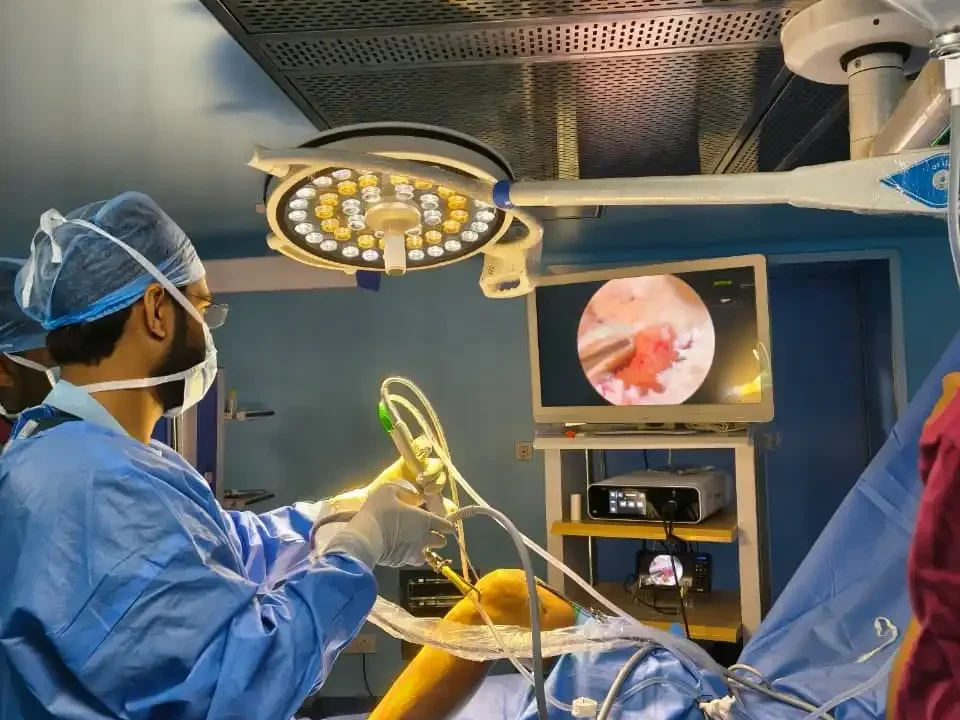
Dr. Prince Uchadiya has performed over 500 arthroscopic procedures, encompassing ACL reconstruction, PCL repair, combined ACL and meniscus injuries, shoulder stabilisation (Bankart repair), rotator cuff repair, and ankle ligament surgery. Every one of those procedures adds to the muscle memory and judgment that separates a competent surgeon from an exceptional one.
3. Fellowship in Arthroscopy and Sports Medicine
ACL reconstruction is an arthroscopic procedure. Performing it well requires dedicated training in keyhole surgery, which is distinct from general orthopaedic surgical training. Dr. Prince Uchadiya holds a formal Fellowship in Arthroscopy and Sports Medicine, reflecting specialised education in the exact technique that ACL surgery demands.
His clinic in Nipania, Indore is equipped with an HD arthroscopy tower, digital imaging systems, and bio-absorbable fixation devices. The surgical environment matches the training: modern, precise, and capable of handling both routine and complex arthroscopic cases.
4. Associated with Multiple Leading Hospitals in Indore
A surgeon’s hospital affiliations reflect the confidence that multiple medical institutions place in their clinical competence. Dr. Prince Uchadiya operates at and is associated with several hospitals across Indore, giving patients flexibility in location, insurance compatibility, and facility preference without compromising on surgeon quality.
Whether the surgery is performed at a private hospital with cashless insurance processing or under a government scheme, the surgeon, the technique, and the rehabilitation protocol remain the same.
5. Transparent, Evidence-Based Communication
The reason patients specifically seek out the leading ACL surgeon in Indore is rarely just about the surgery. It is about the conversation before the surgery. Can this doctor explain my injury in terms I understand? Will they show me my MRI and walk me through what each finding means? Will they tell me honestly if I do not need surgery?
Dr. Prince Uchadiya’s consultation style, consistently reflected in patient feedback, centres on showing the patient their own imaging, explaining the tear classification, discussing both surgical and non-surgical paths with real data, and letting the patient make an informed decision rather than a pressured one.
What an ACL Consultation with Dr. Prince Uchadiya Actually Looks Like
If you are evaluating the trusted ACL surgeon in Indore, knowing what happens during the consultation helps you compare meaningfully rather than going by titles alone.
- Injury history and mechanism review. When the injury happened, how it happened, what sensation was felt (pop, immediate swelling, giving-way), and what has been done since. These details narrow the diagnosis before anything else.
- Clinical examination of both knees. Lachman test, anterior drawer test, and pivot shift test assess ACL integrity directly. Varus and valgus stress tests check collateral ligaments. McMurray test evaluates the meniscus. Both sides are always compared.
- MRI correlation, not MRI reliance. The MRI is reviewed alongside the clinical findings, not in isolation. An MRI can show a tear. A clinical examination tells you how the knee is actually functioning with that tear.
- Honest treatment options. Not every ACL tear requires surgery. Dr. Prince explains which tears can be managed conservatively, which benefit from early reconstruction, and what the real risks of skipping surgery look like over 5, 10, and 15 years.
- Cost transparency before commitment. Surgery cost, hospital charges, graft options, and insurance or Ayushman eligibility are all discussed upfront. Detailed cost information is available on the ACL surgery cost in Indore page.
ACL Surgery Technique: What Dr. Prince Does Differently in the Operating Room
Every top ACL surgeon in Indore performs arthroscopic reconstruction. The difference is in the details of technique.
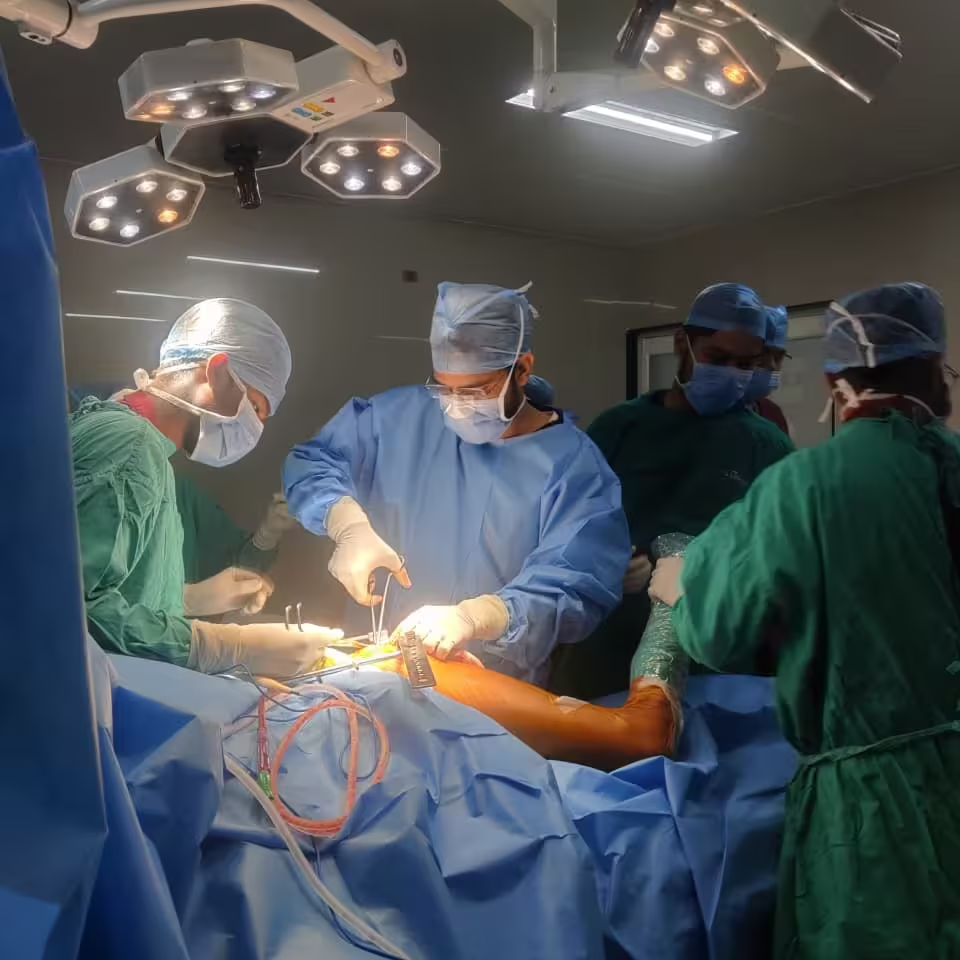
Dr. Prince Uchadiya follows anatomic ACL reconstruction principles, positioning the graft tunnel to replicate the native ACL’s exact angle and orientation rather than the older isometric placement technique that prioritised ease of drilling over biomechanical accuracy. Anatomic placement produces better rotational stability, which is what athletes need when cutting and pivoting.
The graft options include hamstring autograft and patellar tendon autograft. The choice depends on the patient’s specific anatomy, age, sport, and occupational demands. The recommendation is individualised, not defaulted to whichever graft the surgeon finds technically easier.
Surgical procedure takes 60 to 90 minutes. Hospital stay is 1 to 2 days. Walking with crutch support begins within 24 to 48 hours. There are no large incisions, just 2 to 3 keyhole cuts of 4 to 5 mm each.
For the full technical overview of ACL reconstruction surgery in Indore, the dedicated page walks through every step from pre-operative preparation to post-operative care.
Recovery After ACL Surgery with Dr. Prince Uchadiya
A leading ACL surgeon’s responsibility does not end when the arthroscope comes out. The rehabilitation phase determines whether the reconstruction succeeds long-term.
At Dr. Prince Uchadiya’s clinic, post-surgical rehabilitation follows milestone-based progression rather than fixed-calendar timelines. The key phases:
- Weeks 1 to 6: Swelling control, full extension restoration, early quadriceps activation. Crutch-assisted walking progressing to unaided walking.
- Weeks 6 to 16: Progressive strengthening of quads, hamstrings, and hip stabilisers. Closed-chain exercises. Stationary cycling.
- Months 4 to 6: Neuromuscular training, balance work, controlled jogging when strength milestones are met.
- Months 6 to 9: Sport-specific training, return-to-sport testing, clearance only when injured limb reaches 90% strength symmetry with the healthy side.
The detailed post-ACL surgery physiotherapy programme page explains each phase in depth. For runners specifically, the milestone-by-milestone guide to returning to running after ACL surgery in Indore covers exactly when and how running resumes safely.
ACL Surgery Cost and Ayushman Bharat Coverage in Indore
Cost is a legitimate concern and deserves a straightforward answer.
Arthroscopic ACL reconstruction in Indore typically ranges from Rs. 80,000 to Rs. 1,80,000 depending on graft type, fixation devices, concurrent procedures (meniscus repair adds complexity), and hospital facility charges.
Dr. Prince Uchadiya’s clinic offers ACL surgery under Ayushman Bharat PM-JAY for eligible patients. Detailed guidance on how this works, including documentation requirements and the procedure approval process, is covered on the ACL surgery under Ayushman Yojana in Indore page. For Hindi readers, the Indore mein ACL surgery Ayushman guide and the broader Ayushman card se free operation page explain the scheme in detail.
Most private health insurance policies cover ACL reconstruction as a planned surgical procedure. Pre-authorisation is handled by the clinic’s billing team before the surgery date is confirmed.
Who Comes to Dr. Prince Uchadiya for ACL Surgery in Indore
Patients travel from across Madhya Pradesh and neighbouring states for ACL treatment with Dr. Prince. The typical profiles include:
- Cricket, football, and kabaddi players who need to return to competitive sport with a stable, reconstructed knee. Athletes from Bhopal, Ujjain, Dewas, Ratlam, and Jabalpur regularly travel for surgery and follow-up.
- Young professionals whose ACL tear is affecting daily function, career mobility, or fitness goals. Police and armed forces recruitment candidates who need documented proof of surgical recovery find the ACL surgery and police recruitment guide particularly useful.
- Patients who were told to “just rest” and whose knee has continued to give way for months. For them, understanding the long-term consequences of leaving an ACL tear untreated is often what brings them to the consultation.
- Second opinion seekers who received a surgery recommendation elsewhere and want independent verification. A complete ACL tear assessment at the clinic provides that clarity.
ACL with Meniscus Injury: The Combined Case That Reveals a Surgeon’s True Calibre
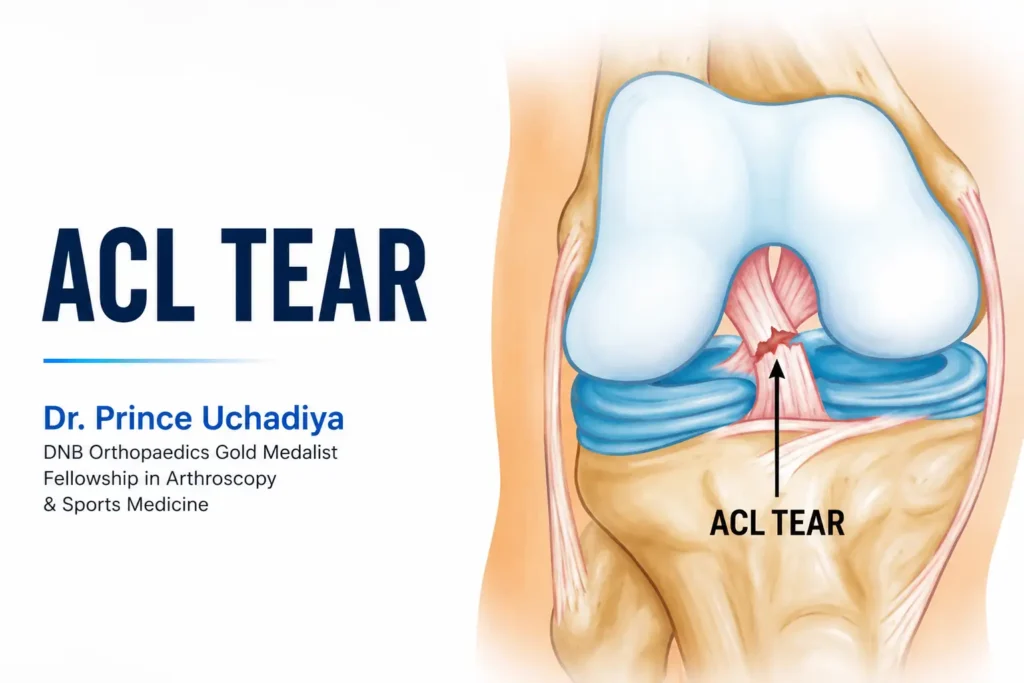
According to PMC research on Indian sports injuries, a significant proportion of ACL tears come with concurrent meniscal damage. Research indicates that up to 50% of acute ACL injuries involve a meniscal tear. This combined injury is where the difference between a competent surgeon and the experienced ACL surgeon in Indore becomes measurable.
The decision tree in a combined case is more complex. Should the meniscus be repaired or partially removed? Should ACL reconstruction and meniscus repair happen simultaneously or in stages? Does the meniscal tear pattern allow repair, or is the damage in an avascular zone where healing is unlikely?
Dr. Prince Uchadiya’s approach prioritises meniscal preservation in every case where repair is technically feasible. Removing meniscal tissue accelerates long-term cartilage degeneration. Repairing it, even when repair is more technically demanding than removal, protects the joint for decades. The dedicated guide on combined ACL and meniscus injuries explains the clinical reasoning behind this approach in full detail.
How to Choose the Right ACL Surgeon in Indore: The Questions That Actually Matter
If you are comparing orthopaedic surgeons for ACL reconstruction, these questions will separate genuine clinical skill from marketing claims:
AAOS clinical guidelines for ACL injuries recommend that patients assess their surgeon on specific, measurable criteria rather than reputation alone. Here is what to ask:
- How many ACL reconstructions do you perform annually? Volume below 30 per year means less pattern recognition. Ask for a specific number.
- Where was your arthroscopy training? A named institution with a dedicated arthroscopy programme is a more reliable signal than “extensive experience.”
- Do you use anatomic or isometric tunnel placement? Anatomic placement restores rotational stability better. If the surgeon does not know what this question means, consider looking further.
- What is your graft preference and why? There is no single correct answer. The important thing is that the surgeon has a reasoned, individualised rationale rather than a one-size-fits-all default.
- What does your return-to-sport protocol look like? If the answer is “come back in 3 months and we will see,” the rehabilitation structure is inadequate. Milestone-based testing with objective strength criteria is the current standard.
- What is your re-rupture rate? An honest surgeon will answer this directly. Average rates are 5 to 10% in high-demand athletes. If the surgeon claims zero, be cautious about the claim’s basis.
Dr. Prince Uchadiya answers every one of these questions during the initial consultation, with specific numbers rather than vague reassurances. That willingness to be precise and transparent is a significant part of why patients regard him as the trusted ACL surgeon in Indore.
10 Questions Patients Ask When Searching for the Top ACL Surgeon in Indore
1. What makes Dr. Prince Uchadiya different from other ACL surgeons in Indore?
Three things primarily. The combination of a Gold Medal in orthopaedics, KEM Hospital Mumbai surgical training, and a Fellowship specifically in Arthroscopy and Sports Medicine. This trifecta of academic distinction, high-volume surgical exposure, and subspecialty training is uncommon in any single surgeon’s profile. Add 500+ arthroscopic procedures on top and the clinical depth is difficult to match.
2. How long does Dr. Prince’s ACL surgery actually take?
Sixty to ninety minutes for a standard primary ACL reconstruction. Combined procedures with meniscal repair take slightly longer. Hospital discharge is day 1 or 2. Walking with support starts within 48 hours.
3. Can I get ACL surgery for free under Ayushman Bharat in Indore?
Eligible patients can receive ACL reconstruction under the Ayushman Bharat PM-JAY scheme. Documentation and procedure code approval are handled before surgery is scheduled. The process is straightforward when managed by a clinic familiar with the scheme.
4. I am a police recruitment candidate. Will ACL surgery affect my candidacy?
Properly performed ACL reconstruction with a full rehabilitation programme allows candidates to pass physical fitness tests for police and armed forces recruitment. Dr. Prince has treated multiple candidates in this exact situation with successful return to physical testing standards.
5. My ACL tear is 8 months old. Can Dr. Prince still operate?
Absolutely. Delayed ACL reconstruction is common and produces good outcomes. The surgery itself is not more difficult with time alone, but the joint condition at the time of surgery matters. If secondary meniscal damage has occurred during the delay, the reconstruction becomes more complex. An MRI at the time of consultation clarifies exactly what the surgeon will be working with.
6. How much does ACL surgery cost with Dr. Prince in Indore?
Rs. 80,000 to Rs. 1,80,000 depending on graft type, fixation devices, concurrent procedures, and hospital facility. Insurance pre-authorisation is handled by the clinic. No hidden charges.
7. Does Dr. Prince operate at only one hospital?
No. Dr. Prince Uchadiya is associated with multiple hospitals across Indore. This gives patients flexibility in choosing a facility based on location, insurance network, or personal preference, while the surgeon and surgical quality remain constant.
8. What graft does Dr. Prince recommend for ACL surgery?
Hamstring autograft is used most frequently because of its reliable outcomes, minimal donor site pain, and good long-term data. Patellar tendon autograft is considered for specific patient profiles, particularly high-demand athletes in contact sports. The recommendation is always individualised during consultation.
9. How soon after ACL surgery can I play cricket or football again?
Return to batting and non-contact activity typically begins around month 4 to 5. Full return to fielding, bowling, or football with pivoting is at month 7 to 9, contingent on passing functional strength and stability tests. Calendar time alone does not determine clearance.
10. I got a surgery recommendation from another doctor. Should I get a second opinion?
Yes, especially if the recommendation was made without a complete clinical examination, if no non-surgical option was discussed, or if you are uncertain about the surgeon’s specific experience with ACL reconstruction. A properly structured second opinion is not disloyal to your first doctor. It is informed decision-making.