
Hearing a sudden “pop” inside your knee while landing from a badminton smash, pivoting on a football turf, bowling in a weekend cricket match, or slipping off a two-wheeler in Indore is a moment most active adults never forget. Within two to four hours, the knee swells tightly (hemarthrosis), straightening the leg feels blocked, and within two weeks the swelling subsides enough to trick many patients into thinking the knee has healed on its own.
Then comes the first sudden turn on stairs or an uneven road, and the knee buckles sideways again. Because the Anterior Cruciate Ligament (ACL) sits deep inside the synovial fluid cavity of the knee, a complete tear cannot stitch itself back together naturally. At Dr. Prince Uchadiya Orthopaedic & Joint Care Clinic, Dr. Prince Uchadiya (MS Orthopaedics Gold Medalist from KEM Hospital Mumbai, MRCS from the Royal College of Surgeons of England, with 500+ arthroscopic ligament surgeries) performs anatomical ACL reconstruction surgery in Indore designed to restore rock-solid rotational stability and protect your meniscus and cartilage for life.
What the ACL Does Inside Your Knee (And Why Losing It Damages the Meniscus)
The Anterior Cruciate Ligament is a strong, rope-like collagen stabilizer running diagonally through the center of the knee from the femur (thighbone) to the tibia (shinbone). Anatomically, it functions through two synergistic fiber bundles:
- The Anteromedial (AM) Bundle: Tightens primarily when your knee is bent, preventing the shinbone from sliding forward (anterior tibial translation) when you decelerate, descend stairs, or squat.
- The Posterolateral (PL) Bundle: Tightens near full extension, controlling rotational pivot-shift forces when you cut, twist, change direction, or land on one leg.
According to the American Academy of Orthopaedic Surgeons (AAOS OrthoInfo), once a complete ACL tear removes this primary restraint, your medial and lateral menisci are forced to act as emergency brakes against forward sliding. Every time your knee gives way or micro-slips, the femoral condyle grinds across the back horn of the meniscus. Within 3 to 12 months of untreated instability, an isolated ACL tear frequently turns into a complex ACL and meniscus combined injury and triggers early articular cartilage damage.
Who Needs ACL Reconstruction Surgery vs Who Can Manage Non-Surgically?
Not every ACL injury requires immediate operating room admission on Day 1. During your consultation at our Nipania or Kanadia Road clinic, Dr. Prince evaluates three clinical factors alongside your 1.5T or 3T Knee MRI:
- Clinical Laxity on Lachman and Pivot-Shift Testing: An MRI shows static anatomy, but hands-on examination shows functional stability. A Grade 1 or low-grade Grade 2 partial sprain with a firm endpoint on the Lachman test and a negative Pivot-Shift can often heal with structured supervised physiotherapy and hinged bracing.
- Presence of Repairable Meniscus or Cartilage Tears: If your MRI reveals a bucket-handle meniscus tear, a meniscus root tear, or an osteochondral fragment blocking knee extension, early keyhole arthroscopic surgery is essential to stitch and save the native meniscus before it gets shredded.
- Activity Demands and Instability Episodes: Active individuals under 45, competitive or recreational athletes (cricket, football, badminton, basketball, gym lifting), army/police aspirants, and anyone experiencing knee buckling during daily walking or stair descent require anatomical ACL reconstruction to prevent early osteoarthritis.
Graft Selection Matrix: Choosing the Right Tendon Autograft for Your Knee
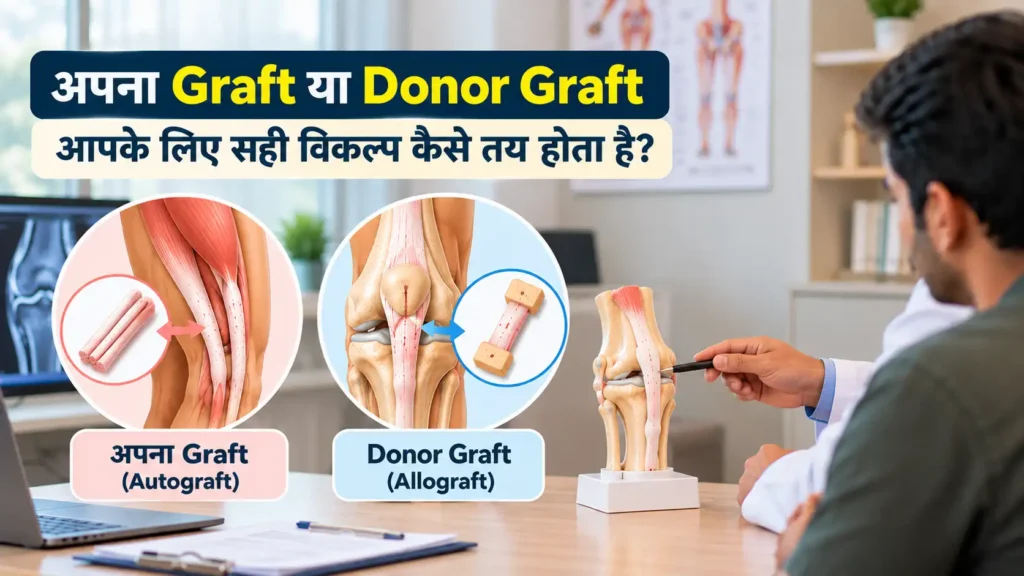
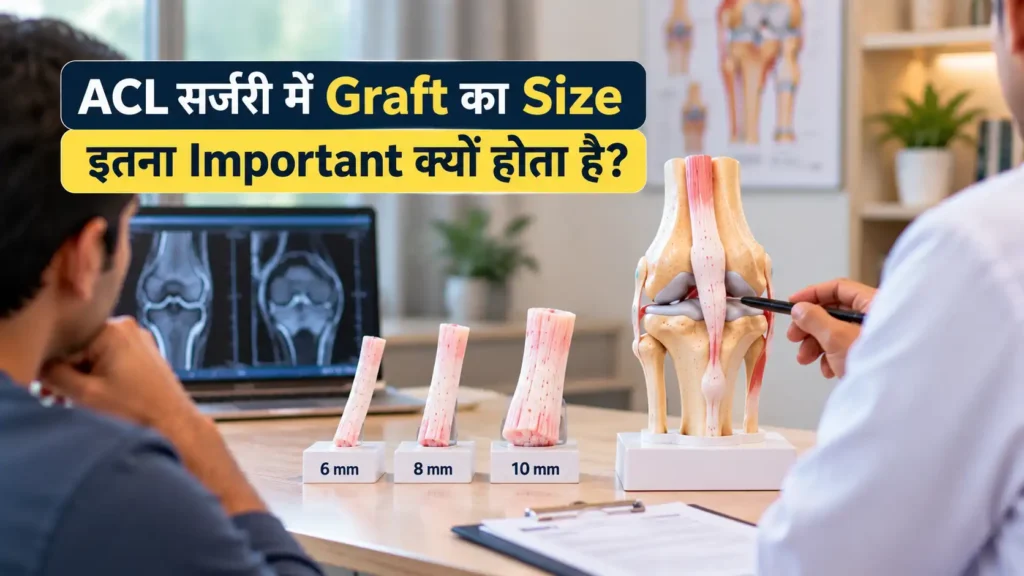
Because a torn ACL cannot simply be sutured end-to-end in most adult tears, ACL reconstruction replaces the torn ligament with a living tendon graft (autograft) harvested through a tiny cosmetic incision from your own leg. As documented in comparative orthopaedic studies on PubMed, graft diameter (ideally 8.0 mm to 9.5 mm+) and graft stiffness directly influence long-term stability. Dr. Prince Uchadiya tailors graft choice to your sport, kneeling habits, and anatomy:
| Autograft Option | Typical Graft Diameter & Strength | Key Clinical Advantages | Best Suited For |
|---|---|---|---|
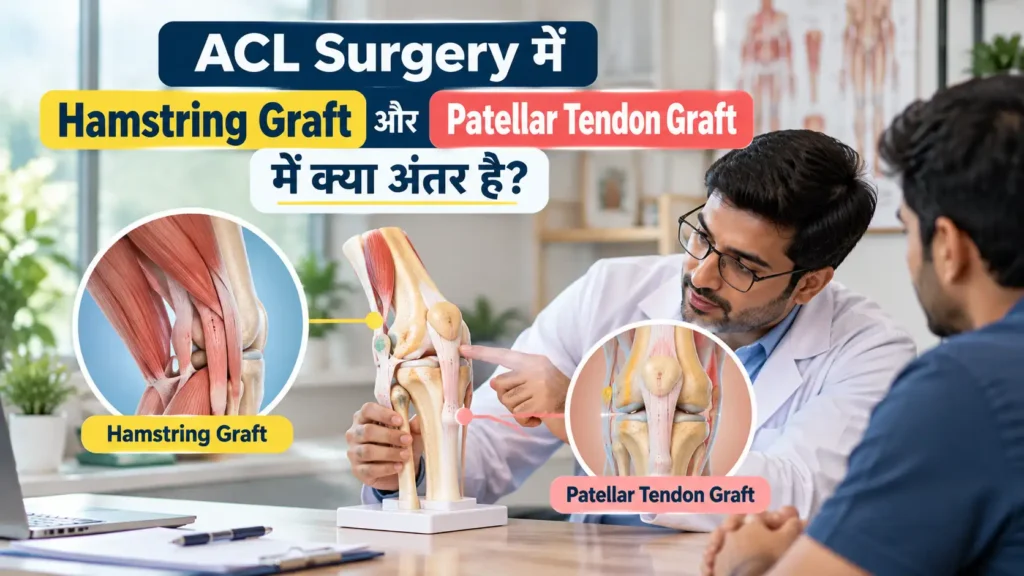
| Peroneus Longus Tendon Autograft (Full/Anterior Half) | Consistently thick (8.5 mm to 9.5+ mm); tensile strength exceeding native ACL | Preserves 100% of hamstring & quadriceps knee muscles; faster knee flexion recovery; minimal donor ankle morbidity | Gym athletes, runners, women with smaller hamstring tendons, and combined ligament tears (read full Peroneus Longus guide) |
| Quadrupled Hamstring Autograft (Semitendinosus + Gracilis) | 7.5 mm to 9.0 mm (4-strand or 5-strand braided configuration) | Small cosmetic incision; zero front-of-knee kneeling pain; time-tested global standard | Recreational athletes, office professionals, and patients who kneel frequently for prayer or floor sitting |
| Bone-Patellar Tendon-Bone (BTB) Autograft | 9.0 mm to 10.0 mm with bone plugs on both ends | Direct bone-to-bone tunnel healing in 6 weeks; extremely rigid under heavy cutting forces | High-impact contact athletes (kabaddi, football, wrestling) & revision ACL surgery |
| All-Inside ACL + FiberTape InternalBrace / LET Augmentation | Thick 4-strand single-tendon graft + high-strength suture tape or lateral tenodesis | Dual cortical suspensory buttons preserve bone stock; LET reduces rotational re-tear risk by 50%+ | High-grade pivot-shift knees, hypermobile joints (generalized laxity), and competitive pivoting athletes |
How Anatomical Keyhole ACL Reconstruction Works Step by Step
Before entering the operating theatre, we ensure acute injury swelling has calmed down and your knee can bend and straighten smoothly (“Pre-Hab”), which cuts post-operative stiffness risk in half. As outlined in clinical guides from Mayo Clinic, the procedure takes 45 to 75 minutes under comfortable spinal regional anaesthesia inside an accredited modular Laminar-Airflow OT:
- Diagnostic 4K Arthroscopy via Two 5mm Keyholes: A pencil-thin fiber-optic camera inspects the entire knee joint, grading the articular cartilage and checking the medial and lateral menisci under direct magnification.
- Meniscus Preservation First: If a meniscus tear is present in the vascular red-red or red-white zone, Dr. Prince repairs it using specialized All-Inside meniscal suture anchors rather than cutting the cushion out.
- Anatomical Independent Footprint Tunnel Placement: Instead of outdated vertical tunnels that leave the knee rotationally loose, the femoral and tibial sockets are drilled at the exact center of your native ACL footprints using an independent transportal technique.
- Rigid Cortical & Biocomposite Fixation: The prepared tendon graft is tensioned across the joint and locked on the femur with an adjustable cortical Titanium loop button (Endobutton / TightRope) and on the tibia with an imported osteoconductive Biocomposite interference screw (or dual-suspensory button). For a full breakdown of implant packages and cashless TPA rules, see our guide on ACL surgery cost in Indore.
Milestone-Based ACL Recovery Timeline: From Day 1 Walking to Return to Sport
Your new tendon graft undergoes a biological transformation called ligamentization over 6 to 9 months, where your body revascularizes and remodels the tendon into a living ligament. Progression through our physiotherapy after ACL surgery protocol in Indore is governed by objective strength milestones rather than arbitrary calendar dates:
| Recovery Phase & Timeframe | Weight-Bearing & Brace Protocol | Range of Motion & Strength Targets | Functional Milestones Unlocked |
|---|---|---|---|
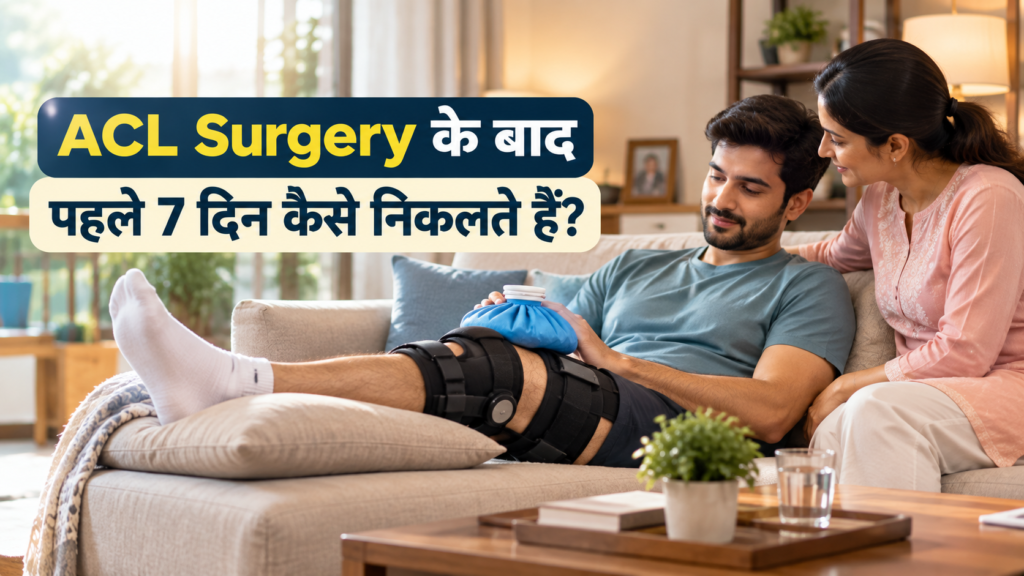
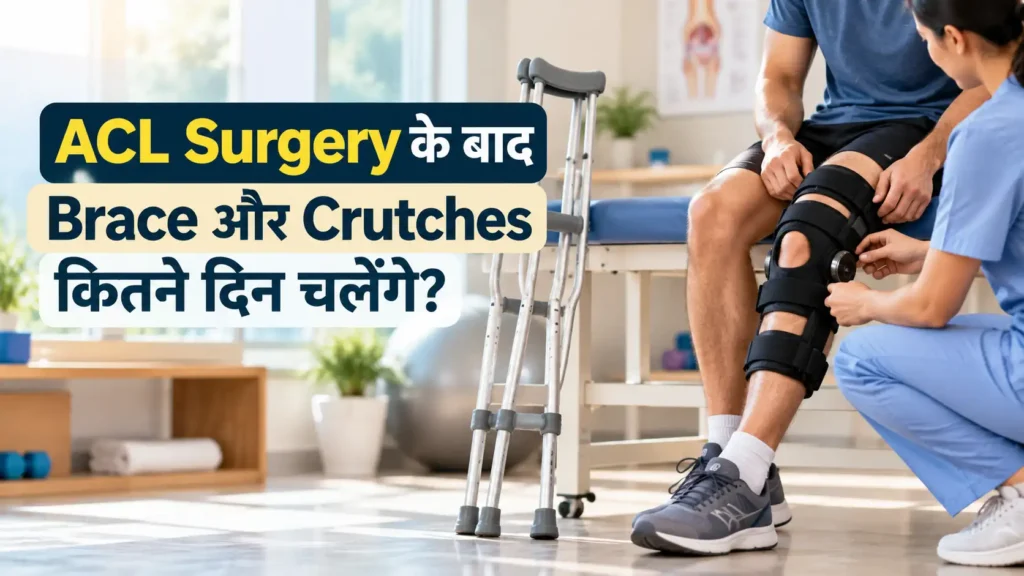
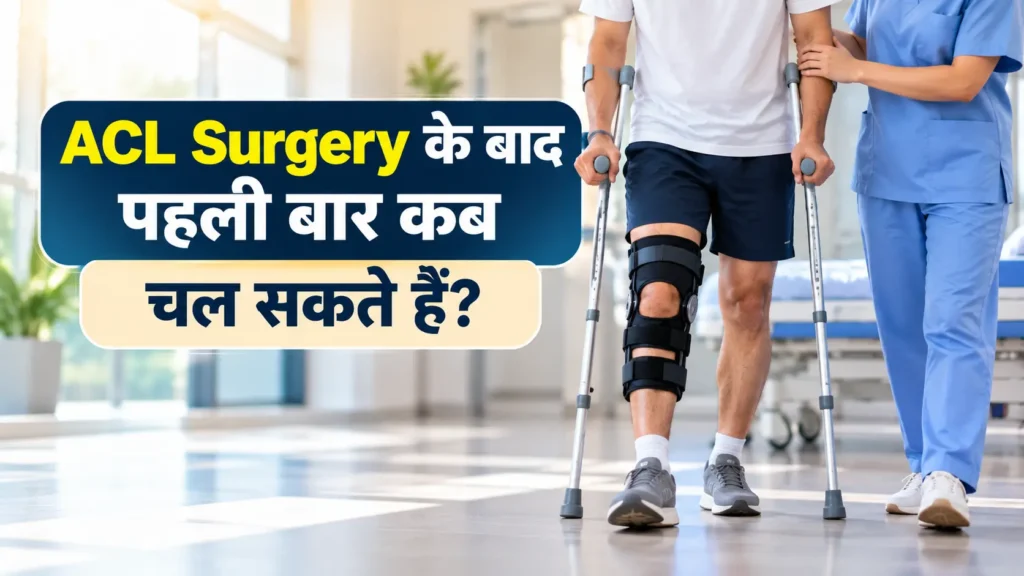
| Phase 1: Weeks 1 to 2 (Acute Protection) | Full weight-bearing with walker/crutches + long knee brace (for isolated ACL; protected if meniscus root repaired) | Lock in 0-degree full knee extension immediately; bend to 90 degrees by Day 14; active quad sets & SLR without lag | Walking to the washroom on Day 1; suture removal at Day 12 to 14; work-from-home desk duties |
| Phase 2: Weeks 3 to 6 (Gait Normalization) | Wean off crutches by Week 2-3; transition out of brace once quadriceps control is solid | Knee flexion reaches 120 to 130+ degrees; closed-chain mini-squats (0 to 45 degrees) & stationary cycling | Independent walking without a limp; driving a car/two-wheeler (Weeks 4 to 6); returning to office work |
| Phase 3: Weeks 7 to 12 (Neuromuscular Rebuild) | Brace-free daily life | Full symmetrical knee bending; leg press, Romanian deadlifts, step-ups, and single-leg balance board training | Brisk walking, swimming (flutter kick), climbing stairs reciprocally without handrail support |
| Phase 4: Months 3 to 6 (Running & Agility) | Sport-specific functional training | Quadriceps strength reaches 75% to 85% of uninjured leg; eccentric deceleration & ladder drills | Straight-line jogging on track/treadmill at Month 3 to 4; controlled sub-maximal agility |
| Phase 5: Months 6 to 9+ (Return to Competitive Sport) | Cleared for full pivoting & contact sports after hop test pass | Limb Symmetry Index (LSI) >90% on single-leg hop, triple hop, and crossover hop tests + psychological readiness | Full return to competitive cricket, football, badminton, basketball & heavy gym training (with ongoing injury prevention) |
Pre-Operative Rehabilitation (“Pre-Hab”): Why 10 Days of Preparation Doubles ACL Recovery Speed
One of the most important differences between modern sports medicine and outdated orthopaedic practice is when ACL surgery is scheduled after an acute injury. Unless you have a locked bucket-handle meniscus tear that physically blocks your knee from straightening, rushing into the operating room within 48 hours of an ACL twist, when the knee is hot, swollen with blood, and stiff, dramatically increases the risk of post-operative scar tissue (arthrofibrosis).
At Dr. Prince Uchadiya Orthopaedic & Joint Care Clinic, we follow the international “Quiet Knee Pre-Hab Rule” before performing keyhole ACL reconstruction. Over 7 to 14 days before surgery, our pre-operative ACL rehab protocol focuses on four clinical targets:
- Eliminating Acute Joint Effusion (Swelling): Using cryotherapy, elevation, compression, and gentle ankle/heel slides to flush inflammatory cytokines out of the synovial cavity.
- Restoring Full 0-Degree Knee Extension Before Surgery: Your ability to straighten your knee completely after surgery is directly predicted by whether you could straighten it before surgery.
- Achieving at Least 120 Degrees of Pain-Free Flexion: Entering the operating theatre with smooth knee bending means your quadriceps and joint capsule glide effortlessly from Day 1 post-op.
- Waking Up Quadriceps Firing Ahead of Time: Practicing isometric quad sets and straight-leg raises before anaesthesia trains your brain-to-muscle pathway so you can lift your leg on the very first morning after surgery.
Cashless Health Insurance, Corporate Mediclaim & 100% Implant Transparency in Indore
Patients travelling from across Indore, Ujjain, Dewas, Ratlam, Dhar, and Khandwa frequently ask whether advanced arthroscopic ACL reconstruction using imported Smith & Nephew, Arthrex, Stryker, or Zimmer Biomet implants is covered by health insurance. Yes, ACL reconstruction is a medically necessary reconstructive procedure covered under all major corporate group policies and retail health insurance plans (including Star Health, HDFC ERGO, ICICI Lombard, Niva Bupa, Care Health, and Tata AIG), as well as MP Government employee reimbursement schemes.
Every patient operated on by Dr. Prince Uchadiya receives two non-negotiable guarantees for lifelong peace of mind:
- Original Implant Barcode Stickers in Your Discharge File: You receive the physical manufacturer serial-number stickers of the exact femoral cortical button, tibial biocomposite interference screw, and meniscal repair anchors implanted in your knee, along with intra-operative 4K arthroscopic photographs showing your intact new graft.
- Defence, Police & Sports Medical Fitness Documentation: For army, SSB, and state police aspirants, or university athletes, we select fixation constructs and surgical incision placement tailored to medical fitness standards and document objective return-to-sport Limb Symmetry Index milestones.
How to Protect Your Graft and Keep Your Knee Strong for Decades
Completing surgery is step one; building lifelong quadriceps, hamstring, and hip stability is what keeps you playing pain-free in your 40s and 50s. Once you graduate from early rehab, follow our long-term blueprint on how to keep joints strong after surgery in Indore and support your healing cartilage matrix with evidence-based nutrition and targeted cartilage supplements where indicated.
If you have suffered a knee twist, heard a pop, or received an MRI showing an ACL tear, consult Dr. Prince Uchadiya at Nipania Main Road (4th Floor, Divyansh Square 2, Above Roshni Eye Hospital, 11:00 AM to 7:00 PM) or Kanadia Main Road near Bengali Square (7:00 PM to 9:00 PM). Book your consultation online or send your Knee MRI report on WhatsApp (+91 70457 04243) for a direct surgical and rehabilitation review.