From Hands to Precision Machines – How Orthopedics Has Evolved
A decade ago, orthopedic surgery relied solely on the surgeon’s steady hand, experience, and intuition. Today, that same surgeon is assisted by robots, sensors, and navigation systems that offer unmatched accuracy and control.
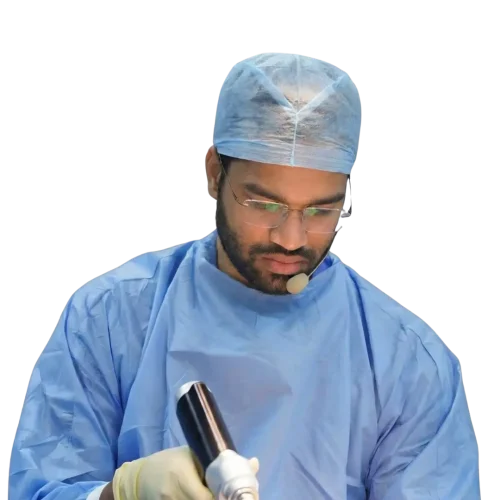
At Synovia Clinic, Indore, Dr. Prince Uchadiya, a Gold Medalist Orthopedic & Joint Replacement Surgeon, is at the forefront of this medical revolution.
He believes that technology doesn’t replace surgeons — it enhances their precision and safety, giving patients faster recovery and longer-lasting results.
“Robotics is not about replacing human skill — it’s about multiplying precision.”
— Dr. Prince Uchadiya
What Is Robotic Orthopedic Surgery?
Robotic orthopedic surgery uses advanced computer systems and robotic arms to assist surgeons during joint replacement or complex bone procedures.
It’s not a “machine doing surgery” — rather, the robot acts as an extension of the surgeon’s hands, ensuring that every cut, alignment, and implant is placed with millimeter-level accuracy.
This technology is especially useful for:
- Knee and Hip Replacements
- Spine Surgery
- Complex Fractures
- Arthroscopy and Sports Injuries
➡️ According to the American Academy of Orthopaedic Surgeons (AAOS), robotic-assisted joint replacements have shown improved implant positioning and patient satisfaction compared to conventional methods.
How Robotic Surgery Works – Step by Step
At Synovia Clinic, robotic joint replacements follow a three-phase process:
1️⃣ Pre-Surgical 3D Planning
- A detailed 3D CT scan of the joint is taken.
- The robot software maps the exact structure, deformities, and angles of your bone.
- Dr. Prince plans the procedure digitally — choosing the perfect implant size and position.
2️⃣ Robotic-Assisted Execution
- During surgery, the robotic arm guides the surgeon’s movements based on the pre-plan.
- It ensures bone cuts and implant placements are within a 1mm tolerance.
- Real-time feedback prevents even micro errors.
3️⃣ Post-Surgery Verification
- Navigation sensors verify alignment and ligament balance.
- The joint is tested for full motion and perfect fit before closure.
“It’s like GPS for surgery — every move is planned, guided, and verified.”
What Is Navigation-Assisted Orthopedic Surgery?
While robotics physically assists the surgeon, navigation systems act as digital guides.
They provide real-time 3D visualization of the surgical field, helping the surgeon track instruments and implants with extreme accuracy.
Navigation is widely used in:
- Knee & Hip Replacements
- Spine and Trauma Surgeries
- Arthroscopic Reconstructions
When combined with robotics, navigation gives surgeons eyes inside the body without making large incisions — ensuring accuracy, symmetry, and longevity of the implants.
Why Precision Matters in Orthopedics
Orthopedic surgeries rely heavily on angles, pressure, and alignment.
Even a few degrees of error in implant placement can lead to early wear, pain, or revision surgery.
Robotic and navigation-assisted systems minimize human variability and ensure:
- Perfect bone alignment
- Balanced joint movement
- Reduced implant wear
- Faster post-surgery mobility
A study in the Journal of Arthroplasty (NIH) found that robotic knee replacements improved alignment accuracy by 94% and reduced revision rates by 40%.
Benefits of Robotic & Navigation-Guided Orthopedic Surgery
| Advantage | Description |
|---|---|
| Higher Precision | Millimeter-level implant positioning ensures longevity. |
| Smaller Incisions | Minimally invasive approach means less pain and scarring. |
| Less Blood Loss | Controlled robotic guidance reduces trauma. |
| Faster Recovery | Early walking and discharge within 24–48 hours. |
| Better Functionality | Perfect alignment improves range of motion and comfort. |
| Long-Lasting Implants | Reduced wear ensures joint durability for 15–20 years. |
Recovery Timeline After Robotic Joint Replacement
| Phase | Duration | Focus |
|---|---|---|
| Phase 1: 0–2 weeks | Pain & swelling control | Begin gentle movement and basic walking |
| Phase 2: 2–6 weeks | Physiotherapy & muscle activation | Regain flexibility and coordination |
| Phase 3: 6–12 weeks | Strength building | Improve balance and mobility |
| Phase 4: 3–6 months | Full recovery | Resume normal life and low-impact sports |
“Robotics has reduced hospital stay and rehab time by nearly half for most patients.”
— Dr. Prince Uchadiya
Real Patient Story – “Precision That Changed My Life”
Case Study:
Ramesh, a 58-year-old businessman from Indore, struggled with severe knee arthritis for years.
After consulting at Synovia Clinic, he underwent robotic knee replacement under Dr. Prince’s care.“I was walking the next day — and within 3 weeks, I felt 20 years younger,” he recalls.
The post-surgery X-rays showed near-perfect implant alignment — something rarely achievable with traditional techniques.
Scientific Research & Global Evidence
- Robotic-assisted knee replacements show 30–40% faster recovery than traditional ones (AAOS).
- Implant alignment precision improves up to 95% (PubMed).
- Patient satisfaction rates are 15–20% higher with robotics (NIH Study).
- Navigation reduces human error and increases implant lifespan by up to 5 years (Mayo Clinic).
How Synovia Clinic Uses Robotics & Navigation in Surgery
At Synovia Clinic, Indore, Dr. Prince Uchadiya integrates robotic precision with human expertise, combining technology and trust.
- Robotic-Assisted Knee & Hip Replacements
- Computer-Navigation Guided Alignment
- Minimally Invasive Arthroscopic Surgery
- Integrated Physiotherapy for Faster Recovery
- AI-Based Pre-Surgical Planning & 3D Imaging
Every surgery is customized to your anatomy, ensuring maximum comfort, stability, and long-term results.
Common Myths About Robotic Orthopedic Surgery
| Myth | Fact |
|---|---|
| “The robot does the surgery, not the doctor.” | Robots assist — the surgeon remains in full control. |
| “It’s only for complex cases.” | It’s ideal for both simple and advanced joint replacements. |
| “It’s unsafe or experimental.” | Robotic surgery is FDA-approved and globally practiced. |
| “Recovery takes longer.” | Recovery is usually faster due to smaller incisions and less trauma. |
Why Choose Synovia Clinic for Robotic Orthopedic Surgery in Indore
- Gold Medalist Orthopedic & Arthroscopic Surgeon – Dr. Prince Uchadiya
- Advanced Robotic & Computer-Navigation Systems
- Modern Operation Theaters & Infection-Controlled Environment
- Precision with Compassion – Personalized Care for Every Patient
- Trained at KEM Hospital, Mumbai
- 150+ Successful Robotic Joint Replacements
At Synovia Clinic, every patient receives not just treatment — but a technological edge for faster, safer recovery.
FAQs – Robotics & Navigation in Orthopedic Surgery
Q1. Is robotic surgery safe?
Yes, robotic orthopedic surgery is highly safe and precise under expert supervision.
Q2. How is it different from traditional surgery?
Robotic systems ensure millimeter-level precision and smaller incisions, resulting in faster recovery.
Q3. Is it more expensive?
While slightly higher in cost, it reduces hospital stay and long-term complications — saving money overall.
Q4. Can all patients undergo robotic joint replacement?
Most cases qualify; the final decision depends on bone quality and joint condition.
Q5. What is the success rate?
Over 95% of patients report improved mobility and long-term satisfaction.