A 22-year-old kabaddi player from Indore came into the clinic having dislocated his left shoulder six times in eighteen months. The first time it happened during a game, the emergency room reduced it, he wore a sling for three weeks, and everyone called it bad luck. The second time happened two months later during training. By the fourth and fifth episodes, the shoulder was slipping out during something as ordinary as reaching for an object above his head. Before the sixth dislocation, he had begun avoiding using that arm altogether. By the time he reached Dr. Prince Uchadiya for recurrent shoulder dislocation surgery in Indore, significant labral damage had accumulated with each episode, and the glenoid bone had started to show measurable deficiency from repeated impacts. His story is not unusual. It is, in fact, a pattern seen repeatedly in young, active patients who are told to wait and see after a first shoulder dislocation, unaware that the risk of it happening again is not small. It is enormous.
This article explains exactly what causes a shoulder to keep dislocating, what happens inside the joint with each episode, when recurrent shoulder dislocation surgery in Indore is the right decision, and what the surgical and rehabilitation process looks like from beginning to return to sport.
Why the Shoulder Is the Most Unstable Large Joint in the Body
The shoulder joint is built for mobility at the expense of stability. The glenohumeral joint, the ball-and-socket articulation between the head of the humerus and the glenoid of the scapula, has the greatest range of motion of any joint in the human body. It can rotate, reach overhead, reach behind the back, and move through nearly 360 degrees of arc. This extraordinary mobility comes from a design where the glenoid socket is relatively shallow, covering only about a quarter of the humeral head surface at any given moment. Unlike the hip, where the femoral head sits deeply within the acetabulum, the shoulder ball sits more like a golf ball balanced on a golf tee.
What keeps the shoulder in place is not bony architecture but a combination of soft tissue structures: the glenoid labrum, a ring of fibrocartilage that deepens the socket and improves contact area; the glenohumeral ligaments, particularly the inferior glenohumeral ligament complex; the rotator cuff muscles, which actively centre the humeral head within the socket during movement; and the joint capsule, a fibrous sleeve surrounding the entire articulation. When these structures are intact and functioning together, the shoulder is stable through its full range of motion. When any of them are damaged or stretched beyond their elastic limits, instability follows.
What Happens Inside the Shoulder During the First Dislocation
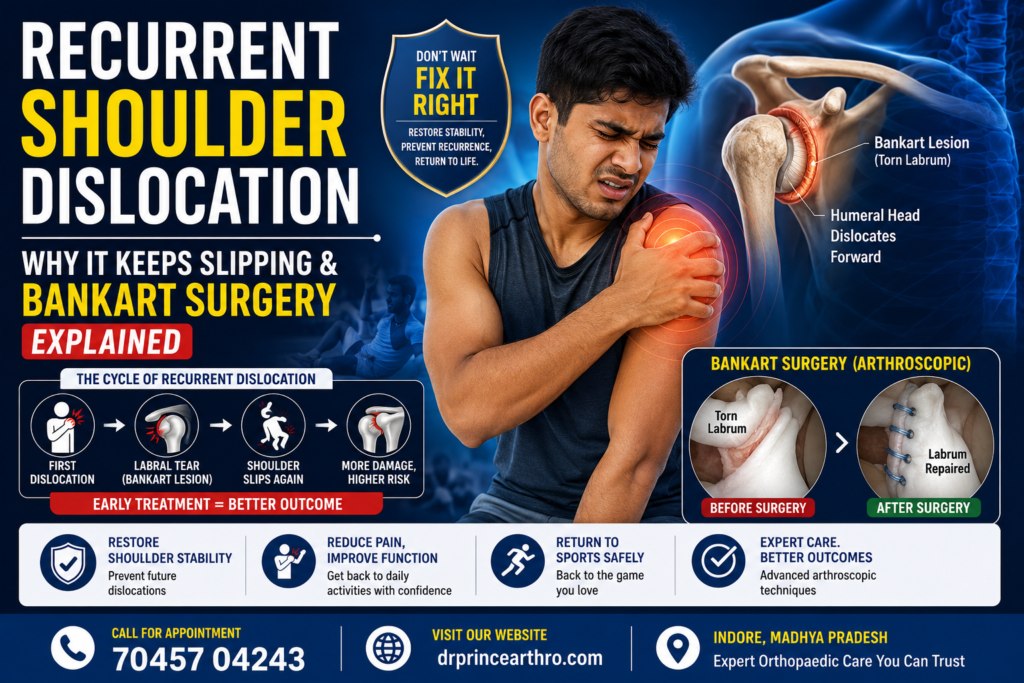
The most common direction of shoulder dislocation is anterior, meaning the humeral head slides forward out of the glenoid socket. This typically happens when the arm is forced into a position of abduction (raised to the side) and external rotation (rotated outward), as happens in a tackle, a fall on an outstretched hand, or a collision during sport. The forward displacement of the humeral head tears the anterior labrum away from the glenoid rim. This specific injury is called a Bankart lesion, and it is found arthroscopically in 94 to 100 percent of patients after an anterior shoulder dislocation.
The inferior glenohumeral ligament, which is the primary passive restraint against anterior dislocation with the arm in the at-risk position, is stretched or torn along with the labrum. In some patients, the impact of the humeral head against the glenoid rim also shears off a piece of glenoid bone, creating what is called a bony Bankart lesion. On the humeral side, the posterior surface of the humeral head is often compressed against the glenoid rim, creating a divot in the bone called a Hill-Sachs lesion. These two structural defects, the glenoid bone loss and the Hill-Sachs lesion, compound the instability created by the labral tear and significantly influence the choice of recurrent shoulder dislocation surgery in Indore.
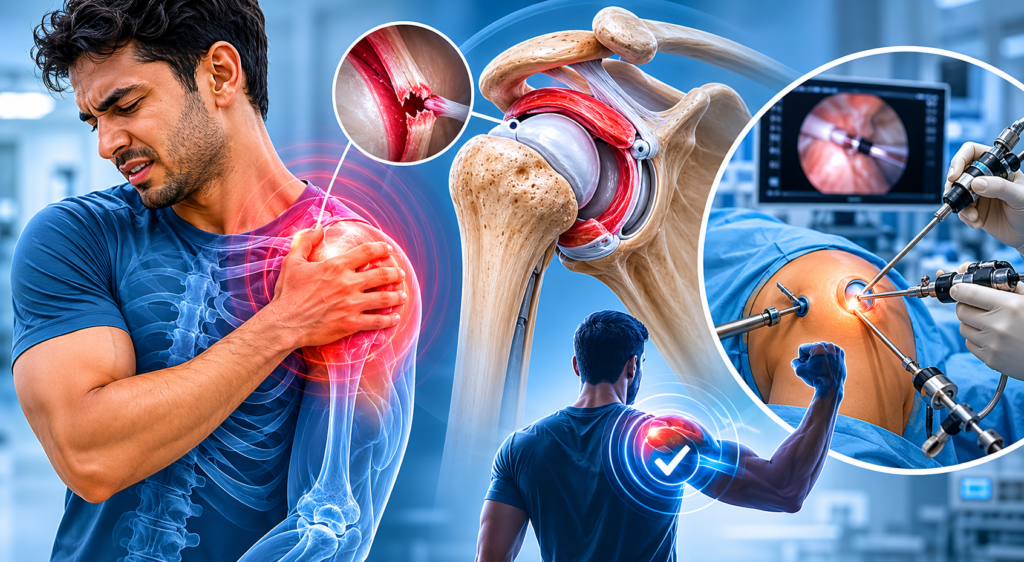
Why the Shoulder Becomes Unstable After the First Dislocation and Keeps Dislocating
Here is the central clinical reality that most patients are not told clearly enough in an emergency room: a Bankart labral tear does not heal reliably on its own. The labrum is a fibrocartilaginous structure with limited blood supply at its insertion point on the glenoid rim. When it is torn away from the bone during dislocation, it does not re-attach firmly enough to restore its original stability function in the majority of patients. The shoulder may feel comfortable after reduction and a period of sling immobilisation, but the anatomical restraint against the next dislocation has been compromised.
The result is a shoulder that is structurally predisposed to dislocate again. And the younger the patient, the higher that risk. Published research following 252 patients prospectively for five years found recurrence rates of 87 percent in patients aged 15 to 20, 74 percent in those aged 21 to 25, and 47 percent in those aged 26 to 30. For athletes under 30 years old who are not treated surgically after a first dislocation, recurrence rates in the literature range from 70 to 90 percent.
Every subsequent dislocation worsens the structural damage. The labrum tears further. The capsule stretches more. The glenoid bone loss progresses with each impact. A shoulder that has dislocated five times has measurably worse tissue quality and greater bone deficiency than one that has dislocated twice. This is why patients who delay recurrent shoulder dislocation surgery in Indore beyond the second or third episode frequently require more complex procedures, with less predictable outcomes, than those who are treated earlier.
The Bankart Lesion: The Core Reason Behind Recurrent Shoulder Dislocation
The Bankart lesion is the most important anatomical finding in the evaluation of recurrent shoulder instability, and understanding it is central to understanding why recurrent shoulder dislocation surgery in Indore is necessary for most active patients. When the labrum is torn and displaced from the glenoid rim, the socket effectively loses its raised rim on the anterior side. The inferior glenohumeral ligament, which attaches to the labrum and provides a critical check-rein against anterior dislocation, goes slack along with the torn labrum. The humeral head no longer has an adequate structural barrier against sliding forward when the arm is placed in the vulnerable position of abduction and external rotation.
In addition to the soft tissue Bankart lesion, some patients develop a bony Bankart lesion where repeated dislocations have chipped away a significant portion of the anterior glenoid rim. When glenoid bone loss exceeds 20 to 25 percent of the glenoid surface, arthroscopic Bankart repair alone is no longer sufficient, and the surgical approach needs to include bony augmentation, typically through the Latarjet procedure, where a piece of bone from the coracoid process is transferred to the glenoid to rebuild the rim and provide additional stability.
Recognising the Symptoms of Recurrent Shoulder Instability
The symptom pattern of recurrent shoulder dislocation is clinically distinctive, though patients often describe it in varied terms depending on whether they are experiencing full dislocations or partial dislocations called subluxations.
- The shoulder “going out” completely: Complete dislocation requires manual reduction, usually by a doctor or in an emergency setting. The shoulder is visibly deformed, the arm cannot be moved, and the pain at the time of dislocation is severe.
- Subluxation: The humeral head slides partially out and snaps back in spontaneously. Patients describe this as the shoulder “slipping” or “popping out and back in.” It is often associated with a flash of severe pain followed by an aching soreness and a feeling of weakness in the arm.
- Apprehension: A well-established symptom of anterior shoulder instability is the apprehension sign. When the arm is placed in the at-risk position of abduction and external rotation, the patient feels a sensation of impending dislocation and instinctively tightens the shoulder muscles to resist further movement. This apprehension often prevents full participation in sport or daily activities involving overhead or reaching movements.
- Aching pain at rest or with activity: The torn labrum and stretched capsule produce a persistent background ache in the shoulder, which worsens with activities that challenge the unstable joint.
- Weakness and loss of confidence in the shoulder: Patients begin to modify their activities, avoid certain arm positions, and lose confidence in the shoulder’s reliability, which progressively reduces their functional capacity and, in athletes, ends competitive participation.
Diagnosing Recurrent Shoulder Dislocation in Indore: What the Assessment Involves
When a patient presents to Dr. Prince Uchadiya with a history of recurrent shoulder dislocation in Indore, the assessment combines a structured clinical examination with specific imaging to characterise the full extent of the damage and determine the most appropriate surgical approach.
Clinical tests include the anterior apprehension test, which reproduces the patient’s instability sensation when the arm is placed in the at-risk position, and the relocation test, where posterior pressure on the humeral head during this maneuver relieves the apprehension. The load and shift test assesses the degree of anteroposterior translation of the humeral head within the socket. Together, these tests provide a reliable clinical picture of the direction and degree of instability.
Plain X-rays are ordered to assess for glenoid bone loss and to identify Hill-Sachs lesions on the humeral head. An MRI scan, with intra-articular contrast (MRI arthrogram) in selected cases, provides detailed imaging of the labrum, capsule, glenohumeral ligaments, and rotator cuff. CT scanning with three-dimensional reconstruction is used when significant glenoid bone loss is suspected, as it provides the most accurate quantification of bone deficiency, which directly determines whether arthroscopic Bankart repair alone is appropriate or whether a bony augmentation procedure such as the Latarjet is required.
Where the cuff is torn alongside the instability, rotator cuff tear changes what the repair has to achieve.
Recurrent Shoulder Dislocation Surgery in Indore: Bankart Repair and Beyond
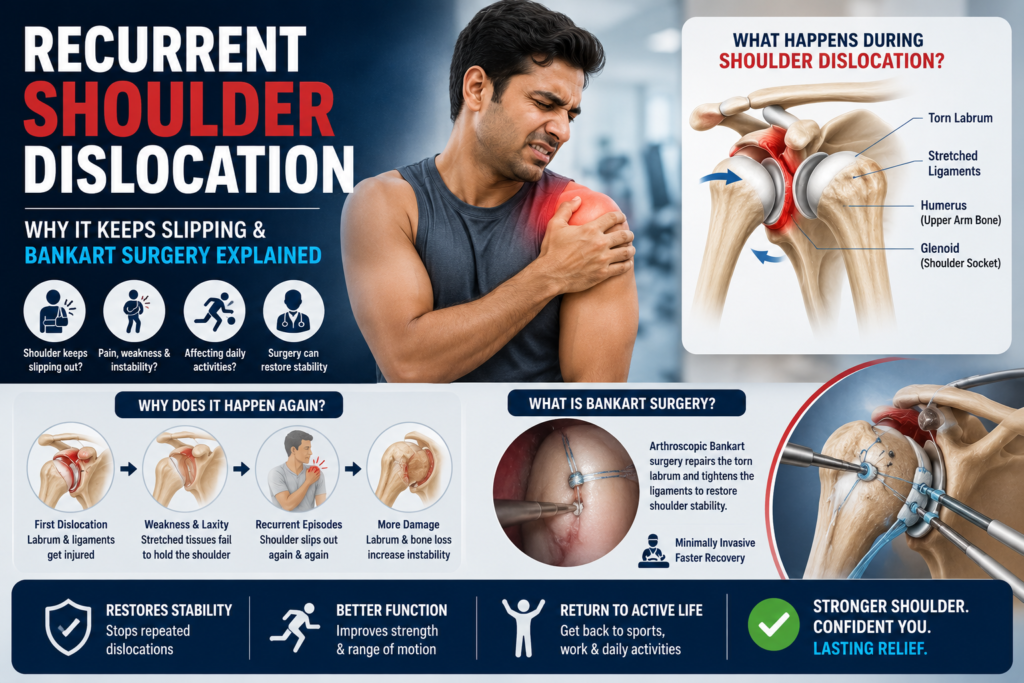
For patients with recurrent shoulder dislocation in Indore who have a Bankart lesion with acceptable glenoid bone stock, arthroscopic Bankart repair is the surgical procedure of choice. It is the gold standard operation for restoring shoulder stability in patients with anterior instability caused by labral tears and capsular laxity.
What Arthroscopic Bankart Repair Involves
Arthroscopic Bankart repair is performed under general anaesthesia through two or three small incisions around the shoulder, through which a camera and precision instruments are introduced into the joint. The torn labrum is identified, the glenoid rim is prepared to provide a fresh healing surface, and the labrum is re-attached to the bone using small titanium or bioabsorbable suture anchors that are placed into the glenoid rim. Multiple anchors are typically placed to restore the labral bumper along the anterior and inferior glenoid. The capsule is simultaneously tightened to eliminate the excess laxity that has accumulated from repeated dislocations. The joint is then tested through the full range of motion to confirm stability before the incisions are closed.
Because the surgery is arthroscopic, it involves very small incisions, less disruption of surrounding muscles compared to open surgery, lower infection risk, and faster initial recovery. Patients undergoing recurrent shoulder dislocation surgery in Indore with Dr. Prince Uchadiya benefit from the arthroscopic approach through the arthroscopic surgery facility available at the clinic, which is equipped for the full range of shoulder arthroscopic procedures.
When a Latarjet Procedure Is Needed Instead
When glenoid bone loss exceeds approximately 20 to 25 percent of the glenoid surface area, or when a significant engaging Hill-Sachs lesion is present that will engage against the glenoid rim during normal shoulder movements, arthroscopic Bankart repair alone has unacceptably high recurrence rates. In these cases, the Latarjet coracoid transfer procedure is indicated. The coracoid process, a bony projection from the scapula, is transferred with its attached conjoint tendon to the anterior glenoid rim, where it simultaneously rebuilds the missing glenoid bone and provides a dynamic sling effect from the conjoined tendon that prevents anterior humeral head translation. The Latarjet procedure is highly effective for cases with significant bone deficiency and has lower recurrence rates than Bankart repair alone in this specific group.
Recovery After Recurrent Shoulder Dislocation Surgery in Indore
Recovery from arthroscopic Bankart repair follows a staged rehabilitation program that balances protecting the healing labral repair against the need to restore range of motion, strength, and sport-specific function. The labrum re-attaches to the glenoid bone over a period of six to twelve weeks, and this healing phase must be protected through careful restriction of movements that would stress the repair during this window.
For the first four weeks, the arm is maintained in a sling, with pendulum exercises and gentle passive range-of-motion work as directed by the physiotherapy team. Active forward flexion is permitted, but external rotation is restricted based on the specific repair performed. From weeks four to eight, the sling is progressively discontinued and active range of motion exercises are progressed. Rotator cuff strengthening begins at this stage. From weeks eight to twelve, strengthening progresses in both intensity and specificity, proprioceptive training is introduced, and functional movement patterns relevant to the patient’s activities are incorporated.
Return to non-contact training is typically permitted at four to five months post-surgery. Return to full contact sport is generally cleared at six months or later, contingent on meeting objective strength and functional criteria. The structured recovery pathway for patients following recurrent shoulder dislocation surgery in Indore continues through the post-injury rehabilitation program available at Dr. Prince Uchadiya’s clinic, ensuring each phase of recovery is guided and progressed appropriately.
What Happens If Recurrent Shoulder Dislocation Is Left Untreated
The consequences of leaving recurrent shoulder dislocation untreated for years are well-documented and serious. Each additional dislocation episode causes further labral tearing, progressive capsular stretching, worsening glenoid bone loss, and additional Hill-Sachs lesion enlargement. The cumulative damage from repeated dislocations means that the tissue quality available for surgical repair deteriorates with each episode. Research shows a dose-dependent relationship between the number of dislocations before surgery and the rate of recurrent instability after surgery. Patients who have had ten dislocations face a significantly harder surgical challenge and worse outcomes than those treated after two or three.
Beyond the immediate structural damage, recurrent shoulder instability leads to compensatory muscle patterns and avoidance behaviours that weaken the rotator cuff and impair the dynamic stabilisation of the joint. Over years, the cumulative damage accelerates glenohumeral arthritis. Published research found that 22.7 percent of patients with recurrent anterior shoulder instability developed clinically significant glenohumeral osteoarthritis at an average follow-up of less than a decade. In some cases, long-standing instability and progressive articular damage eventually leads to a joint that requires shoulder replacement surgery, a far more complex intervention than the Bankart repair that could have solved the problem years earlier.
More information about shoulder replacement, which becomes relevant in cases of advanced glenohumeral arthritis secondary to years of untreated instability, is available on the shoulder replacement surgery page. The clear clinical message is that recurrent shoulder dislocation surgery in Indore is not something to defer indefinitely. Earlier intervention produces more predictable results with simpler procedures.
Frequently Asked Questions About Recurrent Shoulder Dislocation Surgery in Indore
1. What is recurrent shoulder dislocation and why does it keep happening?
Recurrent shoulder dislocation is a condition where the shoulder joint dislocates repeatedly after the first episode. It keeps happening because the first dislocation typically tears the glenoid labrum, a ring of fibrocartilage that deepens the shoulder socket and anchors the primary stabilising ligaments. This structure, called the Bankart lesion when torn, does not reliably heal back to its original position on its own. Without this intact bumper, the shoulder socket is effectively shallower and the stabilising ligaments are slack, making the humeral head vulnerable to sliding forward out of the joint whenever the arm is placed in certain positions. Each subsequent dislocation causes further labral damage and capsular stretching, worsening the instability progressively.
2. Why does a shoulder become unstable after the first dislocation?
After the first dislocation, the anterior labrum is torn from the glenoid rim and the inferior glenohumeral ligament is stretched or disrupted. These are the primary passive restraints against anterior dislocation. When they are compromised, the shoulder no longer has an adequate anatomical barrier against the humeral head sliding forward in the at-risk position of abduction and external rotation. The muscles of the rotator cuff can compensate to some degree through active stabilisation, but during rapid movements, sport, or unexpected positions, this muscular defence is insufficient without the structural integrity of the intact labrum and capsular ligaments. This is why physiotherapy alone has high failure rates in young, active patients after a first anterior dislocation.
3. What causes repeated shoulder slipping or shoulder popping out again and again?
The cycle of repeated slipping occurs because the anatomical cause of the first dislocation, the Bankart labral tear, remains unrepaired. Each time the shoulder subluxates or dislocates, additional labral fibres tear, the capsule stretches further, and in some cases, glenoid bone is eroded from the repeated impact of the humeral head against the rim. This progressive structural deterioration makes the shoulder increasingly easy to dislocate, eventually to the point where minor movements, reaching overhead, turning over in bed, or lifting a light object are sufficient to produce instability. The shoulder is not healing between episodes. It is accumulating damage.
4. Can shoulder dislocation heal completely without surgery?
A first-time shoulder dislocation in an older, low-activity patient may be successfully managed with physiotherapy and activity modification, as recurrence rates are significantly lower in this demographic. However, for patients under 30, for athletes in contact or overhead sports, and for anyone who has already experienced two or more dislocations, the probability of achieving lasting stability without surgical repair of the Bankart lesion is very low. Research shows recurrence rates of 70 to 90 percent in young patients managed conservatively after a first dislocation. Once instability is established and multiple episodes have occurred, physiotherapy can improve muscle strength and proprioception but cannot repair the torn labrum or restore the glenoid bone loss that has accumulated.
5. What are the common symptoms of recurrent shoulder instability?
The most characteristic symptom is apprehension: a sensation that the shoulder is about to dislocate when the arm is moved into the at-risk position of abduction and external rotation, such as throwing, reaching overhead, or sleeping with the arm behind the head. Patients often instinctively avoid these positions. Other symptoms include episodes of complete dislocation requiring reduction, partial dislocations or subluxations where the shoulder slips and returns spontaneously, persistent aching pain in the front and outer shoulder, clicking or clunking sensations during movement, and progressive weakness and reduced confidence in the shoulder’s reliability during sport or work. The pattern of apprehension with specific arm positions, combined with a history of previous dislocations, is highly specific for anterior shoulder instability.
6. Why does shoulder dislocation sometimes happen during sleep or minor movements?
When the capsule has been sufficiently stretched and the labral tear is extensive enough, the threshold for dislocation becomes very low. The shoulder can slip during sleep because the muscles that actively stabilise the joint are fully relaxed, removing the muscular compensation that normally protects an unstable shoulder during waking activity. Similarly, minor movements that place the arm in an at-risk position, even momentarily, can exceed the reduced threshold for dislocation in a shoulder with significant capsular laxity and bone deficiency. When a patient describes dislocating during sleep or with trivial movements, it indicates that the structural damage has reached a stage where the passive restraints alone are completely insufficient, and this is a strong indication for recurrent shoulder dislocation surgery in Indore without further delay.
7. Can physiotherapy prevent repeated shoulder dislocation?
Physiotherapy improves rotator cuff strength, neuromuscular control, and proprioception, all of which contribute to the dynamic stabilisation of the shoulder. For patients with lower-grade instability, mild capsular laxity without a significant labral tear, or multidirectional instability without a traumatic anatomical lesion, physiotherapy is the first-line treatment and can produce meaningful reduction in instability symptoms. However, for patients with a confirmed Bankart tear, significant capsular stretching, and a history of multiple traumatic dislocations, physiotherapy cannot repair the structural damage. It can reduce instability frequency but rarely eliminates it in high-demand patients. The research consistently shows that physiotherapy alone in young, active patients with anterior instability from a Bankart lesion results in very high recurrence rates over two to five years.
8. How many shoulder dislocations are too many before surgery is needed?
There is no universally agreed-upon threshold, but clinical evidence and expert consensus increasingly support early surgical intervention in young, active patients, sometimes even after the first dislocation in a high-risk athlete. The reason is straightforward: each dislocation worsens the structural damage, reduces the tissue quality available for repair, and increases the complexity of the eventual surgery. Research demonstrates a dose-dependent relationship between the number of pre-operative dislocations and the rate of post-operative recurrence. Practically, most orthopaedic surgeons recommend considering recurrent shoulder dislocation surgery in Indore after two confirmed dislocations in an active patient under 30, or after a first dislocation in a high-demand athlete in a contact or throwing sport. The decision is always individualised based on the patient’s age, activity level, structural findings on imaging, and functional goals.
9. What is a Bankart lesion and how is it related to shoulder dislocation?
A Bankart lesion is a tear of the anterior glenoid labrum, specifically at its attachment to the anterior-inferior glenoid rim, that typically occurs during an anterior shoulder dislocation. The labrum at this location is the primary anatomical anchor for the inferior glenohumeral ligament, which is the most important passive restraint against anterior dislocation. When the Bankart lesion is present and the labrum remains detached, the glenoid socket is functionally shallower, the ligament is non-functional, and the shoulder is structurally prone to repeat dislocation in the at-risk position. The Bankart lesion is found arthroscopically in 94 to 100 percent of patients after an anterior shoulder dislocation, which is why it is considered the pathological basis for anterior shoulder instability. Repairing it surgically is the core goal of Bankart repair.
10. What is Bankart surgery and when is it recommended?
Bankart surgery is an arthroscopic procedure in which the torn labrum is reattached to the glenoid rim using suture anchors, simultaneously restoring the anatomical labral bumper and the tension of the inferior glenohumeral ligament. The capsule is also tightened during the procedure to eliminate the excess laxity from prior dislocations. It is recommended for patients with confirmed anterior shoulder instability from a Bankart lesion who have had two or more dislocations, for athletes in contact or overhead sports who have had even a first dislocation with labral tear on MRI, for patients whose shoulder instability has not responded to a full physiotherapy program, and for anyone whose instability is significantly affecting their occupational or sporting function. When glenoid bone loss is greater than 20 to 25 percent, a Latarjet procedure is recommended instead or in addition.
11. Can Bankart surgery restore shoulder stability permanently?
Arthroscopic Bankart repair produces excellent long-term stability in appropriately selected patients. In patients with recurrent shoulder dislocation surgery in Indore performed by an experienced specialist, recurrence rates after arthroscopic Bankart repair are 10 to 20 percent in active athletes in contact sports and 3 to 7 percent in the broader non-contact patient population. The outcome depends on patient selection (excluding cases with excessive bone loss who need a Latarjet), surgical technique and the number of anchors used, and patient compliance with the post-operative rehabilitation protocol and return-to-sport criteria. Patients who return to full contact sport before completing the rehabilitation program face higher recurrence rates. Most patients can expect a stable shoulder that allows full participation in sport and daily activities after appropriate recovery.
12. How long does recovery take after Bankart surgery?
Recovery after arthroscopic Bankart repair typically follows a six-month timeline before return to full contact sport, though basic daily activities and non-contact training are permitted progressively earlier. The arm is kept in a sling for four weeks to allow the repaired labrum to begin healing securely to the glenoid bone. Range-of-motion exercises and physiotherapy begin immediately but are progressed carefully to avoid stressing the repair during the critical healing window of the first six to eight weeks. Strengthening progresses from weeks eight to twelve, with sport-specific functional training introduced at three to four months. Clearance to return to full contact sport is given at six months or later, based on objective criteria rather than time alone. The Latarjet procedure follows a slightly different timeline with a somewhat faster return to non-contact activity in some cases.
13. When can patients return to gym, sports, or daily activities after Bankart surgery?
Light lower-body gym work and walking can begin within two to three weeks of surgery. Upper-body exercises that do not load the operated shoulder are typically permitted from six to eight weeks. Shoulder-specific strengthening with light resistance begins at eight to twelve weeks. Returning to overhead gym exercises, throwing sports, and non-contact training is generally permitted at four to five months when functional criteria are met. Return to full contact sport, including tackling, grappling, and overhead collision activities, requires clearance at six months post-surgery and is contingent on passing objective strength symmetry and functional testing rather than on the time elapsed alone. Patients in physically demanding occupations receive specific guidance on returning to work activities that involve shoulder loading.
14. Can shoulder dislocation cause ligament tears or other shoulder damage?
Yes. A shoulder dislocation is not an isolated labral injury in many patients. The same force that tears the Bankart labrum frequently stretches or partially tears the inferior glenohumeral ligament, stretches the joint capsule, and can cause a Hill-Sachs compression fracture on the posterior humeral head. In older patients, anterior shoulder dislocation is commonly associated with rotator cuff tears, particularly of the subscapularis and supraspinatus tendons, because these tendons must absorb significant force when the humeral head dislocates anteriorly. Axillary nerve injury is another recognised complication of anterior dislocation, producing temporary numbness and weakness over the outer shoulder. This is why an MRI assessment after any shoulder dislocation in an older patient is important to identify additional soft tissue damage that may need separate management.
15. What happens if recurrent shoulder dislocation is left untreated for years?
The long-term consequences of untreated recurrent shoulder dislocation are progressive and serious. With each dislocation, glenoid bone loss worsens, the labral tissue deteriorates in quality, the capsule becomes permanently stretched and ineffective, and the Hill-Sachs lesion on the humeral head enlarges. Eventually, the cumulative bone and soft tissue damage makes even a previously straightforward Bankart repair insufficient, and the patient requires a more complex Latarjet bone transfer procedure. Beyond the surgical implications, the chronic instability and abnormal mechanics produced by long-standing untreated dislocation accelerate cartilage wear in the glenohumeral joint. Published research found that 22.7 percent of patients with recurrent anterior instability develop clinically significant glenohumeral arthritis within a relatively short follow-up period, eventually leading to the need for shoulder replacement surgery. The patient who could have had a one-hour arthroscopic Bankart repair at age 22 may face shoulder replacement surgery at age 45 if the condition is left untreated for decades.
If your shoulder has dislocated more than once, if it slips partially during activity or sleep, or if you feel apprehension every time you raise your arm in certain positions, do not continue waiting for it to stabilise on its own. Every additional episode makes the eventual surgery more complex and the outcome less predictable. Book a consultation with Dr. Prince Uchadiya for recurrent shoulder dislocation surgery in Indore and get a proper assessment of the labral damage, glenoid bone stock, and the most appropriate surgical plan to restore lasting shoulder stability.