Key Takeaways
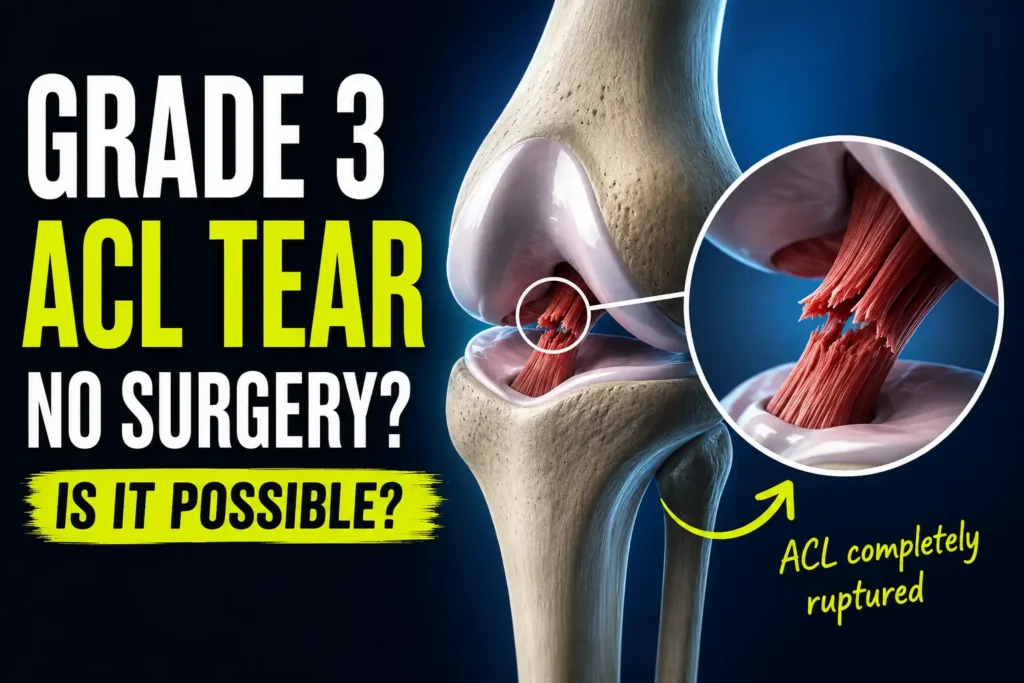
- Grade 3 means the ACL is completely ruptured. No fibres bridge the gap. Grade 3 is the most severe classification, and it is also the classification most commonly assumed to require automatic surgery. That assumption is not entirely accurate.
- A 2023 meta-analysis published in PMC found that in the landmark KANON trial, 39% of patients assigned to rehabilitation-first eventually crossed over to surgery within 2 years. That number climbed to 51% by year 5.
- Roughly half of patients who try grade 3 ACL tear no surgery management genuinely stay off the operating table for at least 5 years. The other half do not, usually because instability or new meniscal damage forces the decision.
- Orthopaedic specialists split grade 3 patients into two groups: copers, whose muscles compensate well enough to avoid giving-way episodes, and non-copers, whose knee remains unreliable no matter how much they train.
- One orthopaedic surgeon who personally lives with an untreated grade 3 tear for 15 years put it plainly in a published account: some patients bike, hike, and ski without issue, while others feel their knee give out on stairs. Both outcomes happen with the identical grade of injury.
Grade 3 ACL tear no surgery decisions rarely come down to a single test result. Two patients. Same MRI finding. Same words on the report: “complete rupture of the anterior cruciate ligament.” One goes on to run half-marathons for a decade without a single problem. The other cannot climb a flight of stairs without their knee buckling within six months.
How can identical damage produce such different lives?
The grading system tells you how torn the ligament is. It does not tell you how your specific knee will function afterward. That distinction is the entire subject of this article.
What “Grade 3” Actually Means on Your MRI Report
ACL injuries are classified into three grades based on how much of the ligament is disrupted:
- Grade 1: The ligament is stretched but the fibres remain continuous. Think of a rope that has been pulled hard but not snapped. Stability is usually preserved.
- Grade 2: Some fibres are torn, others remain intact. The ligament is partially functional. Stability is reduced but not absent.
- Grade 3: Complete disruption. The ligament splits into two separate pieces. No fibres bridge the gap. On clinical examination, this shows up as a Lachman test with no firm endpoint at all.
Here is what many patients researching grade 3 ACL tear no surgery outcomes do not realise: the grade describes the anatomy, not the outcome. A grade 3 tear in a sedentary 58-year-old and a grade 3 tear in a 19-year-old competitive footballer are the same injury on paper and completely different clinical problems in real life.
Why Grade 3 Tears Were Once Considered an Automatic Surgery Sentence
For decades, orthopaedic teaching was straightforward: complete ACL tears do not heal, so complete tears need reconstruction. This logic made sense on the surface. The synovial fluid inside the knee dissolves the blood clot that would normally scaffold tissue repair. No scaffold, no healing. Case closed.
Except the case was never quite that simple. Two things complicate the old rule.
First, “healing” and “functioning” are different outcomes. The ligament tissue itself may never reconnect structurally. But the surrounding muscles, tendons, and nervous system can adapt enough to provide functional stability for many daily activities and even some sports. The ligament itself has not healed. The body has simply built a workaround.
Second, research on the torn stump itself revealed something unexpected. In some patients, the proximal end of the torn ACL scars down onto the posterior cruciate ligament (PCL), creating a structure that provides partial mechanical restraint. It is not a normal ACL. But it is not nothing either.
The Coper and Non-Coper Split: Why Two Identical Injuries Diverge
Orthopaedic research has landed on a useful, if imperfect, way to describe why some grade 3 patients thrive without surgery while others do not: the coper classification.
A coper is someone whose neuromuscular system adapts well enough to an ACL-deficient knee that they experience minimal to no functional instability during their normal activities. Their quadriceps, hamstrings, and hip muscles essentially take over the job the ACL used to do, at least for straight-line and low-demand movements.
A non-coper is someone whose knee continues giving way regardless of how much strength they build. No amount of quad training resolves the instability. Every attempt to increase activity results in another buckling episode.
The uncomfortable truth is that you cannot fully predict which group a patient belongs to on day one. It takes a structured trial of rehabilitation, typically 3 to 6 months, with objective testing at each checkpoint, to find out.
Dr. Prince Uchadiya, DNB Orthopaedics Gold Medalist, Orthopaedic and Arthroscopic Surgeon: “I have had patients walk into my clinic convinced they were ‘coping fine’ with a grade 3 tear, only for the clinical examination to reveal significant laxity they had simply stopped noticing because they had unconsciously changed how they walked, sat, and moved. Compensation can hide instability from the patient without actually removing the risk to the joint.”
The Numbers Behind Grade 3 ACL Tear No Surgery: What the KANON Trial Actually Showed
The most rigorous evidence on this exact question comes from the KANON trial, a randomised controlled study that followed young, active patients with acute ACL ruptures for five years. Patients were assigned to either early reconstruction or a rehabilitation-first strategy with the option of delayed surgery if instability persisted.
The results, summarised in a 2023 meta-analysis, tell a nuanced story:
| Timepoint | Rehab-First Patients Who Crossed to Surgery | Patients Who Remained Surgery-Free |
|---|---|---|
| 2 years | 39% | 61% |
| 5 years | 51% | 49% |
Read that carefully. Nearly half of patients who chose rehabilitation-first genuinely avoided surgery for at least 5 years. That is a meaningful proportion, not a rare exception. But it is also not the majority long-term outcome, and the trend moved toward more crossovers over time, not fewer.
That is the honest picture of grade 3 ACL tear no surgery outcomes: real, achievable for roughly half of carefully selected active patients, but genuinely uncertain at the individual level.
For the half it does not work for, ACL reconstruction surgery remains the reliable route.
Who Actually Succeeds Without Surgery: The Realistic Profile
Grade 3 ACL tear no surgery management works best for a specific patient profile. Based on the accumulated evidence and clinical experience, these patients share specific characteristics:
- Lower baseline activity level. Patients who do not need their knee to pivot, cut, or jump at high intensity have a lower functional bar to clear.
- No meniscal damage at diagnosis. An intact meniscus means the shock-absorbing structure is still in place. This matters enormously for long-term joint health.
- Strong baseline quadriceps. Patients who were already physically active and muscular before injury adapt faster and more completely during rehabilitation.
- Good psychological adaptation. Willingness to genuinely modify activity, rather than quietly hoping to return to the exact same sport at the exact same intensity, correlates with better long-term outcomes.
- Older age. Patients over 35 to 40 generally have fewer decades of cumulative wear ahead of them and often naturally reduce high-risk activity as they age anyway.
Young, competitive athletes in pivoting sports rarely fit this profile. That does not mean grade 3 ACL tear no surgery is impossible for them. It means the odds of long-term success are meaningfully lower, and the trial period needs closer monitoring.
What Living With a Non-Reconstructed Grade 3 Tear Actually Feels Like
Beyond the statistics, it helps to understand what daily life looks like for patients managing without surgery.
Flat-ground walking, cycling, swimming, and controlled gym training are typically comfortable. Stairs, particularly descending, sometimes produce a mild sense of looseness that patients learn to anticipate and control with quad engagement. Uneven terrain, like hiking on rocky trails, requires more conscious attention and often benefits from trekking poles or a functional brace.
What most patients describe as genuinely difficult is not any single activity. It is the unpredictability. A misplaced step, a sudden turn to avoid a bicycle, a child running into their path. These unplanned moments are when a coper’s careful compensation can fail, and when a giving-way episode occurs without warning.
This unpredictability is exactly why the broader consequences of leaving a complete tear unreconstructed deserve careful reading before committing to this path long-term. Understanding the long-term effects of ACL tear without surgery, particularly what happens to the meniscus and cartilage over 5 to 15 years, gives essential context that a single clinic visit cannot fully convey.
When Grade 3 ACL Tear No Surgery Stops Being the Right Choice
The decision to pursue conservative management is not permanent. It should be reviewed against clear, objective triggers:
- Any giving-way episode after completing a full structured rehabilitation programme
- New meniscal symptoms, such as clicking, locking, or catching, that were not present initially
- Persistent swelling after activities that previously felt manageable
- Quadriceps strength that plateaus below 80% symmetry despite consistent training
- A change in life circumstances, such as wanting to take up a new sport that requires pivoting
Any single one of these signals is a reasonable trigger to revisit the surgical conversation. The detailed protocol for what structured conservative management actually involves, phase by phase, is covered separately in the guide on ACL tear treatment without surgery, and the specific milestone timeline is broken down month by month in the piece on ACL tear recovery time without surgery. Meniscal damage changes that calculation entirely, as ACL and meniscus injury explains.
Grade 3 ACL Assessment in Indore: How Dr. Prince Uchadiya Frames the Decision
At Dr. Prince Uchadiya‘s clinic in Nipania, Indore, a grade 3 diagnosis never leads straight to a surgical recommendation without a proper conversation first. The process typically follows this sequence.
First, a complete clinical and imaging assessment confirms the grade and checks specifically for meniscal or cartilage involvement. Second, an honest discussion covers the patient’s actual activity goals, not generic assumptions about their age or lifestyle. Third, if conservative management seems reasonable, a structured trial begins with clear checkpoints at 6 weeks, 3 months, and 6 months. Fourth, if the trial is not producing stability, ACL reconstruction is discussed as the next step, with the advantage that the patient now enters surgery with a stronger, better-conditioned knee than they would have had immediately post-injury.
Patients who have already been told elsewhere that surgery is their only option, without a proper functional trial being offered, may benefit from a structured second opinion to confirm whether that recommendation fits their specific circumstances.
Dr. Prince Uchadiya, DNB Orthopaedics Gold Medalist, Orthopaedic and Arthroscopic Surgeon: “A grade 3 tear is not automatically a surgery case, and it is not automatically a no-surgery case either. I have watched patients surprise me in both directions. My job is to give each person an honest, structured trial with clear checkpoints, not a blanket rule based only on the word ‘complete’ on their MRI report.”
Running that trial properly needs supervision, which is why an ACL specialist in Indore should set the checkpoints.
10 Questions Patients Ask About Grade 3 ACL Tears Without Surgery
1. If my tear is grade 3, does that automatically mean surgery?
No. Grade 3 describes the anatomy of the tear, not a mandatory treatment pathway. Roughly half of carefully selected patients in rigorous trials avoided surgery for at least five years. Whether you fall into that group depends on your activity level, meniscal status, and how your knee responds to structured rehabilitation, not the grade alone.
2. My knee feels completely normal. Does that mean my grade 3 tear is not a big deal?
It might mean you are adapting well, which is genuinely good news. But “feels normal” during daily activities is different from “is structurally stable” during unpredictable movements. Many patients only discover the true extent of their instability when their surgeon performs a Lachman test, which reveals laxity the patient had unconsciously stopped noticing.
3. What is the difference between a coper and someone who just hasn’t tested their knee yet?
A true coper has been formally tested through structured rehabilitation and objective assessment, including strength testing and hop tests, and has demonstrated consistent stability without giving-way episodes over several months. Someone who simply avoids demanding activities and assumes they are fine has not actually been tested. The label “coper” should come from clinical evidence, not from an absence of symptoms alone.
4. Can a grade 3 tear turn into a grade 2 over time?
No, the grading reflects the structural anatomy at the time of the injury, and a complete tear does not spontaneously regrow fibres to become partial. What can change is functional stability, which improves through muscular compensation, not through the ligament itself healing to a lesser grade.
5. I’m 45 and moderately active. Am I a good candidate for skipping surgery?
You are closer to the profile that tends to do well with conservative management than a 22-year-old competitive athlete would be. But “moderately active” needs more specifics. If your activities involve tennis, badminton, or recreational football, your risk profile is higher than someone who walks, cycles, or swims. A proper clinical assessment can clarify exactly where you fall.
6. How long should I try conservative management before deciding it isn’t working?
Most orthopaedic protocols use a 3 to 6 month structured trial as the benchmark. This gives enough time for muscular adaptation to reach its realistic ceiling while limiting the window during which secondary meniscal damage could accumulate if the knee is genuinely unstable.
7. Is it true that some surgeons themselves have skipped ACL surgery?
Yes, and their accounts are genuinely useful because they combine clinical knowledge with lived experience. Some describe managing well for over a decade with activities like cycling and hiking, while acknowledging that stairs or sudden direction changes occasionally reveal the underlying instability. Their experience underscores that outcomes vary significantly even among people who understand the risks professionally.
8. Will avoiding surgery save me money in the long run?
Not necessarily. If conservative management eventually fails and you need delayed reconstruction, you have paid for months of physiotherapy in addition to the eventual surgical cost. There is also the possibility of needing meniscal treatment if secondary damage develops during the delay, which adds further cost and complexity. The financial calculation only favours avoiding surgery if the conservative approach genuinely succeeds long-term.
9. Does having a grade 3 tear in one knee increase my risk for the other knee?
Not directly through the tear itself, but altered movement patterns from a compensating, unstable knee can place unusual stress on the opposite leg over time. Some patients develop overuse issues or altered biomechanics in the uninjured limb from years of favouring it. That ripple effect is another reason why definitive treatment, whether surgical or a successful conservative trial, matters for whole-body mechanics.
10. If I choose surgery later, does waiting make the operation harder?
It depends entirely on what happened to your knee during the waiting period. If the meniscus and cartilage remained intact and you experienced no significant instability episodes, delayed reconstruction can proceed with a similar technical difficulty to early surgery, sometimes with the advantage of a stronger pre-operative knee from months of rehabilitation. If secondary damage occurred, the surgery becomes more complex and the long-term outlook shifts accordingly.