Key Takeaways
- A complete ACL tear does not heal on its own. The ligament sits inside synovial fluid that actively prevents natural repair. “Rest and it will heal” is factually incorrect for complete tears.
- An umbrella meta-analysis published in PubMed (2021) found a near 7-fold increased risk of osteoarthritis after ACL injury. This risk exists regardless of whether surgery is performed, but untreated instability accelerates it significantly.
- A Brigham and Women’s Hospital study projected that 22.3% of patients with ACL tears and concurrent meniscal damage will need a total knee replacement in their lifetime, compared to 6% of uninjured individuals.
- Not every ACL tear requires surgery. Partial tears in low-demand patients, older individuals with sedentary lifestyles, and a small subset of “copers” can manage without reconstruction. The decision depends on specific clinical criteria, not blanket advice.
- Delaying surgery by even a few months increases osteoarthritis risk. A 2025 PubMed meta-analysis of 3,953 ACL reconstructions showed a 10% reduction in osteoarthritis when surgery was performed early rather than delayed.
Every orthopaedic surgeon has a version of this story. A 24-year-old football player tears his ACL. He reads online that some people do fine without surgery. He tries physiotherapy for three months. The knee feels stable enough to walk. He returns to casual play. Six months later, the knee buckles during a routine jog. MRI now shows a complete ACL tear plus a large medial meniscal tear that was not there before.
The ACL tear was the original problem. The meniscal damage is the consequence of leaving it unaddressed. That distinction, between the initial injury and the progressive damage it causes, is what this article is about.
If you are researching the long-term effects of ACL tear without surgery, you are asking exactly the right question. The answer is not simple, but it is honest.
Can ACL Tear Heal Without Surgery? The Biology Behind the Answer
The question “can ACL tear heal without surgery” is one of the most searched queries by patients after an ACL injury. The short answer: partial tears can sometimes stabilise with conservative management. Complete tears do not heal.
The ACL sits entirely inside the knee joint, bathed in synovial fluid. This fluid is essential for joint lubrication, but it contains enzymes that actively break down blood clots, the very scaffolds that the body uses to begin tissue repair. When you cut your skin, a clot forms, fibroblasts migrate in, and scar tissue bridges the gap. Inside the knee, that clot dissolves before repair can begin.
This is not a matter of rest or time. It is a biological limitation. Understanding it is the first step in making an informed decision about ACL tear treatment without surgery.
| Factor | Partial ACL Tear | Complete ACL Tear |
|---|---|---|
| Natural healing potential | Possible (remaining fibres provide scaffold) | Not possible (synovial fluid prevents clot formation) |
| Knee stability | Often preserved if >50% fibres intact | Compromised, progressive instability |
| Clinical test (Lachman) | Firm or slightly soft endpoint | No endpoint, significant translation |
| Return to pivoting sports | Possible with rehabilitation | High risk of re-injury and secondary damage |
| Conservative management success rate | 60-80% in selected patients | Only ~39.8% return to pre-injury activity |
The question “how to heal ACL tear naturally” appears frequently in search data. The honest answer is that no supplement, brace, exercise, or alternative therapy can make a completely torn ACL reattach. When conservative management is not enough, ACL surgery becomes the definitive option. But what rehabilitation can do is strengthen the muscles around the knee to compensate partially for the missing ligament. That compensation has limits, and those limits define who can manage without surgery and who cannot.
Dr. Prince’s Clinical Insight: “As the best orthopaedic surgeon in Indore, I see this pattern consistently in my practice. Patients with partial ACL tears and good quadriceps strength can do well without surgery if they avoid pivoting sports. Patients with complete tears who try to return to football, kabaddi, or basketball without reconstruction almost always come back with additional meniscal damage. The ACL did not heal in between. The meniscus paid the price.”
Whether the ligament can knit at all is answered under ACL Tear Natural healing.
ACL Tear Treatment Without Surgery: What Actually Works
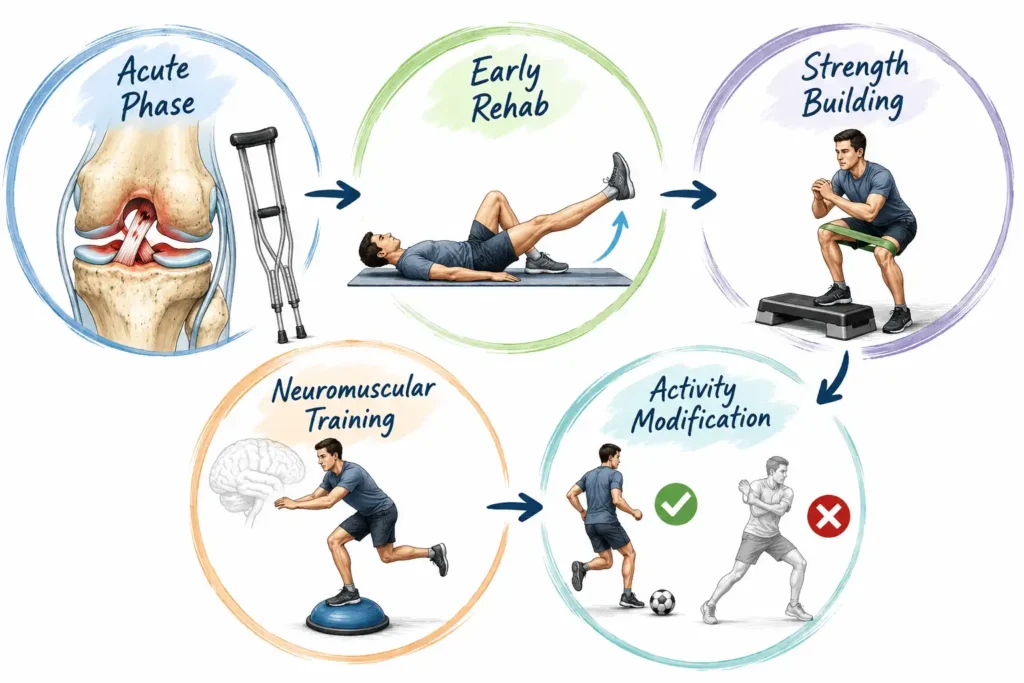
When surgery is deferred or declined, the non-surgical treatment protocol must be structured and specific, not just “rest and do some exercises.” A proper conservative management programme includes:
- Acute phase management (Weeks 1-2): RICE protocol, crutch-assisted walking, and maintaining full knee extension. Losing extension early is one of the most common mistakes that complicates later treatment.
- Early rehabilitation (Weeks 2-6): Quadriceps activation is the top priority. The vastus medialis oblique (VMO) inhibits rapidly after ACL injury. Straight leg raises, quad sets, and terminal knee extension exercises restore the protective muscular control that partially compensates for ligament loss.
- Progressive strengthening (Weeks 6-12): Closed-chain exercises: wall squats, step-ups, single-leg press. Open-chain extension is introduced carefully within a safe range. Hip abductor and core strengthening addresses the proximal muscle weakness that worsens knee valgus.
- Neuromuscular training (Months 3-6): Balance training, proprioception drills, and perturbation exercises that challenge the knee’s dynamic stability. This phase trains the nervous system to react protectively when the knee is stressed.
- Activity modification (Permanent): Avoiding pivoting sports, high-risk cutting movements, and activities that produce the rotational forces the ACL was designed to resist. This is the trade-off of non-surgical management.
The long-term effects of ACL tear without surgery make one thing clear: ACL recovery without surgery is not a 6-week course. It is a permanent commitment to specific training and activity restriction. Patients who understand this distinction make better long-term decisions.
Which patients that applies to is set out in full under ACL tear without surgery.
Complete ACL Tear Treatment Without Surgery: When Is It Realistic?
A complete ACL tear, sometimes classified as a grade 3 ACL tear, means the ligament is fully disrupted with no intact fibres bridging the gap. The question patients ask most directly is: can I manage a complete ACL tear without surgery?
The long-term effects of ACL tear without surgery in complete tears depend on three specific variables:
- Activity demands. A 55-year-old who walks for fitness and does not play sport has fundamentally different requirements than a 22-year-old kabaddi player. Complete ACL tear treatment without surgery can work for the first patient. It is unlikely to work for the second.
- Functional instability. Some patients with complete ACL tears develop compensatory neuromuscular control and rarely experience giving way episodes. These individuals are called “copers.” They are the minority, not the majority.
- Associated injuries. A complete ACL tear with an intact meniscus has a different prognosis than one with concurrent meniscal damage. Each episode of instability in an ACL-deficient knee increases the likelihood of meniscal injury.
An 11-year follow-up study published in PubMed compared ACL reconstruction with conservative management. The findings were telling: conservatively managed patients had 24% osteoarthritis at 11 years, while the reconstructed group showed higher stability scores. The study concluded that physical activity levels were similar in both groups, but long-term joint health differed.
Grade 3 ACL tear no surgery protocols follow the same rehabilitation framework described above, with one critical addition: the patient must accept that certain movements and sports carry a measurably higher risk of secondary damage.
Dr. Prince’s Clinical Insight: “The conversation I have with patients considering non-surgical management of a complete ACL tear is always the same. I show them their MRI, I show them a normal ACL for comparison, and I explain what happens to the meniscus over time in an unstable knee. Then I let them decide. The patients who choose conservative management with full understanding do well. The patients who choose it because they are hoping the ACL will ‘heal on its own’ almost always return for surgery later, but with a more damaged joint.”
What that later operation involves once the joint is already worn is set out under ACL reconstruction surgery.
ACL Tear Recovery Time Without Surgery: A Realistic Month-by-Month Timeline
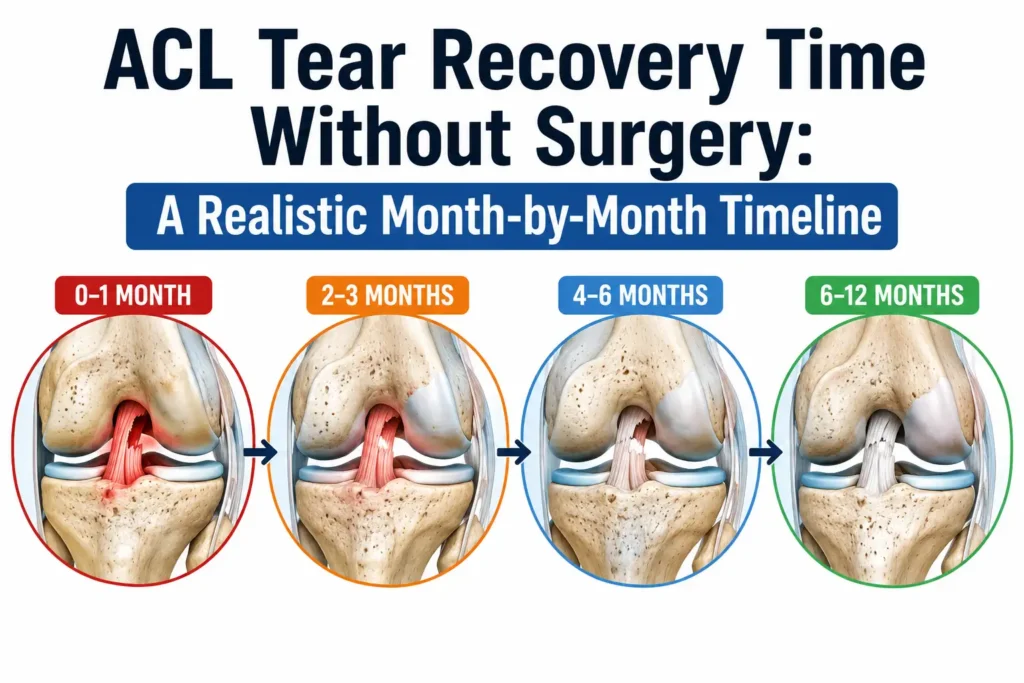
The long-term effects of ACL tear without surgery begin with understanding recovery timelines. Patients searching for ACL tear recovery time without surgery are usually looking for a specific number. The truthful answer is that conservative ACL recovery does not have an “end date” because the ACL itself does not recover. What improves is the muscular compensation around the knee.
| Timeframe | Conservative Management Milestone | Post-Reconstruction Milestone |
|---|---|---|
| Week 1-2 | Swelling control, walking without crutch | Swelling control, crutch-assisted walking |
| Month 1 | Full range of motion, light cycling | ROM restoration, quad activation |
| Month 3 | Strength nearing normal, no giving-way | Progressive strengthening, stationary cycling |
| Month 6 | Maximum conservative improvement reached | Light jogging begins (if milestones met) |
| Month 9-12 | Ongoing maintenance required indefinitely | Return to sport (if 90% strength symmetry) |
| Year 5+ | Joint degeneration risk increases progressively | Graft matures, monitoring continues |
The key distinction: conservative management reaches its ceiling at approximately 6 months. After that, the knee does not get more stable. It either stays where it is (with ongoing maintenance) or slowly degrades as compensatory patterns break down with fatigue, aging, or weight gain. Surgical reconstruction via arthroscopy surgery, by contrast, restores structural stability that does not depend on ongoing muscular compensation.
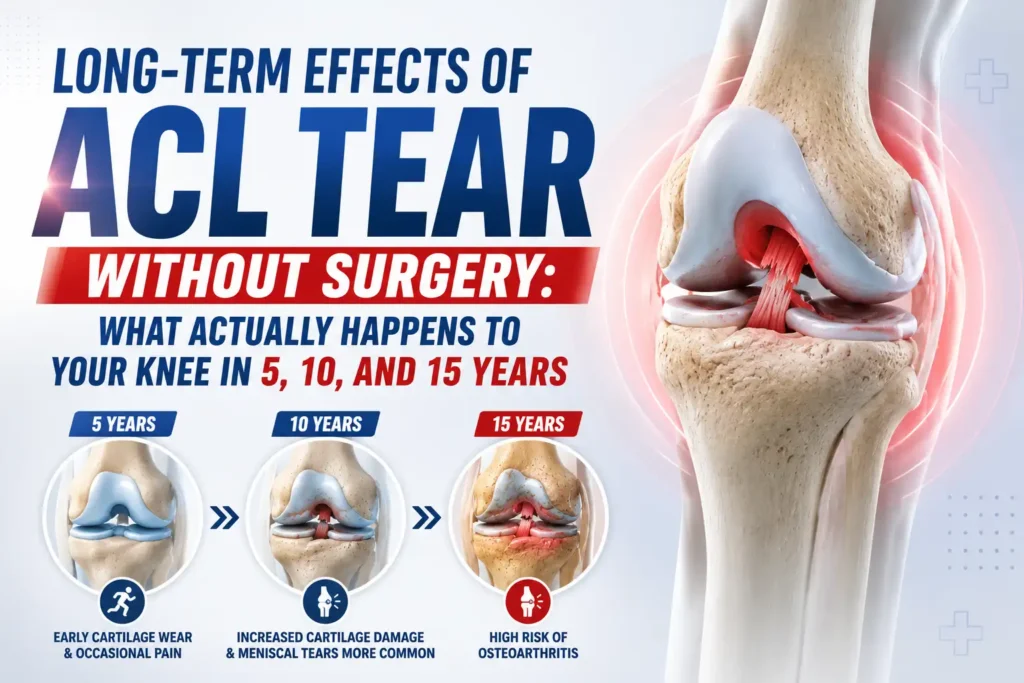
Long-Term Effects of ACL Tear Without Surgery: What Happens Year by Year
The long-term effects of ACL tear without surgery are well documented in orthopaedic research, and the evidence is clear enough to present in specific, measurable terms.
Years 1 to 3: Instability and Secondary Injury Risk
The immediate long-term effect of an untreated ACL tear is chronic functional instability. The knee gives way during activities that involve rotation, deceleration, or uneven surfaces. Each giving-way episode subjects the meniscus and articular cartilage to abnormal forces. Research from Hospital for Special Surgery (HSS) found that cartilage damage in ACL-deficient knees worsens progressively over time, even when no other initial injury was present.
During these first three years, approximately 50% of patients with untreated ACL tears develop a meniscal tear. This is not a separate injury. It is a direct consequence of the rotational instability that the absent ACL can no longer control.
Years 5 to 10: Cartilage Degeneration and Early Arthritis
The cumulative effect of abnormal joint mechanics begins to show on imaging. Articular cartilage, which cannot regenerate once damaged, thins progressively. The subchondral bone underneath begins to remodel abnormally.
The umbrella meta-analysis cited earlier documented a near 7-fold increased risk of osteoarthritis after ACL injury. While this risk exists even after reconstruction, the rate of progression is significantly higher in ACL-deficient knees that are subjected to ongoing instability episodes.
At the 10-year mark, the data becomes stark. Patients who had early reconstruction show approximately 20.6% osteoarthritis prevalence. Those managed conservatively show rates of 24% or higher, with the difference widening as activity levels and age interact.
Years 10 to 15+: Joint Failure and Replacement Risk
Among all the long-term effects of ACL tear without surgery, joint replacement risk is the most sobering. The Brigham and Women’s Hospital study modelled lifetime outcomes for patients who sustained ACL tears by age 25. Patients with concurrent meniscal damage, the very damage that accumulates without surgical stabilisation, faced a 22.3% lifetime risk of total knee replacement. The uninjured comparison group faced 6%.
This is the long-term trajectory of ACL deficiency: instability leads to meniscal damage, meniscal damage leads to abnormal joint loading, abnormal loading leads to cartilage degeneration, and cartilage degeneration leads to osteoarthritis and potentially joint replacement.
Understanding the long-term effects of ACL tear without surgery is not about creating fear. It is about providing the factual basis that patients need to make an informed decision. Some patients will still choose conservative management, and for the right candidates, that is a valid choice. But it should be made with full knowledge of what the evidence shows over 5, 10, and 15 years.
Expert Tip: If you have been managing an ACL tear conservatively and your knee has been stable for more than two years without any giving-way episodes, that is a genuinely positive prognostic sign. Continue your strengthening programme and get annual clinical reviews. But if you have had even one significant giving-way episode after the initial injury, the meniscus is at risk, and the conversation about surgery should be reopened. A consultation with a qualified ligament injury specialist at that point is not optional.
Partial ACL Tear Treatment Without Surgery: A Different Calculation
When discussing the long-term effects of ACL tear without surgery, partial tears deserve separate discussion because the biology is genuinely different. When some fibres remain intact, they provide a scaffold for limited healing and continued stability. The remaining fibres still contribute to rotational control, albeit imperfectly.
Conservative management of partial ACL tears is reasonable when:
- More than 50% of the ACL fibres are intact on MRI
- The Lachman test shows a firm (not soft) endpoint
- No concurrent meniscal tear is present
- The patient does not require return to level 1 pivoting sports
- Functional testing at 3 months shows less than 10% strength deficit
Partial ACL tear treatment without surgery follows the same progressive rehabilitation protocol as complete tears, but with a more optimistic biological ceiling. The remaining fibres do provide some mechanical restraint, and the compensatory muscular strengthening builds on a partially intact foundation.
Who Can Actually Skip ACL Surgery? The “Coper” Profile
Among the important nuances of the long-term effects of ACL tear without surgery is the fact that not every patient needs reconstruction. Research has identified a specific profile of patients who adapt successfully to ACL deficiency without surgery. These individuals are called “copers.”
The characteristics that predict successful non-surgical management:
- No giving-way episodes after the initial injury and swelling resolution
- Strong quadriceps, at least 80% of the uninjured side within 3 months
- Good performance on single-leg hop test, at least 80% of the uninjured side
- No concurrent meniscal injury
- Willingness to permanently modify activities, avoiding level 1 pivoting sports
- Low to moderate activity demands, walking, cycling, swimming rather than competitive sport
Patients who meet all six criteria have a reasonable chance of functioning well without reconstruction. Patients who meet four or fewer almost always progress to surgery within 2 to 5 years, often with additional joint damage that was not present at the time of the original injury.
The Decision Framework: Surgery vs No Surgery for ACL Tears
Rather than presenting this as a binary choice, the clinical decision follows a logical assessment:
- Is the tear partial or complete? Partial tears with firm endpoint = conservative trial reasonable. Complete tears with no endpoint = surgery strongly favoured in active patients.
- What are the activity demands? Any sport involving pivoting, cutting, jumping, or rapid deceleration = surgery recommended. Walking, cycling, swimming = conservative possible.
- Is there concurrent meniscal damage? If yes, the argument for surgical stabilisation strengthens significantly. A meniscus tear in an ACL-deficient knee will progress.
- What is the patient’s age? Younger patients have more years of potential cumulative damage ahead. Older patients with low demands may not develop enough degeneration for it to become clinically significant in their remaining active years.
- Has conservative management already failed? Even one giving-way episode after adequate rehabilitation = strong indication for surgery.
Understanding the long-term effects of ACL tear without surgery is what makes this framework so important in evidence-based orthopaedic practice. It is not based on fear, financial motivation, or blanket recommendations. It is based on matching the treatment to the patient’s biology, demands, and goals.
10 Real Questions Patients Ask About the Long-Term Effects of ACL Tear Without Surgery
1. Can I run with a torn ACL?
Straight-line running on flat surfaces is often possible once swelling resolves and quadriceps strength returns. The risk comes with any sudden change of direction, uneven terrain, or deceleration. Many patients run comfortably in a controlled environment but are one misstep away from a giving-way episode that damages the meniscus.
2. How long does it take to walk normally after an ACL tear without surgery?
Most patients walk without a significant limp within 4 to 6 weeks of injury if swelling is controlled and quadriceps activation is maintained. Walking normally does not mean the knee is healed. It means the muscular compensation is sufficient for the low demand of flat-surface walking.
3. Will wearing a brace replace the need for ACL surgery?
No. Functional knee braces can provide a sense of security and some rotational constraint, but they do not replicate the biomechanical function of an intact ACL. Braces reduce the “surprise” of giving-way episodes but do not prevent the progressive joint damage that occurs with ongoing instability.
4. I was told I have a grade 3 ACL tear. Does that always need surgery?
Grade 3 means complete disruption. It does not automatically require surgery. If you meet the “coper” criteria described above, conservative management is an option. But the data is clear: most patients under 35 with grade 3 tears who remain active eventually require reconstruction, and those who delay have more secondary damage at the time of surgery.
5. My knee feels fine now. Does that mean the ACL has healed?
No. The absence of pain does not indicate healing. Pain after ACL injury comes primarily from swelling and bone bruising, both of which resolve within weeks to months regardless of whether the ACL heals. The ACL itself has minimal pain fibres. You can have a completely torn, non-functional ACL with no pain at all.
6. What percentage of people with ACL tears develop arthritis?
Approximately 36% of patients develop radiographic osteoarthritis within 10 years after ACL injury, regardless of whether they had reconstruction. The risk is higher in patients with concurrent meniscal damage and those who did not receive any structured treatment. Surgery does not eliminate the arthritis risk, but early reconstruction and meniscal preservation reduce the rate of progression.
7. Can stem cell therapy or PRP heal a torn ACL?
At present, no high-quality clinical evidence supports the use of stem cell therapy or platelet-rich plasma (PRP) injections as a definitive treatment for complete ACL tears. Some early-phase research is exploring biologically enhanced ACL repair, but this remains investigational. Patients who are offered stem cell therapy as a proven ACL treatment should seek a structured orthopaedic second opinion from an orthopaedic surgeon with ACL reconstruction experience.
8. If I choose not to have surgery now, can I still have it in 2 years?
Yes, ACL reconstruction can be performed years after the initial injury. However, the condition of the knee at the time of surgery matters. A reconstruction performed at 3 months in a knee with an intact meniscus is a simpler procedure with a better prognosis than one performed at 24 months in a knee with accumulated meniscal and cartilage damage.
9. Is physiotherapy alone enough for an ACL tear?
For partial tears in appropriate patients, yes. For complete tears in patients who will avoid pivoting sports permanently, sometimes. For complete tears in any patient who wants to return to sport involving direction change, jumping, or contact, physiotherapy alone is insufficient. The ACL remains torn regardless of how strong the surrounding muscles become.
10. How do I know if I am a “coper” who can manage without ACL surgery?
Complete the rehabilitation protocol fully, approximately 3 to 6 months. If after that period you have no giving-way episodes, your single-leg hop test is at least 80% of the other side, your quadriceps strength symmetry is above 80%, and you are willing to permanently avoid high-risk activities, you may be a successful coper. If any of those criteria are not met, surgery should be seriously considered.