You already know your Anterior Cruciate Ligament is torn. The MRI confirmed it. The pop during that tackle or that sharp change of direction told you before the MRI did. Now you have one question that no generic orthopaedic website answers properly: when will I play football again, and who should I trust with my knee to make that happen?
Football demands more from a reconstructed ACL than almost any other sport. Rapid pivoting, deceleration from a full sprint, lateral cutting, jumping for headers, and absorbing tackles , these movements test every millimetre of graft placement and every week of rehabilitation. A surgeon who reconstructs your Anterior Cruciate Ligament without understanding these football-specific demands will give you a stable knee. A surgeon who understands football will give you a knee that can actually play.
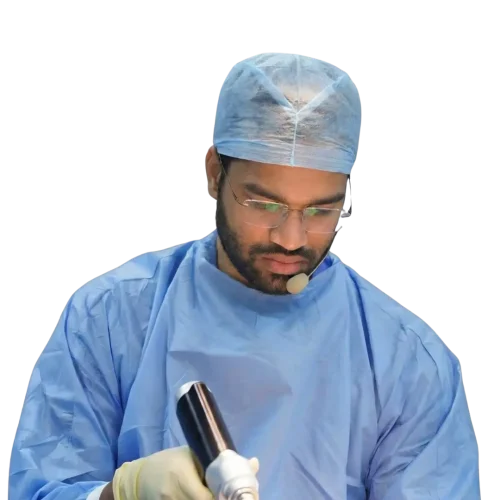
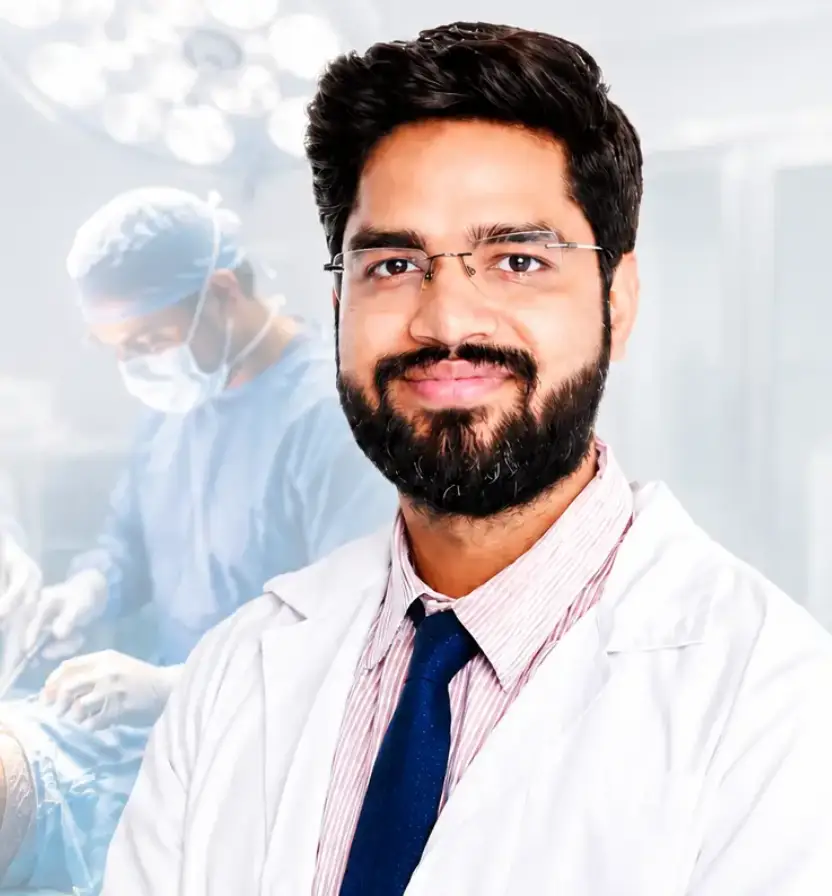
Dr. Prince Uchadiya, DNB Orthopaedics Gold Medalist, Orthopaedic and Arthroscopic Surgeon at Nipania, Indore, has reconstructed the Anterior Cruciate Ligament in footballers ranging from college players to district-level competitors. His approach to ACL surgery for football players in Indore is built around one principle: the reconstruction is not complete when the graft is fixed. It is complete when the player passes match-readiness testing.
Why Football ACL Injuries Are Different from Every Other Sport
Not all ACL tears are created equal. The mechanism, the concurrent damage, and the functional demands of return vary dramatically by sport. Football presents a specific injury profile that the leading ACL surgeon for footballers must account for:
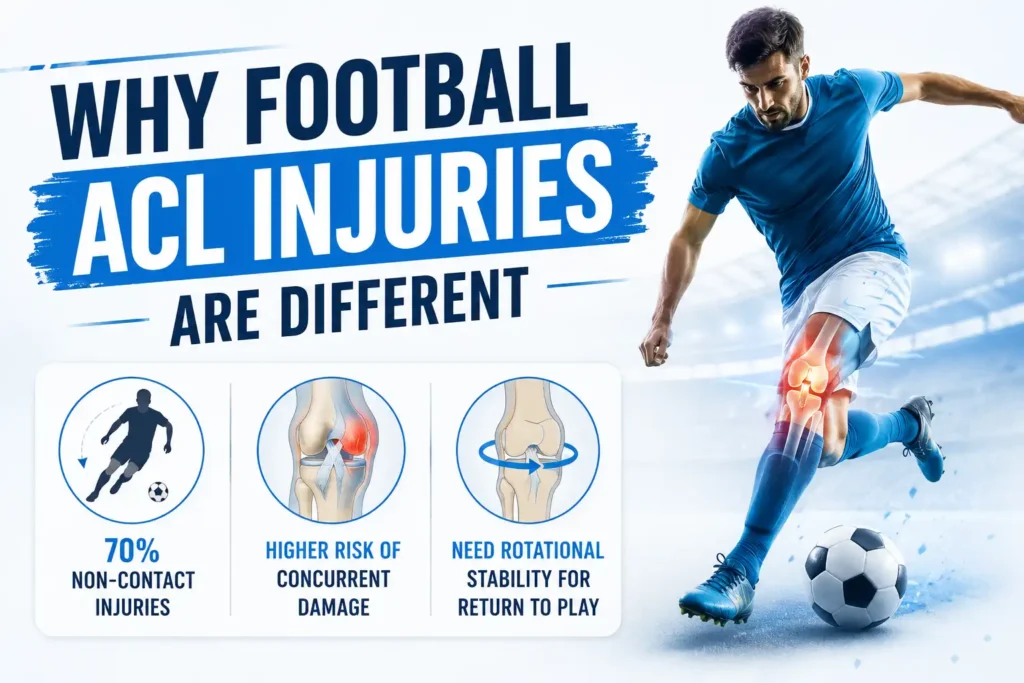
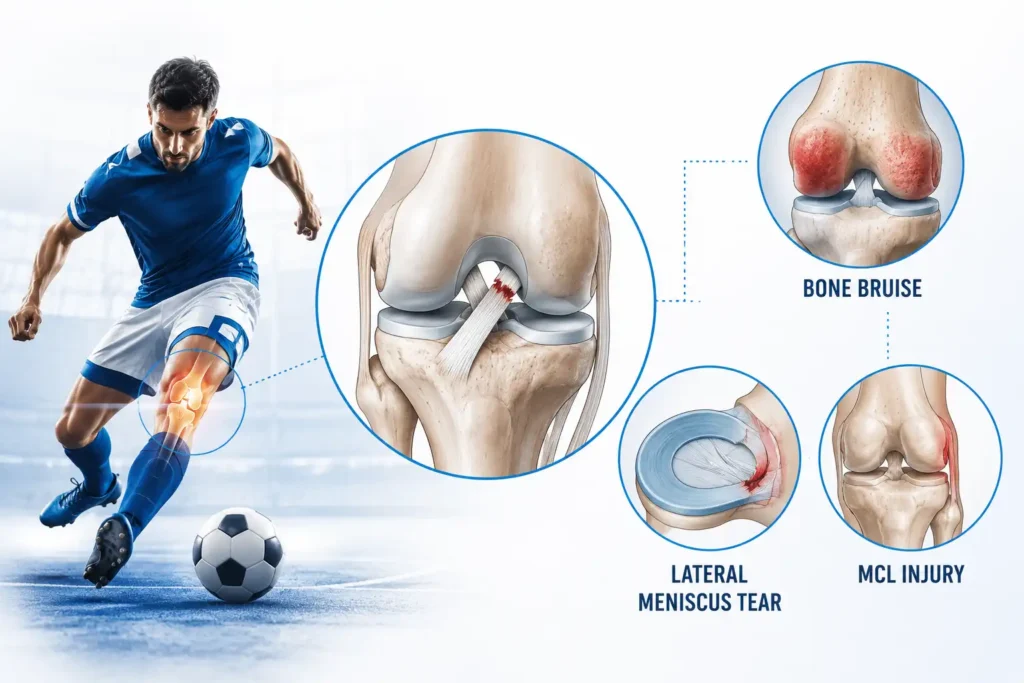
- 70% of football ACL tears are non-contact. A sudden pivot, a sharp deceleration, or a poorly planted foot during a direction change. The knee buckles without anyone touching it. This non-contact mechanism produces a specific bone bruise pattern on MRI and often involves rotational damage to the lateral meniscus.
- Contact ACL injuries carry higher concurrent damage risk. A tackle from the side or a collision during an aerial challenge can tear the ACL alongside the MCL (medial collateral ligament) or damage the meniscus and cartilage simultaneously. According to PMC research on football-specific ACL injuries, managing these combined injuries demands surgical judgment that isolated ACL reconstruction alone does not require.
- Football demands rotational stability that straight-line sports do not. A runner needs the ACL to resist forward tibial translation. A footballer needs that plus rotational control during cutting, pivoting, and rapid deceleration with direction change. This is why anatomic graft placement, matching the native ACL’s exact footprint, matters more for footballers than for almost any other patient group.
Getting the early decisions right matters just as much, which is why mistakes after ACL injury is worth reading first.
How Dr. Prince Uchadiya Approaches ACL Surgery for Football Players Differently
A general ACL reconstruction gives you a stable knee. ACL surgery for football players in Indore at Dr. Prince Uchadiya’s clinic gives you a football-ready knee. The differences are specific and measurable:
1. Anatomic Tunnel Placement for Rotational Control
Older isometric tunnel placement stabilises the knee in a straight line. It does not restore the rotational control a footballer needs during cutting and pivoting. Dr. Prince Uchadiya uses anatomic single-bundle reconstruction, drilling tunnels at the exact position where the native Anterior Cruciate Ligament attached to the femur and tibia. This restores both anterior stability and the rotational restraint that football movements demand.
2. Graft Selection Matched to Football Demands
For most footballers, hamstring autograft provides excellent stability with less anterior knee pain, important for a sport involving frequent kneeling, sliding tackles, and kicking. For competitive contact footballers at higher levels who need maximum initial fixation strength, patellar tendon autograft with bone-to-bone healing is considered. The recommendation is matched to the player’s position, level, and specific demands.
3. Meniscus Preservation as a Non-Negotiable Priority
Up to 50% of football ACL tears involve concurrent meniscal damage. The top ACL surgeon for football injuries in Indore does not remove meniscal tissue when it can be repaired. Every salvageable meniscus is preserved because a footballer’s knee absorbs forces during play that a meniscus-deficient joint cannot sustain long-term without accelerated cartilage breakdown. The detailed reasoning is covered in the combined ACL and meniscus injury guide.
Can You Play Football After ACL Surgery? The Evidence-Based Answer
Yes. Research confirms that 83 to 90% of athletes return to their pre-injury sport after ACL reconstruction. A 2026 AAOS-referenced meta-analysis of professional footballers showed a 90% return-to-sport rate after ACL reconstruction.
But the numbers come with an important caveat: only 55 to 65% return to their exact pre-injury level of competition. The gap between “returning to play” and “returning to full performance” is filled by two things , the quality of the reconstruction and the completeness of sport-specific rehabilitation.
This is exactly why choosing the right surgeon for ACL surgery for football players in Indore matters. The surgical technique determines the ceiling. The rehabilitation determines whether you reach it. The milestones that rehabilitation is measured against are listed under ACL recovery for athletes.
ACL Injury Football Recovery Time: The Real Month-by-Month Timeline
Generic ACL recovery timelines say “6 to 9 months.” For a footballer, that range is meaningless without position-specific context. At Dr. Prince Uchadiya’s clinic, the football-specific ACL recovery timeline follows this progression:
| Phase | Timeline | What You Can Do | What You Cannot Do Yet |
|---|---|---|---|
| Foundation | Month 1-2 | Walking, quad activation, gentle cycling, full extension | Any football activity, running, jumping |
| Strength | Month 3-4 | Progressive squats, hamstring curls, controlled jogging on flat ground | Cutting, pivoting, ball work, sprinting |
| Agility intro | Month 5-6 | Linear sprinting, gentle change-of-direction drills, individual ball work (passing, dribbling) | Tackles, match play, competitive training, aerial challenges |
| Football drills | Month 7-8 | Full-speed direction changes, shooting, heading, controlled small-sided games WITHOUT body contact | Full contact training, competitive matches |
| Match readiness | Month 8-9 | Full team training WITH contact, match simulation, clearance testing | Competitive matches (until clearance testing passed) |
| Return to match | Month 9-10 | Competitive football , clearance granted after passing ALL functional benchmarks | Nothing , fully cleared |
Calendar time alone never determines clearance. A player at month 9 who has not passed strength and stability benchmarks does not play. A player at month 8 who has passed every test may be cleared early. The return-to-sport milestone framework explains how these benchmarks work in practice.
The 5 Clearance Tests Before a Footballer Touches the Pitch Again
At Dr. Prince Uchadiya’s clinic, no footballer returns to competitive play without passing these five objective assessments:
- Quadriceps strength symmetry above 90%. The reconstructed leg’s quad strength must reach at least 90% of the healthy side, measured on a dynamometer. Below 90%, the knee compensates during cutting and the re-injury risk spikes.
- Single-leg hop test above 90%. Hop for distance on the surgical leg, compared to the healthy side. This tests explosive power and confidence in the knee simultaneously.
- T-test agility drill within sport-specific benchmarks. A timed agility test involving forward sprint, lateral shuffle, and backward movement. Football-specific because it replicates match movement patterns.
- Controlled deceleration without apprehension. Full-speed sprint to sudden stop, observed for knee valgus (inward collapse) and any hesitation. If the player subconsciously protects the knee during deceleration, they are not ready regardless of strength numbers.
- Psychological readiness. Assessed through validated questionnaires and clinical observation. Fear of re-injury changes movement patterns in ways that increase actual re-injury risk. A player who is physically ready but psychologically guarded needs more time, not early clearance.
Dr. Prince Uchadiya, DNB Orthopaedics Gold Medalist, Orthopaedic and Arthroscopic Surgeon: “Football players are the most motivated patients I operate on. They want to be back on the field yesterday. My job is to channel that motivation into structured rehabilitation instead of premature return. Every footballer who has passed all five clearance tests at my clinic has returned to competitive play without re-injury. Every one who tried to rush back without passing them learned why the tests exist.”
Cost of ACL Surgery for Football Players in Indore
Arthroscopic ACL reconstruction: Rs. 80,000 to Rs. 1,80,000. For footballers specifically, concurrent meniscal repair (needed in up to 50% of football ACL cases) may add to the surgical time and cost. Every variable is disclosed before surgery.
Players searching for ACL surgery for football players in Indore travel from Ujjain, Dewas, Ratlam, Bhopal, and across Madhya Pradesh travel to Indore for ACL surgery for football players because the combination of the best ACL surgeon credentials for footballers, sport-specific surgical approach, and transparent pricing is not available closer.
Ayushman Bharat coverage is accepted. Documentation and pre-authorisation are handled by the clinic.
The Surgeon Who Understands Football: Why It Matters for Your ACL
A surgeon who does not play or follow football may not intuitively understand why a central midfielder needs different rotational stability than a goalkeeper. Why a winger’s cutting pattern loads the ACL differently from a centre-back’s aerial challenges. Why a striker’s deceleration and shooting mechanics place specific demands on the knee that straight-line testing alone cannot assess.
Dr. Prince Uchadiya’s practice at his Nipania, Indore clinic includes footballers as one of the most common patient groups for ACL reconstruction. The consultation includes position-specific discussion, sport-specific rehab planning, and return-to-play criteria tailored to football rather than generic “return to activity” benchmarks.
The most experienced ACL surgeon for football players near Indore is not simply the one who has done the most surgeries. It is the one who understands what the knee needs to do after the surgery is over.
Football-Specific Rehabilitation After ACL Surgery for Football Players in Indore
Standard ACL rehabilitation focuses on strength, range of motion, and basic functional milestones. Football-specific rehabilitation adds layers that generic protocols miss:
- Cutting and pivoting drills introduced progressively. Not just lateral shuffles, but actual football-pattern direction changes with increasing speed and unpredictability.
- Ball work integrated from month 5. Passing, receiving, dribbling , at controlled intensity initially, progressing to match-speed by month 7-8.
- Deceleration training from sprinting speed. The movement that tore the ACL in the first place must become the movement the player is most confident performing. Repeated exposure under controlled conditions builds that confidence.
- Position-specific loading. A goalkeeper needs explosive lateral diving. A striker needs rapid deceleration and shot planting. A midfielder needs sustained multi-directional movement. Each position gets specific attention in the later rehab phases.
- Contact readiness. Body contact is introduced gradually: shoulder-to-shoulder challenges first, then tackle simulation, then full competitive scenarios. The complete post-ACL physiotherapy guide covers the generic progression, while football-specific additions are layered on top during consultations.
10 Questions Football Players Ask About ACL Surgery in Indore
1. Will I play football at the same level after ACL surgery?
83 to 90% of athletes return to sport after ACL reconstruction. Among those who complete full structured rehabilitation, the majority return to their pre-injury level. The players who do not return often cite psychological barriers (fear of re-injury) rather than physical limitations. Completing all five clearance tests, including psychological readiness, maximises your chances.
2. How long until I can kick a ball again?
Light passing and stationary ball work begins around month 5. Controlled dribbling and shooting at sub-match intensity around month 6-7. Full-speed shooting and crossing with competitive intent around month 8. Match play around month 9-10 after clearing all benchmarks.
3. I play centre-back. Does my position affect the surgery or rehab?
Yes. Defenders face more aerial challenges and contact tackles. Rehab for defenders emphasises landing mechanics from headers, lateral stability during tackles, and confidence in body contact. The surgical reconstruction itself is identical, but the rehab loading and sport-specific drills differ by position.
4. I tore my ACL during a tackle. Does a contact injury change the surgery?
Contact injuries more frequently involve concurrent MCL damage or multi-ligament injury. The surgical plan may need to address more than just the ACL. Dr. Prince’s clinical examination assesses all four knee ligaments, not just the ACL, to identify any concurrent damage that changes the approach.
5. Is hamstring graft or patellar tendon graft better for footballers?
Hamstring graft is preferred for most footballers because it produces less anterior knee pain, which matters for a sport involving kneeling, sliding, and kicking. Patellar tendon graft is reserved for competitive contact players at higher levels where maximum initial fixation strength outweighs the kneeling sensitivity trade-off. Dr. Prince recommends individually during consultation.
6. Can I do gym training while recovering from ACL surgery?
Upper body training can resume within 2-3 weeks. Lower body gym work (leg press, controlled squats) begins around month 2-3 with specific restrictions on depth and load. Deep squats, lunges with heavy load, and plyometric exercises are introduced progressively from month 4-5 onward. Every exercise has a specific introduction point , nothing is left to guesswork.
7. How much does ACL surgery cost for a football player in Indore?
Rs. 80,000 to Rs. 1,80,000 for arthroscopic ACL reconstruction. If concurrent meniscus repair is needed (common in football injuries), the surgical time and cost increase accordingly. Ayushman Bharat accepted. Full cost transparency before surgery.
8. My season starts in 6 months. Is that enough time?
Minimum 7 to 9 months for competitive match return with full clearance testing. Six months is aggressive and not recommended for football-level demands, even if the knee “feels ready.” Returning too early significantly increases re-rupture risk. Planning surgery immediately gives you the best chance of making the following season rather than forcing a premature return for the current one.
9. I am from Bhopal/Ujjain/Dewas. Can I get this surgery in Indore and manage rehab locally?
Yes. The surgical stay is 3-4 days. Rehabilitation follows Dr. Prince’s written protocol at home or with a local physiotherapist. Milestone check-ins at months 3 and 6 happen at the Indore clinic. Football-specific drills from month 5 onward can be supervised by a local coach following the surgeon’s guidelines.
10. What is the re-injury risk after returning to football?
Published re-rupture rates range from 3 to 10%, with younger athletes in pivoting sports at the higher end. The strongest modifiable factor is rehabilitation completeness. Players who pass all five clearance tests before returning have significantly lower re-injury rates than those who return based on calendar time alone. Completing rehabilitation is not optional for footballers. It is the difference between a career-continuing recovery and a career-ending re-tear.
Players who also train in the gym have an extra layer to manage, covered under ACL surgery for gym athletes.