Key Takeaways
- A complete ACL tear means 100% of the ligament fibres are disrupted. The ligament cannot reattach itself because synovial fluid inside the knee prevents the blood clot formation necessary for natural healing.
- Despite this biological reality, not every complete tear demands surgery. A New England Journal of Medicine study showed that structured rehabilitation produced similar 5-year patient satisfaction scores to surgical reconstruction in carefully selected patients.
- The catch: “carefully selected” is doing all the heavy lifting in that sentence. The patients who did well without surgery were older, less active, and willing to permanently avoid pivoting sports. Young athletes in the same study crossed over to surgery at high rates.
- According to AAOS clinical guidelines, ACL reconstruction is strongly recommended for patients who wish to return to activities involving cutting, pivoting, or jumping.
- The real decision is not made by your MRI. It is made by your age, your activity goals, your meniscal status, and your willingness to accept permanent activity restrictions.
The question of complete ACL tear treatment without surgery plays out in orthopaedic clinics every single week. Here is how it typically unfolds.
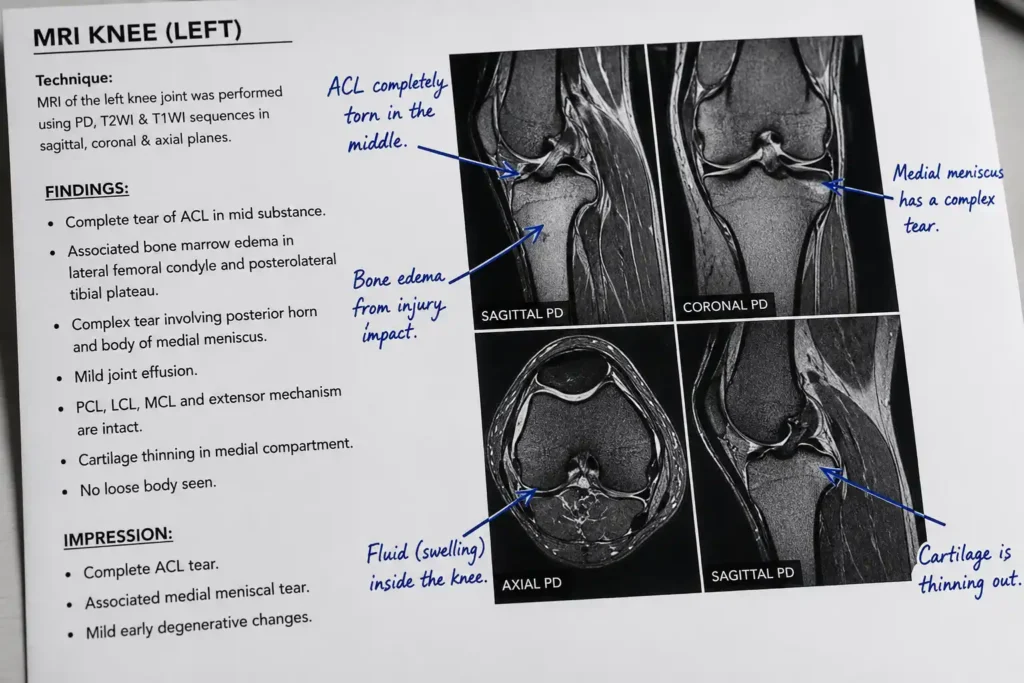
A patient walks in with an MRI report that says “complete tear of the anterior cruciate ligament.” They have already spent two hours on Google. Half the articles say surgery is mandatory. The other half say physiotherapy is enough. They are more confused now than before they read anything.
The reason for the confusion is simple: both sides are telling incomplete truths. Surgery is not always mandatory. Physiotherapy is not always enough. The answer depends on factors that the MRI report does not capture. And that is what this article is about.
Why a Complete ACL Tear Is Biologically Different from Every Other Ligament Injury
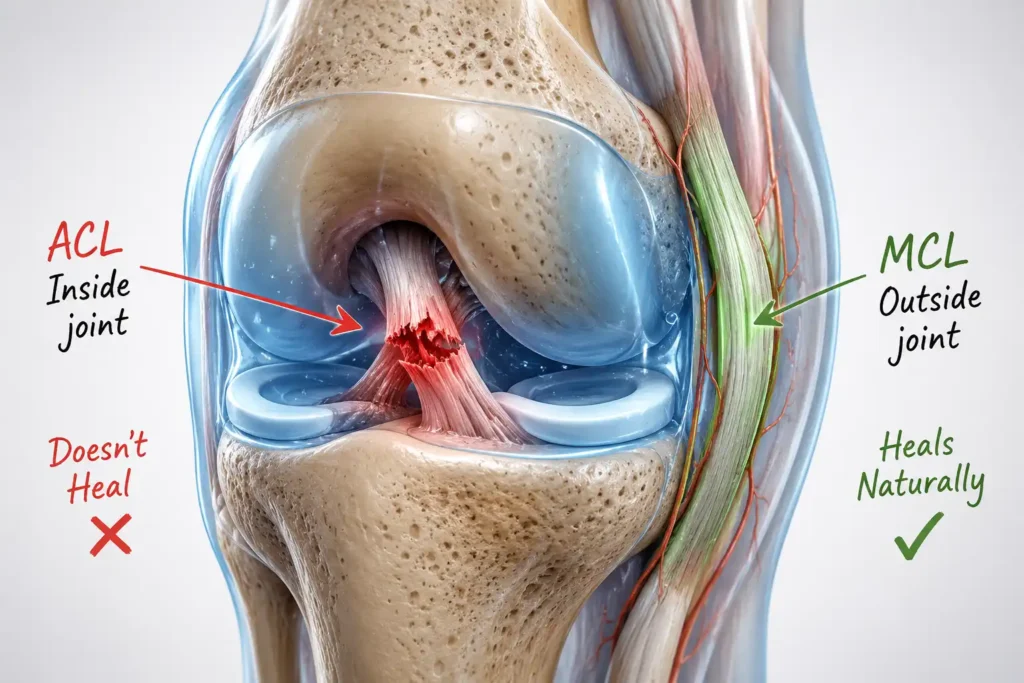
When you sprain your ankle, the torn ligament heals. When you tear your MCL (the ligament on the inner side of the knee), it usually heals too. So why does a completely torn ACL not heal?
The answer is location. The ACL lives entirely inside the knee joint, surrounded by synovial fluid. This fluid is brilliant at lubricating the joint and nourishing the cartilage. But it is terrible for healing. Here is what happens when you tear the ACL:
- The torn ends bleed. A small blood clot forms between them, just like any other injury.
- Synovial fluid dissolves the clot. The enzymes in the fluid break down the fibrin scaffold before repair cells can migrate in.
- Without a scaffold, no bridge forms. The torn ends float freely. They cannot reconnect.
- Scar tissue may form on the stump. Sometimes the torn ACL scars onto the PCL (the ligament behind it), creating a false impression of stability on examination. But this scar has zero mechanical strength.
This is not a matter of rest, diet, supplements, or willpower. It is a biological limitation of the intra-articular environment. Understanding this is the first step in evaluating whether complete ACL tear treatment without surgery is realistic for your specific situation.
Dr. Prince Uchadiya, DNB Orthopaedics Gold Medalist, Orthopaedic and Arthroscopic Surgeon: “I show every patient the same thing during their consultation. I pull up their MRI, I show them the intact ACL on the uninjured side, and then I show them the complete tear on the affected side. Then I explain why the gap between those two torn ends will never close on its own. Once they understand the biology, the rest of the conversation becomes much clearer.”
The 4 Patients Who Sat in My Clinic Last Month: Same Tear, Four Different Decisions
Complete ACL tear treatment without surgery is not a one-size-fits-all question. Let me walk you through four real patient profiles (details changed for privacy) that illustrate how the same MRI finding leads to completely different treatment paths.
Patient A: 20-year-old college football player
Complete ACL tear during a tackle. Wants to return to competitive football. MRI also shows a small lateral meniscal tear.
Decision: surgery. A complete tear in a 20-year-old who plays a pivoting sport with concurrent meniscal damage is one of the clearest surgical indications in orthopaedics. Conservative management here risks career-ending secondary damage.
Patient B: 52-year-old school teacher
Complete ACL tear from slipping on a wet floor. Does not play any sport. Walks for fitness. Knee feels stable during daily activities. No meniscal tear on MRI.
Decision: structured conservative management. Her activity demands do not stress the ACL-deficient knee. With proper quad and hip strengthening, she can function well without reconstruction.
Patient C: 34-year-old recreational cricketer
Complete ACL tear during fielding. Wants to keep playing weekend cricket. No meniscal tear currently, but knee has given way twice since injury.
Decision: surgery recommended, patient chose conservative trial first. After 4 months of physiotherapy, the knee gave way during a casual game. Came back for reconstruction. By then, a new meniscal tear had appeared on the follow-up MRI.
Patient D: 45-year-old gym enthusiast
Complete ACL tear during a group fitness class. Wants to continue gym training but is willing to avoid jumping and lateral movements. Strong quadriceps, passed hop test at 85%, no giving-way episodes after 3 months of rehab.
Decision: conservative management working well at 12-month follow-up.
Same MRI finding. Four completely different outcomes. That is why complete ACL tear treatment without surgery is never a yes-or-no question. The tear is the starting point of the conversation, not the conclusion.
Complete ACL Tear Treatment Without Surgery: The Honest Assessment
When does complete ACL tear treatment without surgery have a realistic chance of success? The evidence points to a specific patient profile:
- No functional instability after rehabilitation. If the knee does not give way during daily activities and moderate exercise after 3 to 6 months of structured physiotherapy, the muscular compensation is working.
- No meniscal tear on MRI. An intact meniscus means the joint has its shock absorbers in place. Each giving-way episode risks tearing the meniscus. If it is intact now and the knee is stable, that is a genuinely positive sign.
- Activity demands do not exceed the knee’s compensatory capacity. Walking, cycling, swimming, gym training with modifications, straight-line jogging. These are within the capacity of a well-rehabilitated ACL-deficient knee. Cricket fielding, football, kabaddi, basketball, and competitive badminton are not.
- The patient understands and accepts the trade-off. Conservative management is not a cure. It is a managed compromise. The ACL remains torn. The activity restrictions are permanent. The strengthening programme is lifelong. Patients who understand this fully tend to do well. Patients who are hoping the ACL will “heal with time” invariably return disappointed.
For a detailed walkthrough of the 5-phase rehabilitation protocol and the broader context of long-term effects of ACL tear without surgery, that forms the backbone of conservative management, the ACL tear treatment without surgery guide covers every phase from acute management through permanent activity modification.
What “Grade 3” Actually Means: Clearing Up the Grading Confusion
Patients often arrive having been told they have a “Grade 3 ACL tear” and want to know if that changes their options. Here is what the grading system actually means:
| Grade | What It Means | Stability on Examination | Conservative Success Rate |
|---|---|---|---|
| Grade 1 | Fibres stretched but intact | Stable, firm endpoint | High (80%+) |
| Grade 2 | Partial tear, some fibres disrupted | Some laxity, endpoint present | Moderate (50-70%) |
| Grade 3 | Complete tear, all fibres disrupted | Significant laxity, no endpoint | Low in active patients (20-40%) |
A grade 3 ACL tear no surgery approach follows the same assessment framework described above. The grade itself does not decide the treatment. The combination of grade, patient age, activity demands, meniscal status, and functional stability after rehab together determine whether conservative management is a realistic long-term path.
The broader picture of what happens to a knee with an untreated complete ACL tear over 5, 10, and 15 years is covered in the pillar guide on long-term effects of ACL tear without surgery, which every patient considering non-operative management should read.
The Meniscus Question: Why It Changes Everything
If there is one factor that tilts the complete ACL tear treatment without surgery decision more than any other, it is the meniscus.
The meniscus is a C-shaped cartilage pad that sits between your femur and tibia. It absorbs shock, distributes load, and protects the articular cartilage underneath. In an ACL-deficient knee, every rotational instability episode puts abnormal shearing force on the meniscus.
For anyone evaluating complete ACL tear treatment without surgery, the meniscus numbers are uncomfortable but important:
- Approximately 50% of patients with untreated complete ACL tears develop a meniscal tear within 5 years
- A meniscus tear in an ACL-deficient knee is harder to repair and more likely to require partial removal
- Partial meniscus removal accelerates cartilage degeneration, which accelerates arthritis
- Once the meniscus is damaged, the long-term joint prognosis worsens regardless of whether ACL reconstruction is eventually performed
This is exactly why the timing of complete ACL tear treatment without surgery matters so much. A patient who chooses conservative management today and transitions to surgery at 6 months (with an intact meniscus) has a dramatically better long-term prognosis than one who waits 2 years and arrives with secondary meniscal damage.
When Conservative Management Fails: Recognising the Moment
Complete ACL tear treatment without surgery is always a trial, never a guarantee. The responsible approach is to begin structured rehabilitation with clear criteria for success and equally clear signals that the approach is not working.
The signals that should trigger an immediate surgical conversation:
- Any giving-way episode after completing 6 months of structured rehab. Not a stumble. An actual buckling event where the knee shifts and you lose control momentarily. One is enough.
- New clicking, catching, or locking in the knee. These were not there before. They suggest a meniscal tear has developed, which means the instability is causing secondary damage right now.
- Persistent swelling after moderate activity. Joint effusion that keeps returning means the cartilage surfaces are being irritated by abnormal mechanics.
- Quad strength plateau below 80% symmetry. If after 6 months of dedicated training the injured leg cannot reach 80% of the other side, the compensatory strategy has reached its ceiling.
Recognising these signals early and acting on them is the difference between a straightforward arthroscopic reconstruction and a complex procedure in a damaged joint.
Complete ACL Tear in Indore: How Dr. Prince Uchadiya Makes the Decision
Wait, let me correct that. Dr. Prince Uchadiya does not make the decision. The patient does. What Dr. Prince does is give the patient everything they need to make that decision properly.
The consultation at Dr. Prince Uchadiya Orthopaedic And Joint Care Clinic, Nipania, Indore follows a specific sequence:
- Clinical examination first, MRI second. The Lachman test, anterior drawer, and pivot shift tell the surgeon how the knee is functioning right now, not just what the anatomy looks like on a scan.
- Activity mapping. Not “are you active?” but specifically “what exactly do you do, how often, and what would you be willing to give up permanently?”
- Meniscal status review. Is the meniscus intact? If yes, the window for safe conservative trial is open. If no, the argument for surgical stabilisation strengthens considerably.
- Honest conversation. Both pathways explained, including what each one cannot do. Conservative management cannot restore structural stability. Surgery cannot guarantee zero arthritis risk.
For patients who need the complete picture of ACL tear recovery time without surgery versus surgical timelines, the detailed comparison helps set realistic expectations about what each path demands.
The topic of partial ACL tear treatment without surgery involves a genuinely different biological reality and decision framework, and patients with partial tears should not apply the same logic used for complete tears.
Dr. Prince Uchadiya, DNB Orthopaedics Gold Medalist, Orthopaedic and Arthroscopic Surgeon: “The hardest conversation is with the 25-year-old cricketer who has a complete ACL tear, no meniscal damage, and a knee that feels stable walking around the house. He genuinely believes he does not need surgery. And right now, standing in my clinic, he might be right. But I have to show him what his knee will look like in 3 years if he goes back to fielding without a functioning ACL. That projection is what makes the difference between a decision based on how the knee feels today and a decision based on where the knee is heading.”
10 Questions Patients Ask About Complete ACL Tears Without Surgery
1. My ACL is completely torn but I can walk perfectly. How is that possible?
Walking is the simplest thing your knee does. It barely uses the ACL at all because there is almost no rotation or sudden direction change involved. Your muscles take over easily for flat-surface, straight-line walking. The problem is not walking. The problem is the one unexpected step on uneven ground or the one moment your child runs into your leg at the park. That is when the missing ACL shows itself.
2. My doctor said “let’s try physio first and see.” Is that a valid approach?
Absolutely, as long as “see” has clear criteria. A vague “let’s try and see” without defining what success looks like at 3 months and 6 months is not a plan. Ask your doctor: what specific markers will tell us at 3 months whether conservative treatment is working? If they cannot answer that specifically, consider getting a second opinion from someone who can.
3. I read that ACL tears can heal naturally. Is that true for complete tears?
For partial tears where some fibres remain intact, limited healing is possible because the remaining fibres provide a scaffold. For complete tears with a full gap between the torn ends, natural healing does not occur in the biological environment of the knee joint. The synovial fluid prevents it. No amount of rest changes this biology.
4. If I skip surgery, what is the worst that can realistically happen?
The realistic worst case is not dramatic. It is gradual. The knee gives way occasionally. Each episode damages the meniscus a little more. Over 5 to 10 years, the meniscus wears down, cartilage thins, and early arthritis sets in. You may not feel it happening year to year. But MRI at year 5 will show it. The damage is cumulative and largely irreversible.
5. How do I know if I am one of the people who can manage without surgery?
Complete the full rehabilitation protocol over 3 to 6 months. Then test yourself against these criteria: zero giving-way episodes since rehab began, quad strength above 80% of the other side, hop test above 80%, no new knee symptoms, and a genuine willingness to permanently avoid any sport with pivoting. Meet all five? You might be a successful coper. Miss even one? That conversation about surgery needs to happen.
6. Is it true that surgery causes arthritis too?
Yes, ACL reconstruction does not eliminate the arthritis risk entirely. The initial bone bruise from the injury itself starts a degenerative process that continues regardless of treatment. But here is the distinction: surgery stabilises the joint, which protects the meniscus, which slows the cartilage degeneration. An unstable, untreated knee degenerates faster because every instability episode accelerates the process.
7. Can I still get surgery 2 or 3 years after my injury?
Yes. There is no absolute time limit. But the condition of the joint matters enormously. A knee at 3 months with an intact meniscus is a very different surgical environment from a knee at 3 years with secondary meniscal and cartilage damage. The surgery is still possible and still beneficial, but the ceiling for how good the knee can ultimately be is lower.
8. My friend’s complete ACL tear “healed” with physiotherapy. Did it really heal?
Almost certainly, what healed was the swelling and pain, not the ligament. The ACL remains structurally torn. Your friend’s muscles got strong enough to compensate for the missing ligament during normal daily activities. That is a legitimate functional outcome. But if you were to examine their knee with a Lachman test, it would still show anterior laxity. Functional improvement and structural healing are not the same thing.
9. What should I do in the first week after being told I have a complete ACL tear?
Three things. One: do not panic. A complete ACL tear is not an emergency that requires surgery tomorrow. Two: protect the knee. Use crutches if needed, ice regularly, and do not try to “test” the knee by twisting on it. Three: book a consultation with an arthroscopic surgeon who performs ACL reconstructions regularly. Not to commit to surgery, but to get a complete clinical assessment so you understand both pathways fully before choosing one.
10. What is the one thing I should absolutely avoid doing right now?
Do not go back to playing your sport to “see if the knee holds up.” That single test can tear your meniscus, and a torn meniscus in an ACL-deficient knee changes the entire long-term prognosis. Get the diagnosis confirmed, understand your options, complete the rehabilitation protocol, and then make an informed decision. Not a test-and-hope decision on the field.