Key Takeaways
- ACL tear treatment without surgery is a structured, multi-phase rehabilitation protocol, not “rest and it will heal.” It requires 3 to 6 months of dedicated physiotherapy and a permanent commitment to activity modification.
- A landmark BMJ trial (KANON study) found that approximately 51% of patients who initially chose non-surgical treatment eventually required ACL reconstruction within 2 years because conservative management alone could not restore functional stability.
- Non-surgical treatment works best for partial tears with more than 50% intact fibres, patients over 40 with low activity demands, and the small subset of “copers” who pass all six objective screening criteria.
- It does not work for complete tears in athletes who need to pivot, cut, or jump. Attempting conservative management in these patients risks progressive meniscal and cartilage damage that complicates eventual surgery.
- A 2024 PMC review on individualised ACL management confirmed that the decision between surgery and conservative treatment must be patient-specific, based on clinical examination, imaging, activity demands, and functional testing, not blanket protocols.
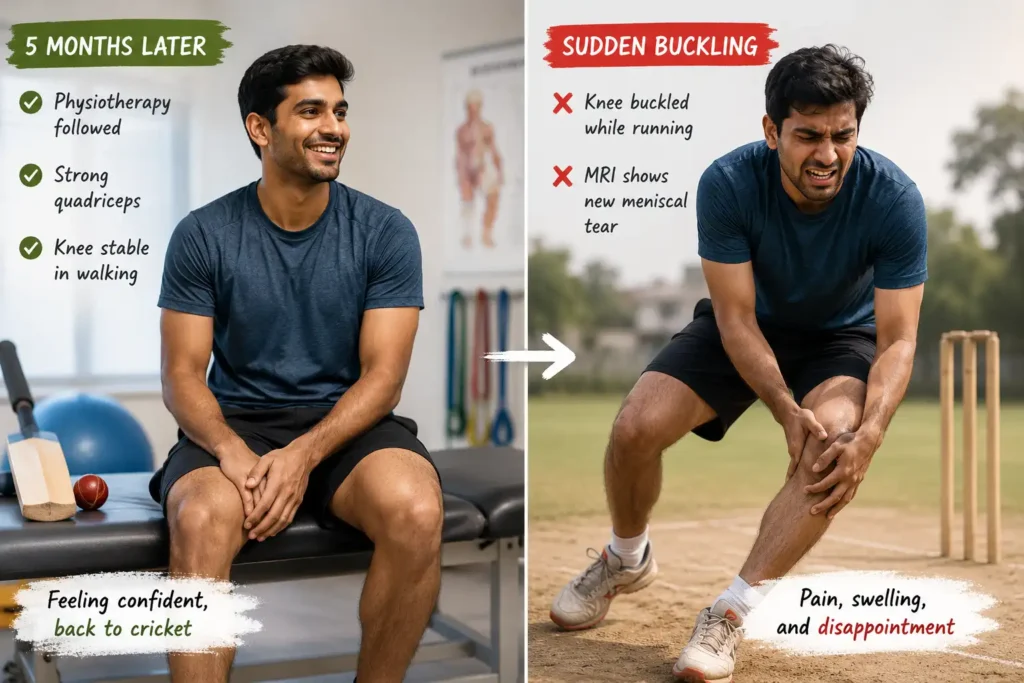
A 28-year-old weekend cricketer in Indore came to Dr. Prince Uchadiya’s clinic after trying to manage his ACL tear conservatively for 5 months. He had been told by a physiotherapist that surgery was unnecessary. His quadriceps were strong. His knee rarely gave way during walking. But the moment he attempted a quick run between wickets, the knee buckled. MRI now showed a medial meniscal tear that was not present in his original scan.
His conservative treatment had not failed because it was done poorly. It failed because it was the wrong treatment for his specific injury profile. A complete ACL tear in a 28-year-old who plays a pivoting sport was never going to stabilise without reconstruction.
That distinction, between who benefits from ACL tear treatment without surgery and who does not, is what this article addresses with clinical honesty.
What ACL Tear Treatment Without Surgery Actually Involves: The 5 Phase Protocol
Most online content presents non-surgical ACL management as a list of exercises. That misses the point entirely. Effective ACL tear treatment without surgery is a phased, milestone-driven rehabilitation programme with permanent lifestyle implications.
Phase 1: Acute Management (Days 1 to 14)
The first priority is restoring full knee extension. Losing even 5 degrees of extension in the first two weeks creates a flexion contracture that is difficult to correct later and worsens long-term outcomes regardless of whether surgery eventually happens.
- RICE protocol for swelling control
- Crutch-assisted walking with full extension encouraged
- Gentle quadriceps sets (isometric contraction with knee straight)
- Straight leg raises to maintain hip flexor and quad activation
Phase 2: Early Rehabilitation (Weeks 2 to 6)
The VMO (vastus medialis oblique) inhibits rapidly after ACL injury. This muscle is the primary medial stabiliser of the kneecap and contributes to knee control during functional movements.
- Terminal knee extension exercises with resistance band (last 30 degrees only)
- Stationary cycling (high seat position to minimise patellofemoral load)
- Prone hamstring curls (light resistance)
- Hip abductor strengthening (side-lying, then standing)
Phase 3: Progressive Strengthening (Weeks 6 to 12)
- Closed-chain exercises: wall squats, leg press (0 to 70 degrees only), step-ups
- Single-leg balance training on stable surfaces, progressing to unstable
- Core and hip strengthening (glute bridges, planks, side planks)
- Gradual increase in walking speed and duration
By week 12, the patient should be walking normally without any sense of instability on flat, predictable surfaces.
Phase 4: Neuromuscular Training (Months 3 to 6)
This is the phase that separates effective ACL tear treatment without surgery from generic physiotherapy.
- Perturbation training: standing on a wobble board while the therapist applies unexpected pushes to the knee
- Lateral stepping drills with resistance
- Single-leg squat holds for endurance
- Controlled deceleration training (learning to slow down safely)
Research from the 2024 PMC review confirms that neuromuscular training is the component most strongly associated with successful non-operative outcomes. Patients who skip this phase plateau early and remain at high risk of giving-way episodes.
Phase 5: Permanent Activity Modification
This is where most patients struggle with the reality of non-surgical management. The ACL does not regenerate. Conservative treatment strengthens the muscles around the knee to compensate for the missing ligament. That compensation works under controlled conditions. It breaks down under:
- Sudden unexpected direction changes
- Pivoting on a planted foot
- Landing from a jump on one leg
- Fatigue during prolonged physical activity
Patients who choose ACL tear treatment without surgery must permanently avoid activities that produce these forces. That means no competitive football, no kabaddi, no basketball, and no cricket fielding. Walking, cycling, swimming, gym training (with modifications), and straight-line running are generally safe.
Dr. Prince Uchadiya, DNB Orthopaedics Gold Medalist, Orthopaedic and Arthroscopic Surgeon: “The best non-surgical ACL patients I see are the ones who understood from day one that this is not a 12-week fix. They committed to the strengthening programme, they accepted the activity restrictions, and they did not try to cheat the process by returning to their sport ‘just to test it.’ The ones who tested it almost always came back with a meniscal tear.”
When ACL Tear Treatment Without Surgery Fails: The Warning Signs
Conservative management is not a one-way door. It can be abandoned in favour of surgery at any point if the knee does not respond. The signals that non-surgical treatment is failing:
- Giving-way episodes after completing Phase 4: Even one significant buckling episode after 6 months of structured rehab indicates that muscular compensation is insufficient. The meniscus is now at measurable risk.
- Persistent swelling after activity: Recurrent effusion (fluid in the joint) after moderate activity suggests ongoing cartilage irritation from abnormal joint mechanics.
- Inability to achieve 80% strength symmetry: If the injured leg cannot reach 80% of the uninjured leg’s quadriceps strength by month 6 despite consistent training, the dynamic stability needed for safe function is unlikely to develop.
- New symptoms: Clicking, locking, or catching sensations that were not present initially suggest a meniscal tear has developed secondary to instability.
Any of these findings should trigger an immediate reassessment. The full picture of what happens to an ACL-deficient knee over years is covered in the pillar guide on long-term effects of ACL tear without surgery, which presents the 5, 10, and 15-year data clearly.
ACL Tear Treatment Without Surgery vs Reconstruction: An Honest Comparison
| Factor | Non-Surgical Treatment | ACL Reconstruction |
|---|---|---|
| Knee stability | Depends on muscular compensation (variable) | Structural stability restored (consistent) |
| Return to pivoting sport | Not recommended (high re-injury risk) | 85-90% return to pre-injury level |
| Surgery risk | None | Infection <1%, graft failure 5-10% |
| Rehabilitation duration | 3-6 months (ceiling reached), then permanent maintenance | 6-9 months (progressive improvement continues) |
| Meniscus protection | Ongoing risk with each instability episode | Significantly reduced after reconstruction |
| Long-term arthritis risk | Higher with ongoing instability | Present but slower progression |
| Ideal candidate | Older, low-demand, no sport requiring pivot | Young, active, any sport with direction change |
If surgery becomes the right path, modern ACL reconstruction is arthroscopic: 2 to 3 small incisions, 1 to 2 days hospital stay, walking within 48 hours. The procedure has evolved dramatically from the open surgeries of 15 years ago.
Who Is the Ideal Candidate for ACL Tear Treatment Without Surgery?
Not every patient with a torn ACL needs an operation. The clinical challenge is identifying who can genuinely succeed without one. Based on current evidence, the strongest candidates for non-surgical management are:
- Patients with partial ACL tears where more than 50% of fibres remain intact, the Lachman test shows a firm endpoint, and no concurrent meniscal injury exists. The detailed guide on partial ACL tear treatment without surgery covers this specific scenario.
- Patients over 40 with low activity demands who walk for fitness and do not participate in sport requiring pivoting, cutting, or jumping.
- Patients who meet all six coper criteria after completing the full rehabilitation protocol: no giving-way, 80%+ quad strength, 80%+ hop test, no meniscal tear, no pivot sport, willing to modify permanently.
- Patients with medical contraindications to surgery where the surgical risk outweighs the benefit of reconstruction.
Everyone else, particularly young athletes with complete tears who want to return to any sport involving rotation, benefits more from surgical reconstruction. The question is not whether surgery works. It is whether the individual patient’s biology, demands, and goals align with non-surgical management.
ACL Tear Treatment Without Surgery in Indore: What Dr. Prince Uchadiya Recommends
At Dr. Prince Uchadiya Orthopaedic And Joint Care Clinic, Nipania, Indore, the ACL treatment approach is diagnostic-first. No patient receives a blanket recommendation for surgery or conservative management before a complete evaluation.
The consultation includes:
- Clinical examination with Lachman test, anterior drawer, and pivot shift assessment
- MRI correlation to classify the tear and identify associated meniscal or cartilage pathology
- Functional assessment of quad strength, hop test, and gait pattern
- An honest conversation about the patient’s sport, goals, age, and willingness to modify activity
Patients considering returning to running after any knee treatment should review the milestone-based framework in the return to running after knee surgery guide, which applies equally to post-conservative and post-surgical rehabilitation.
For patients managing a complete ACL tear treatment without surgery, the recovery ceiling and long-term joint trajectory differ significantly from partial tears. For those with a grade 3 ACL tear no surgery approach, the ACL tear recovery time without surgery is typically 3 to 6 months to reach maximum conservative improvement, but the knee does not continue improving beyond that point.
Dr. Prince Uchadiya, DNB Orthopaedics Gold Medalist, Orthopaedic and Arthroscopic Surgeon: “I never tell a patient they must have surgery. I show them their MRI, I perform the clinical tests in front of them, and I explain what each finding means. Then I give them two honest pathways: what conservative management can realistically achieve and what reconstruction offers. The decision is always theirs. But it has to be an informed decision, not one based on fear of surgery or hope that the ligament will magically heal.”
10 Questions Patients Actually Ask About ACL Tear Treatment Without Surgery
1. My physio says I don’t need surgery. My orthopaedic surgeon says I do. Who do I believe?
Both may be right for different reasons. A physiotherapist evaluates movement and muscle strength. An orthopaedic surgeon evaluates structural damage, joint stability, and long-term joint health. The physio sees your knee compensating well today. The surgeon sees what happens to an unstable joint over 10 years. The best approach? Get the surgical opinion, understand the risks of both paths, then decide. Not one opinion cancelling the other.
2. I tore my ACL 3 months ago and I’m walking fine. Does that mean I don’t need surgery?
Walking uses almost no rotational force on the knee. It is the lowest-demand activity your knee performs. Walking well after an ACL tear tells you very little about whether the knee can handle sport, uneven ground, or unexpected movements. The real test is not “can I walk?” It is “does my knee give way when I don’t expect it to?”
3. Can I play any sport at all without ACL surgery?
Straight-line sports and low-pivot activities are possible for many patients. Swimming, cycling, some gym training, and controlled jogging are usually safe. Anything involving sudden direction change, pivoting, jumping and landing, or contact carries significant risk. If your sport requires any of those, you are playing with a time bomb underneath your kneecap.
4. Will wearing a knee brace make up for a torn ACL?
A brace provides some rotational support and a psychological sense of security. It does not replace the biomechanical function of an intact ACL. Think of it as a seatbelt, not a roll cage. It helps, but it will not save you in a serious crash. Athletes who rely on braces alone without structured rehabilitation are at very high risk of secondary meniscal injury.
5. How do I know if my conservative treatment is actually working?
Three objective markers: your quad strength on the injured side is above 80% of the healthy side, your single-leg hop distance is above 80% of the healthy side, and you have had zero giving-way episodes in the past 3 months. If all three are true after 6 months of structured rehab, conservative management is working. If any one fails, the conversation about surgery needs to happen.
6. My friend tore his ACL and never had surgery and he’s fine. Why can’t I do the same?
Your friend may be a “coper,” someone whose neuromuscular system adapted well enough to compensate for the missing ligament. That is genuinely possible for some people. But what your friend may not be telling you is that he stopped playing football, avoids uneven surfaces, and has quietly accepted a lower activity level. Or his MRI may show meniscal damage he does not yet feel. Not every “fine” is actually fine underneath.
7. What happens if I try conservative treatment and it doesn’t work?
You can have ACL reconstruction at any point. There is no “too late” in absolute terms. But the condition of your knee at the time of surgery matters enormously. A reconstruction at 4 months in a knee with intact meniscus is a cleaner, simpler surgery than one at 18 months in a knee with secondary meniscal and cartilage damage. Delay does not close the surgical door, but it makes the surgery harder and the recovery longer.
8. Is PRP or stem cell therapy a real alternative to ACL surgery?
As of 2025, no Level 1 clinical evidence supports PRP or stem cell therapy as a standalone treatment for complete ACL tears. Some early research shows promise for partial tears and biological augmentation, but these remain investigational. If someone is marketing stem cell therapy as a proven ACL cure, that claim is ahead of the evidence. Get a second opinion from an experienced orthopaedic surgeon before committing.
9. If I choose surgery later, will my results be worse because I waited?
It depends on what happened to the knee during the waiting period. If the meniscus stayed intact and no further instability episodes occurred, delayed surgery can produce excellent outcomes. If the delay caused secondary meniscal damage, the reconstruction is still effective but the overall joint prognosis is worse because the shock absorber is now compromised. Time itself is not the enemy. Instability episodes during that time are.
10. What’s the single most important thing I should do right now if I have a torn ACL and I’m not sure about surgery?
Get a proper clinical examination from an orthopaedic surgeon who performs ACL reconstructions regularly. Not a general physician. Not an online quiz. Not a friend who “had the same thing.” A surgeon who can do the Lachman test, read your MRI properly, and give you an honest assessment of both paths. The right information now prevents the wrong decision for the next 10 years.
Where the tear is complete, grade 3 ACL tear explains how much that narrows the options.