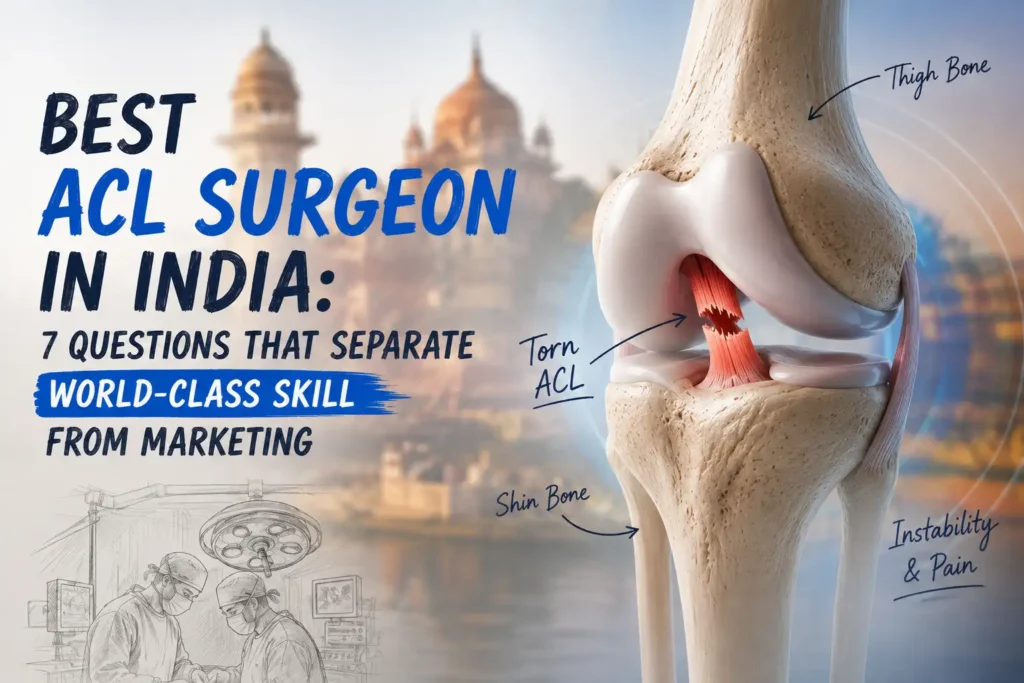
A torn ACL puts you in a position no patient wants to be in: choosing a surgeon for a procedure that will shape how your knee functions for the next 20 to 30 years, with no reliable way to tell who is genuinely qualified and who simply markets well.
Degrees, hospital names, and website testimonials all look similar on a screen. What actually separates a top ACL surgeon in India from an average one are the clinical decisions they make before, during, and after surgery. Decisions that you can test with the right questions.
What follows are seven specific clinical questions, why each one matters for your knee, and Dr. Prince Uchadiya’s answers to each, on the record, for you to compare against any surgeon you consult.
Why Finding the Right ACL Surgeon Matters More in India Than Anywhere Else
India has over 70,000 registered orthopaedic surgeons. Fewer than 5% have formal fellowship training in arthroscopy. Fewer still perform ACL reconstructions at volumes high enough to maintain peak surgical skill.
The gap between a general orthopaedic surgeon, which any patient searching for a leading ACL reconstruction specialist in India should understand, who occasionally performs ACL surgery and a subspecialty-trained arthroscopic surgeon who performs it weekly is not a marketing distinction. It is a measurable clinical difference. Published research on PubMed demonstrates that surgeon volume directly correlates with ACL reconstruction outcomes: lower revision rates, fewer complications, better functional scores.
In a country where the patient has no regulatory body ranking surgeons by procedure-specific outcomes, the burden of evaluation falls entirely on you. These seven questions are the tools for that evaluation.
Question 1: How Many ACL Reconstructions Do You Perform Per Year?
Volume is the single most validated predictor of surgical quality across all of orthopaedics. When evaluating the most experienced ACL surgeon in India for your case, remember that a surgeon performing 5 ACL reconstructions annually and one performing 50 are not offering the same product, regardless of what their degrees say.
High-volume surgeons develop intraoperative pattern recognition that low-volume surgeons simply cannot build. Recognising a lateral meniscal tear that was not visible on MRI. Adjusting tunnel angle when bone quality is softer than expected. Choosing between hamstring and patellar tendon graft based on anatomy visible only during surgery. These decisions happen in real time and improve with repetition.
What a credible answer sounds like: A specific number. “I perform approximately 40 to 60 ACL reconstructions per year” is credible. “I have extensive experience” is not an answer.
Dr. Prince Uchadiya’s answer: Over 500 arthroscopic procedures spanning ACL, PCL, meniscus, shoulder, and ankle. ACL reconstruction is the single most frequently performed procedure in his practice.
Question 2: Do You Use Anatomic or Isometric Tunnel Placement?
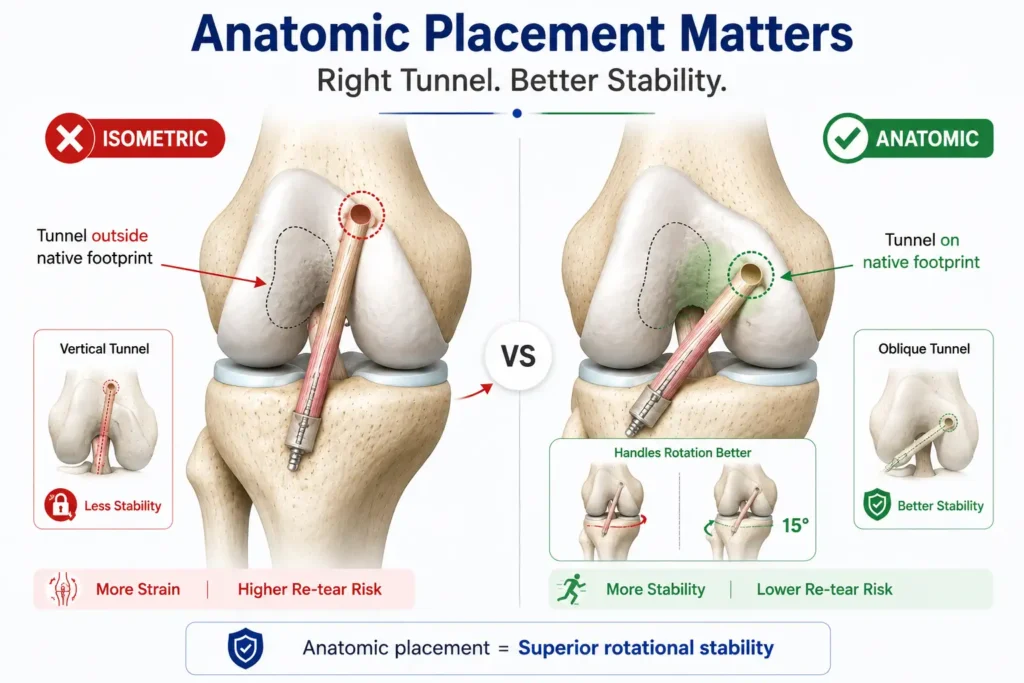
This question separates surgeons who have kept current with ACL reconstruction science from those still using techniques developed 20 years ago.
Isometric placement positions the graft tunnel based on geometric convenience. Anatomic placement positions it to replicate the native ACL’s exact footprint on the femur and tibia. According to AAOS clinical standards, anatomic reconstruction produces superior rotational stability, which is what the knee actually needs during cutting, pivoting, and deceleration.
A surgeon who does not know what this question means has not engaged with ACL-specific surgical literature in the past decade. That information alone is worth the consultation fee.
Dr. Prince Uchadiya’s answer: Anatomic single-bundle reconstruction. Tunnel placement guided by direct arthroscopic visualisation of the native ACL footprint, not by fixed reference points on fluoroscopy.
Question 3: What Is Your Graft Preference, and Why?
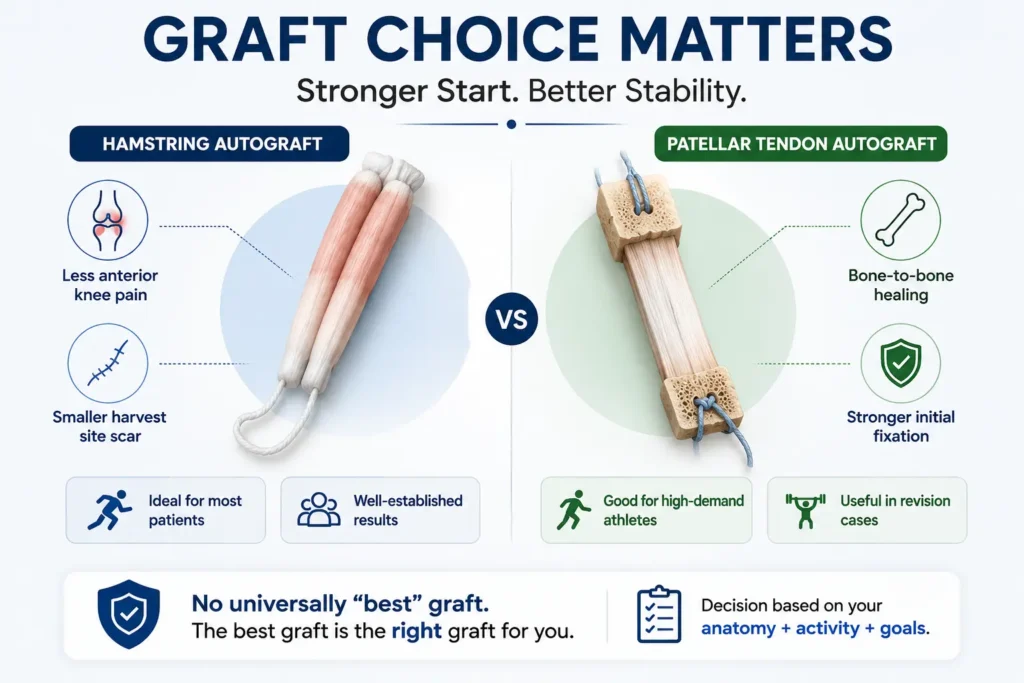
There is no universally “best” graft. There is a best graft for each patient. Hamstring autograft and patellar tendon autograft (bone-patellar tendon-bone) are the two most established options, each with distinct advantages.
Hamstring autograft produces less anterior knee pain and a smaller harvest site scar. Patellar tendon autograft provides bone-to-bone healing at both ends, which some evidence suggests offers a marginally stronger initial fixation for high-demand contact athletes.
The question is not which graft the surgeon prefers. It is whether they can articulate why they prefer it for your specific case, and whether they are comfortable using the alternative when your anatomy or activity demands it.
What a weak answer sounds like: “I always use hamstring.” A surgeon who uses only one graft is either not trained in both techniques or is prioritising their own surgical convenience over your specific needs.
Dr. Prince Uchadiya’s answer: Hamstring autograft for most patients due to reliable outcomes and minimal donor site morbidity. Patellar tendon autograft for specific cases: competitive athletes in contact sports, revision reconstructions where hamstring has already been harvested, or patients with naturally lax ligaments where stronger initial fixation benefits the outcome.
Question 4: What Is Your Re-Rupture Rate?
Published ACL graft re-rupture rates in high-quality centres range from 3 to 10%, depending on patient population. Younger athletes in pivoting sports sit at the higher end. Older, less active patients sit at the lower end.
A surgeon who claims a 0% re-rupture rate is either not following up long enough, not treating high-demand athletes, or not being honest. A surgeon who quotes a specific percentage and explains what patient group it applies to is demonstrating both transparency and clinical rigour.
This question also reveals whether the surgeon tracks their own outcomes systematically. Surgeons who do not know their re-rupture rate are not measuring the single most important indicator of their surgical quality.
Dr. Prince Uchadiya’s answer: Tracked prospectively. Re-rupture rate consistent with published benchmarks for a predominantly young, active patient population. Every case is followed to a minimum of 12 months post-surgery with functional testing at defined intervals.
Question 5: What Are Your Return-to-Sport Criteria?
This question exposes the biggest gap between an average ACL surgeon and a genuinely skilled one.
“Come back in 6 months and we will see” is not a return-to-sport protocol. It is the absence of one. Milestone-based return-to-sport testing, the current international standard, involves specific, measurable criteria that must be met before competitive activity is permitted:
- Quadriceps strength symmetry above 90% of the healthy side
- Single-leg hop test above 90% of the healthy side
- No episodes of giving-way or apprehension during agility testing
- Psychological readiness assessed through validated questionnaires
- Sport-specific functional testing tailored to the patient’s actual sport
A surgeon who clears patients for sport based on calendar time alone, without objective testing, is accepting an unnecessarily high re-injury risk.
Dr. Prince Uchadiya’s answer: Milestone-based clearance at every stage. No patient returns to competitive sport without passing functional strength and stability benchmarks. The full protocol is documented in the return-to-sport milestone framework, specific to each activity level.
Question 6: Where Did You Complete Your Arthroscopy Fellowship?
ACL reconstruction is an arthroscopic procedure. The general orthopaedic residency covers arthroscopy in varying depth, but a dedicated fellowship provides hundreds of hours of supervised arthroscopic operating that residency alone does not.
The fellowship institution matters because it determines the complexity of cases the surgeon was exposed to during training. A fellowship at a high-volume sports medicine centre exposes the trainee to multi-ligament injuries, revision cases, and complex combined pathology. A fellowship at a low-volume institution may provide excellent teaching but limited case diversity.
Dr. Prince Uchadiya’s answer: Fellowship in Arthroscopy and Sports Medicine, following MS Orthopaedics at KEM Hospital Mumbai (one of India’s highest-volume trauma and sports injury centres) and DNB Orthopaedics (Gold Medal, highest national score). Additional international qualification: MRCS Part A, Royal College of Surgeons, England.
Those credentials are what to look for locally too, as our arthroscopy doctor in Indore page explains.
Question 7: When You Find a Meniscal Tear During ACL Surgery, Do You Repair or Remove?
This is the question that tests clinical philosophy, not just technical skill.
Up to 50% of ACL injuries involve concurrent meniscal damage. During surgery, when a meniscal tear is found that was not visible on MRI, the surgeon makes a decision that affects the patient’s joint health for the next 20 to 30 years: repair the meniscus (technically harder, longer surgery, more complex rehab) or remove the damaged portion (technically easier, faster surgery, but accelerated cartilage degeneration long-term).
Surgeons who default to removal are choosing their own convenience over the patient’s long-term joint preservation. The detailed clinical reasoning behind meniscal preservation during ACL surgery is explained in the combined ACL and meniscus injury guide.
Dr. Prince Uchadiya’s answer: Repair whenever the tear pattern and vascularity allow it. Meniscal tissue, once removed, does not regenerate. Every salvageable meniscus is repaired, even when repair adds 20 to 30 minutes to the procedure. The short-term inconvenience of a longer surgery and more cautious rehab is a fraction of the cost of premature arthritis at age 40.
The Credential Profile That Answers All Seven
Dr. Prince Uchadiya, DNB Orthopaedics Gold Medalist, Orthopaedic and Arthroscopic Surgeon, brings a profile that directly addresses every question listed above:
- Gold Medal in DNB Orthopaedics , not a class rank, a national rank. Highest aggregate across written, clinical, and oral examination in the country.
- MS Orthopaedics, KEM Hospital Mumbai , surgical training at one of India’s busiest trauma and sports injury centres.
- Fellowship in Arthroscopy and Sports Medicine , dedicated subspecialty training in exactly the technique ACL surgery demands.
- MRCS Part A, Royal College of Surgeons, England , international standards layered on top of Indian surgical training.
- 500+ arthroscopic procedures , ACL, PCL, meniscus, shoulder, ankle. Volume that builds judgment no textbook can replicate.
- Associated with multiple hospitals in Indore , flexibility for patients across insurance networks and Ayushman Bharat coverage.
That profile is why patients across the country consider Dr. Prince Uchadiya when looking for the best ACL surgeon in India. Not because a website says so. Because the qualifications, the training institution, the procedure volume, and the clinical philosophy behind every answer are verifiable, specific, and on record.
Why Patients from Across India Choose Indore Over Metro Hospitals
A fair question: if Dr. Prince Uchadiya has KEM Mumbai credentials, why practice in Indore? And why should patients consider travelling to a tier-2 city for surgery they could get in Mumbai or Delhi?
| Factor | Metro Hospital (Mumbai/Delhi) | Dr. Prince Uchadiya, Indore |
|---|---|---|
| ACL surgery cost | Rs. 1,50,000 to 3,50,000 | Rs. 80,000 to 1,80,000 |
| Surgeon training | Varies by individual surgeon | KEM Mumbai + DNB Gold Medal + Arthroscopy Fellowship |
| Surgical technique | Anatomic arthroscopic (at top centres) | Anatomic arthroscopic (same technique) |
| Follow-up feasibility | Impractical for non-local patients | Accessible from MP, Rajasthan, Gujarat, Chhattisgarh |
| Wait time | 2 to 6 weeks at top centres | Typically within 7 to 10 days of consultation |
| Ayushman Bharat | Limited availability at private metros | Accepted with full documentation support |
Patients searching for a trusted ACL specialist in India often overlook this: the surgical technique does not change with the city. The training does not downgrade with the pin code. Patients from Bhopal, Ujjain, Dewas, Ratlam, Jabalpur, Jaipur, Ahmedabad, Surat, and Nagpur travel to Indore for arthroscopic ACL reconstruction because the clinical quality matches metro standards while the cost, accessibility, and follow-up logistics are significantly better. Comprehensive ACL surgery cost details are available on the dedicated page.
What Happens Before, During, and After ACL Surgery with Dr. Prince Uchadiya
Patients researching the right ACL surgeon in India want to know what the actual experience looks like, not just credentials.
Before Surgery
Every patient undergoes a clinical examination using the Lachman test, anterior drawer, and pivot shift assessment. MRI is reviewed slice by slice, not summarised from a printed report. Treatment options, surgical and non-surgical, are discussed with specific reference to the patient’s age, tear pattern, meniscal status, and activity goals. For patients where non-surgical management is genuinely viable, the long-term evidence on ACL tears managed without surgery is reviewed so the decision is informed, not pressured.
During Surgery
Anatomic single-bundle reconstruction. 60 to 90 minutes. Two to three keyhole incisions of 5 mm each. HD arthroscopic visualisation. Graft selection individualised. Concurrent meniscal repair when indicated. Walking with crutch support begins within 24 hours.
After Surgery
Milestone-based rehabilitation spanning 6 to 9 months. Detailed protocol in the post-ACL surgery physiotherapy guide. Objective testing at months 3, 6, and 9 before any return to sport is cleared. Patients eligible under Ayushman Bharat receive full coverage with documentation handled internally.
Dr. Prince Uchadiya, DNB Orthopaedics Gold Medalist, Orthopaedic and Arthroscopic Surgeon: “Any surgeon can list credentials. What I want patients to do is test those credentials with real clinical questions. Ask me about tunnel placement. Ask me about my re-rupture rate. Ask me what I do when I find a meniscal tear during surgery. The answers will tell you whether I am the right surgeon for your knee. And if my answers do not satisfy you, keep looking. The right surgeon for your ACL is the one whose answers make clinical sense to you, not the one whose website looks the most impressive.”
10 Questions Patients Ask When Searching for the Best ACL Surgeon in India
1. Does it matter where in India I get my ACL surgery done?
The city matters far less than the surgeon. A Gold Medalist arthroscopic surgeon in Indore performing 50+ ACL reconstructions annually offers measurably better outcomes than a general orthopaedic surgeon in Mumbai performing 5. Evaluate the surgeon’s training, volume, and technique. The hospital’s city name is the least important variable.
2. Are metro hospitals automatically better for ACL surgery?
Metro hospitals have brand recognition. Surgical quality comes from the individual surgeon, not the institution’s marketing budget. KEM-trained surgeons practise across the country. Fellowship-trained arthroscopic specialists exist outside Mumbai and Delhi. The assumption that geographical proximity to a famous hospital equals better surgery is not supported by outcome data.
3. What is the average ACL surgery cost across India?
Rs. 80,000 to 3,50,000 depending on city, hospital category, surgeon fees, graft type, and concurrent procedures. Metro private hospitals typically charge Rs. 1,50,000 to 3,50,000. Indore offers Rs. 80,000 to 1,80,000 for the same arthroscopic procedure with equivalent clinical standards.
4. Can I travel for ACL surgery and manage follow-up remotely?
Partially. The surgery and immediate post-operative care require physical presence. Subsequent rehabilitation can be managed locally with a physiotherapist following the surgeon’s written protocol. Milestone assessments at months 3 and 6 should ideally happen in person. A surgeon within driveable distance makes this significantly more practical than one requiring a flight for every follow-up.
5. How do I verify a surgeon’s claimed experience?
Ask specific clinical questions, not general ones. A surgeon with genuine high-volume ACL experience will answer questions about tunnel placement technique, graft selection rationale, and re-rupture tracking without hesitation. A surgeon inflating their experience will give vague or deflecting answers. The seven questions listed above are designed exactly for this verification.
6. Is robotic ACL surgery better than standard arthroscopic surgery?
Robotic assistance in ACL reconstruction is marketed aggressively but does not currently have Level 1 evidence showing superior outcomes over standard arthroscopic technique performed by an experienced surgeon. The surgeon’s skill, training, and judgment determine the result. The robot is a tool, not a substitute for surgical judgment.
7. Should I choose a surgeon who specialises only in ACL, or one who does multiple joint surgeries?
An arthroscopic surgeon who performs ACL, meniscus, shoulder, and ankle procedures is well-rounded and maintains broad arthroscopic skill. A surgeon who does only ACL may have high volume in that one procedure but a narrower overall surgical perspective. The ideal profile is high ACL volume within a broader arthroscopic practice, not artificial hyper-specialisation or diffuse generalism.
8. My friend got ACL surgery in Thailand for cheaper. Should I consider medical tourism?
International medical tourism for ACL surgery introduces follow-up complications that domestic surgery avoids. ACL rehabilitation spans 6 to 9 months with milestone testing at defined intervals. Managing that process across international borders is impractical. India has surgeons with world-class training at a fraction of international costs. Travelling abroad for a procedure available at equivalent quality domestically adds risk without adding value.
9. What credentials should I look for in an ACL surgeon?
In order of importance: fellowship training in arthroscopy or sports medicine (non-negotiable), high annual ACL reconstruction volume (minimum 30 per year), training at a recognised high-volume institution, and verifiable outcome tracking. Board certification (MS/DNB in Orthopaedics) is the baseline, not the differentiator. What sits above that baseline is what separates an adequate surgeon from a trusted one.
10. Why should I consider Dr. Prince Uchadiya specifically?
Because every answer listed above is specific, verifiable, and on the record. Gold Medal in DNB Orthopaedics (national rank). KEM Hospital Mumbai training (highest-volume institution). Fellowship in Arthroscopy. 500+ arthroscopic procedures. Anatomic tunnel placement. Meniscal preservation philosophy. Milestone-based return-to-sport protocol. Ayushman accepted. Transparent cost structure. And a standing invitation to test every claim with the seven questions listed above during your consultation.