Key Takeaways
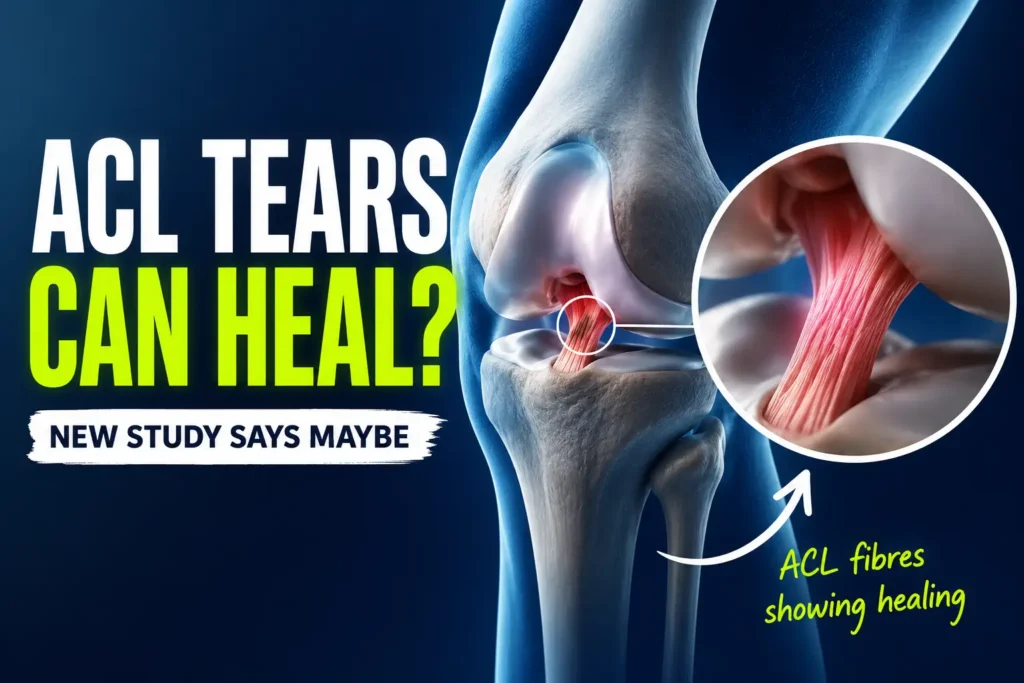
- For decades, orthopaedic teaching held that a torn ACL cannot heal. New MRI research is challenging that certainty, though not overturning it entirely.
- A 2024 study presented at OARSI, tracking 43 knees with 3D MRI, found that 30% showed normal, continuous ACL fibres at 2 years, with another 33% showing continuity after structured rehabilitation.
- A separate bracing approach, the Cross Bracing Protocol, produced even more striking numbers: 90% of 80 patients showed MRI signs of healing at just 3 months, published in the British Journal of Sports Medicine.
- Grade matters enormously. Patients with Grade 1 sprains in that same study had a 92% return to pre-injury sport. Patients with Grade 2 to 3 tears had a much lower 64%.
- This evidence changes what patients should ask their surgeon. It does not mean every torn ACL will heal, and it does not mean bracing replaces a proper clinical assessment.
The question of whether can ACL tear heal without surgery has followed orthopaedics for decades. For as long as most currently practising orthopaedic surgeons have been in training, one fact was treated as settled science: the ACL cannot heal itself. Full stop, end of discussion.
That certainty is now being tested by imaging technology that simply did not exist when the original assumption was formed. High-resolution 3D MRI can now detect continuity in ACL fibres that older scanning methods missed entirely. What researchers are finding is uncomfortable for old textbooks and genuinely useful for patients.
So can ACL tear heal without surgery? The honest, current answer is: sometimes, under specific conditions, and the science is moving faster than most clinical practice has caught up with. The full picture of what happens when healing does not occur is covered separately in long-term effects of ACL tear without surgery.
The Study That Is Changing the Conversation
The strongest recent evidence on the strongest evidence for can ACL tear heal without surgery came at the 2024 OARSI World Congress on Osteoarthritis, where researchers from the University of Melbourne presented findings from the NACOX study using advanced 3D MRI to examine ACL structure over time. The results, drawn from 43 knees followed for 2 years, broke down as follows:
- 30% showed normal, continuous ACL fibres. On imaging, these ligaments looked essentially reconnected.
- 33% showed continuous fibre structure after rehabilitation alone. Not necessarily normal, but bridging the gap.
- 16% remained partially ruptured. Some fibre disruption persisted.
- 21% remained completely ruptured. No meaningful healing occurred.
Put simply: roughly two-thirds of the knees in this study showed some degree of structural continuity at 2 years without surgery. That is a genuinely striking number, and it directly challenges the blanket rule that complete ACL tears never heal.
The Bracing Study That Made Headlines
A separate and even more widely reported study examined something called the Cross Bracing Protocol, developed by orthopaedic surgeon Dr. Tom Cross. The concept is mechanically simple: hold the knee at 90 degrees of flexion for 4 weeks using a hinged brace, bringing the torn ACL ends into closer proximity, then progressively increase mobility over an additional 8 weeks.
Published in the British Journal of Sports Medicine, the results were notable. Among 80 patients who followed this protocol, 72 knees, or 90%, showed evidence of ACL healing on MRI at just 3 months. That timeline is remarkably fast compared to the multi-year data from other studies.
Grade of injury made a significant difference in outcomes. Patients with Grade 1 sprains achieved a 100% normal knee stability exam and a 92% return to pre-injury sport. Patients with Grade 2 to 3 tears saw those figures drop considerably, to 40% and 64% respectively.
An orthopaedic surgeon commenting on this research, uninvolved in the original study, called it potentially “a game changer,” while also noting the follow-up period was too short to draw firm long-term conclusions.
Why Older Textbooks Say This Cannot Happen
Before addressing whether can ACL tear heal without surgery in specific cases, it helps to understand why the traditional explanation says they do not. That explanation centres on the knee’s synovial environment. Synovial fluid, essential for lubricating the joint, also contains enzymes that dissolve blood clots. Since blood clots normally provide the scaffold for tissue repair everywhere else in the body, their absence inside the joint was thought to make ACL healing structurally impossible.
The newer bracing research offers a plausible explanation for why this assumption may not apply universally. By physically bringing the torn ends closer together and reducing the gap, the Cross Bracing Protocol may create conditions where a stable clot can form and persist long enough for tissue bridging to occur, even in a synovial environment that would otherwise dissolve it.
The bracing approach offers a mechanical workaround to a biological problem, not proof that the original biology was wrong. Both explanations can be true simultaneously.
What Determines Whether Your ACL Can Heal
The question of can ACL tear heal without surgery for your specific case depends on more than wishful thinking. Not every torn ACL is a candidate for natural healing, even with bracing. Research has identified several factors that predict success:
- Location of the tear. Tears located closer to the femoral attachment, rather than mid-substance ruptures, tend to have better healing potential because more tissue remains available for bridging.
- Proximity of the torn ends. On initial MRI, if the torn ends are already close together with minimal fibre separation, the odds of natural continuity improve.
- Absence of concurrent injury. A tear with no associated meniscal damage, no significant bone bruising, and no other ligament involvement has a cleaner healing environment.
- Grade of the tear. Grade 1 sprains heal reliably. Grade 2 to 3 tears heal less predictably and less completely, as the bracing study numbers show clearly.
- Age and activity demands. Younger patients and those with lower-intensity activity goals appear to be better candidates, partly because the functional bar for success is lower.
A qualified orthopaedic surgeon can assess most of these factors directly through examination and imaging. For a foundational understanding of how ACL and other ligament injuries are typically identified, the guide on recognising ACL and ligament tears covers the early warning signs worth knowing before your first consultation.
Dr. Prince Uchadiya, DNB Orthopaedics Gold Medalist, Orthopaedic and Arthroscopic Surgeon: “This research is genuinely exciting, and I follow it closely. But I want patients to understand what it does and does not mean. It does not mean every ACL tear should now skip the operating table. It means we now have a more precise way to identify the specific subset of patients for whom a structured non-surgical approach has real biological support, rather than just hope.”
Even where healing occurs, physiotherapy after ACL surgery is what converts it into usable stability.
What This Research Does Not Prove
Enthusiasm about new findings can outpace what the evidence actually shows. Several important caveats apply here.
The bracing study followed patients for only 3 months on the primary MRI endpoint. Long-term outcomes, including return to competitive sport years later and eventual osteoarthritis rates, remain unknown. A knee that shows fibre continuity on MRI is not automatically a knee with normal mechanical strength. Structural bridging and full functional strength are related but distinct outcomes.
The NACOX study’s 2-year data is more reassuring on duration but still represents a relatively small sample of 43 knees. Larger, longer-term trials are needed before this becomes standard first-line advice for every patient.
None of this means the research should be dismissed. It means it should be applied carefully, with appropriate patient selection, not treated as a universal green light to avoid surgery.
Separating Real Healing Evidence from Overhyped Marketing Claims
The question of can ACL tear heal without surgery has become marketing material too. Since this research gained media attention, some clinics have started marketing aggressive “natural ACL healing” packages, sometimes bundling in treatments with far weaker evidence behind them, such as certain injectable therapies presented as guaranteed regeneration.
It is worth understanding the difference between the specific, structured protocols studied in these trials and generic promises of biological healing. The detailed comparison on PRP versus stem cell therapy for cartilage and joint conditions explains where genuine evidence currently stands for these adjacent but distinct treatment categories, which are frequently, and sometimes misleadingly, marketed alongside ACL healing claims.
If a clinic offers you a treatment with confident promises of ACL regeneration without discussing tear location, grade, and imaging follow-up, that is a signal to seek a second, more rigorous opinion.
How Can ACL Tear Heal Without Surgery Assessment Works in Practice
Answering can ACL tear heal without surgery for your case requires more than reading a research summary online. It requires structured clinical evaluation.
The process typically involves a clinical examination using tests such as the Lachman test, which assesses anterior knee laxity and gives an experienced examiner immediate information about ligament integrity. This is paired with detailed MRI review, specifically looking at tear location, fibre separation distance, and any concurrent injury to the meniscus or other structures.
If the profile matches favourable healing criteria, a structured bracing and rehabilitation protocol can begin, with planned follow-up imaging at defined intervals to track progress objectively rather than relying on symptoms alone. If the profile does not match, or if follow-up imaging at 3 months shows no meaningful change, surgical reconstruction remains available without having lost significant time, provided the trial period was appropriately monitored from the start.
This assessment-driven approach also connects to the broader questions covered in the guide on ACL tear treatment without surgery, which details the full non-surgical rehabilitation pathway beyond just the healing question addressed here, in the piece exploring grade 3 ACL tear no surgery outcomes specifically for complete ruptures, and in the month-by-month breakdown found in ACL tear recovery time without surgery.
Dr. Prince Uchadiya, DNB Orthopaedics Gold Medalist, Orthopaedic and Arthroscopic Surgeon: “What excites me most about this research is not that it lets people avoid surgery. It is that it gives us better tools to have an honest, evidence-based conversation instead of a one-size-fits-all rule. Some patients genuinely are good candidates for a structured non-surgical trial. My job is to figure out, with real data, whether you are one of them.”
10 Questions Patients Ask About Whether an ACL Can Heal Naturally
1. If my ACL can heal naturally, why do so many athletes still get surgery?
Because natural healing, even when it occurs, restores structural continuity but not necessarily the exact mechanical strength and precise tension of a healthy native ACL. For elite athletes whose careers depend on maximum knee performance, surgical reconstruction with a graft remains the more predictable, proven path. The natural healing research is most relevant for recreational and moderately active patients rather than professional competitors.
2. How would I know if my specific tear is a good candidate for natural healing?
Your surgeon needs to review your MRI specifically for tear location, the gap distance between torn ends, and whether other structures like the meniscus are involved. This is not something you can determine by reading your radiology report alone. Book a consultation where these images are reviewed with you directly.
3. Does wearing a regular knee brace do the same thing as the Cross Bracing Protocol?
No. The Cross Bracing Protocol involves a specific, hinged brace locked at 90 degrees of flexion for a defined period, followed by a precise progressive mobility schedule. A generic off-the-shelf knee brace worn for general support does not replicate this mechanism and should not be assumed to produce the same healing effect.
4. Can a completely torn, fully separated ACL heal with bracing?
The evidence for this is weaker than for tears with the ends already close together. Complete ruptures with wide separation between the torn ends have a lower likelihood of forming a stable bridging clot, even with the brace bringing the knee into flexion. This is exactly why tear-specific imaging assessment matters before deciding on this approach.
5. If I try a non-surgical healing protocol and it doesn’t work, have I wasted time?
If the trial is properly monitored with follow-up MRI at defined checkpoints, typically around 3 months, you have not lost meaningful time. Surgical reconstruction remains just as viable afterward. What genuinely wastes time is an unmonitored trial with no imaging follow-up, where months pass without anyone confirming whether healing is actually occurring.
6. Is this new research accepted by most orthopaedic surgeons yet?
Not universally. Genuine emerging science describes this territory well, and clinical practice tends to be conservative about adopting new approaches until longer-term data accumulates. Many experienced surgeons are cautiously interested rather than fully convinced, which is a reasonable scientific position given the relatively short follow-up periods in the current studies.
7. Does age affect whether my ACL can heal on its own?
Younger patients, including adolescents with open growth plates, appear to have somewhat better healing potential in some of the case reports and smaller studies. However, age alone is not the deciding factor. Tear characteristics and grade matter more than age in most of the available evidence.
8. What is the risk of trying to heal naturally instead of just having surgery early?
If your tear is closely monitored during a structured trial, the main risk is a few months of continued activity limitation rather than any lasting harm to the knee, provided you are not stressing an unstable joint in the meantime. The risk profile changes if the trial is unsupervised or if you resume high-demand activity before healing is confirmed on imaging.
9. Can meniscus tears heal the same way?
Meniscus healing potential depends heavily on which zone of the meniscus is torn, since blood supply varies significantly across its structure. This is a related but separate question from ACL healing, and it should be assessed independently as part of your overall knee evaluation, particularly if both structures are involved in the same injury.
10. Where should I go to get properly assessed for this specific approach?
Look for an orthopaedic surgeon who is familiar with the current MRI-based healing research, has access to the imaging technology needed for precise follow-up, and is willing to discuss both the non-surgical trial and surgical reconstruction as genuinely open options rather than defaulting immediately to one or the other.