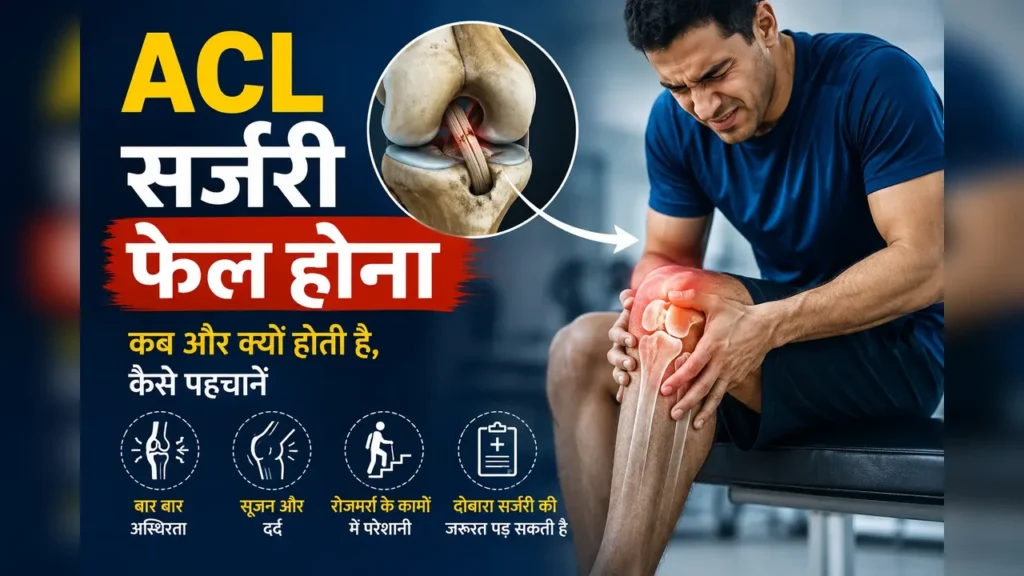
A knee that buckles on a staircase, years after a sports injury nobody operated on, is rarely bad luck. It is usually the signature of an ACL tear left untreated for years, quietly reshaping the joint long after the original accident has been forgotten. Patients walk into the clinic on Nipania main road, Indore, describing the same story: a twist on the football field or a fall from a two wheeler at 19, a swollen knee that “settled down” in a few weeks, and then a decade of occasional giving way that they simply learned to live with. What they are describing, in plain terms, is chronic anterior cruciate ligament insufficiency, and it comes with consequences that go far beyond an unstable knee.
An ACL tear left untreated for years means the anterior cruciate ligament never healed or was surgically reconstructed after the original injury, leaving the knee mechanically unstable. Over time, this instability causes repeated micro trauma to the meniscus and cartilage, often leading to early osteoarthritis and permanent loss of knee function.
What an ACL Tear Left Untreated for Years Does to Your Knee
The anterior cruciate ligament sits deep inside the knee joint and controls two movements: forward sliding of the shinbone on the thighbone, and rotation during pivoting. When it tears and stays unrepaired, the knee loses that internal brake. Everyday actions such as stepping off a curb, pivoting to answer someone calling your name, or descending stairs quickly can cause the tibia to shift out of place for a split second. Patients often call this “the knee slipping” or “the knee not trusting itself.”
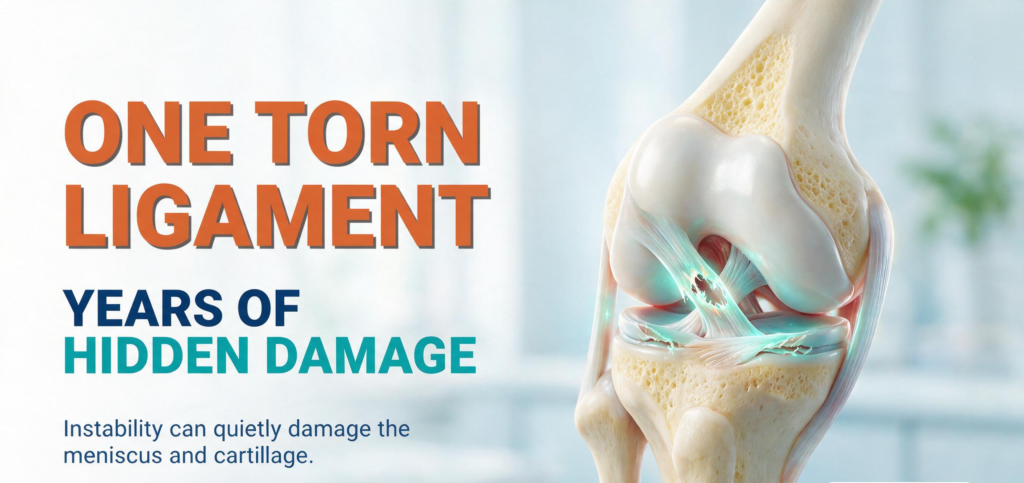
That instability does not stay confined to the ligament. Every episode of shifting grinds the meniscus and articular cartilage that line the joint. Over months and years, this repeated low grade trauma builds into structural damage that a scan can clearly show, even in patients who insist they have “gotten used to” the knee and manage fine in daily life.
Why the ACL Doesn’t Heal on Its Own
Unlike the medial collateral ligament on the side of the knee, which sits outside the joint capsule and has its own blood supply, the ACL lives inside the synovial cavity, bathed in joint fluid. That fluid is excellent at keeping the joint lubricated, but it also washes away the blood clot that any torn tissue needs to begin repair. Without that clot, the two torn ends of the ligament cannot knit back together.
This is a key reason doctors are direct with patients: a completely torn ACL will not mend itself with rest, physiotherapy alone, or time. Partial tears with intact fibers can sometimes be managed conservatively in low demand patients, but a complete rupture left alone simply stays torn, and the knee keeps compensating around a ligament that is no longer doing its job.
Early Warning Signs Patients Tend to Ignore
Because the sharp pain of the original injury usually fades within a few weeks, many people never connect their later knee complaints back to that old accident. The pattern worth watching for includes:
- A knee that occasionally “gives way” or feels like it will buckle during quick turns or uneven ground
- Recurrent swelling after long walks, gym sessions, or a day of standing
- A sense that the knee is loose, or that the shin shifts slightly forward when going down stairs
- Clicking, catching, or locking, which often signals a meniscus tear developing alongside the old ligament injury
- Muscle wasting around the thigh on the injured side, from years of subconsciously avoiding full use of that leg
Any one of these on its own might seem minor. Together, over years, they point toward a knee that has been quietly deteriorating.
The Domino Effect: Meniscus, Cartilage and Early Osteoarthritis
This is the part patients find hardest to accept, because the knee often still “works” for ordinary life. But mechanically, an ACL tear left untreated for years sets off a predictable chain reaction. Each time the tibia shifts abnormally, the meniscus, the C shaped cartilage cushions inside the knee, absorbs shear forces it was never designed to handle. Meniscus tears follow, often affecting the same knee more than once, since a torn meniscus is even harder to repair fully once it happens on top of ligament instability.
Underneath the meniscus lies the articular cartilage, the smooth surface that lets bones glide against each other painlessly. Repeated abnormal loading wears this surface thin. Once cartilage is lost, it does not regenerate the way skin or bone does. The end result, well documented in orthopaedic literature and in clinic experience alike, is early onset osteoarthritis, sometimes appearing in patients in their thirties or forties who would otherwise have had decades before joint wear became an issue.
Treated vs Untreated ACL Tear: What the Difference Looks Like Over Time
| Factor | Knee Treated With ACL Reconstruction | ACL Tear Left Untreated for Years |
|---|---|---|
| Joint stability | Restored, tibia and femur move together normally | Progressive looseness, episodes of giving way |
| Meniscus health | Protected from repeat shear injury | Higher risk of recurrent or unrepairable tears |
| Cartilage wear | Slowed significantly with timely surgery | Accelerated, often leading to early cartilage loss |
| Return to sport or activity | Structured rehab allows return to pivoting sports | Pivoting sports usually become unsafe or impossible |
| Long term joint health | Lower long term risk of premature osteoarthritis | Meaningfully higher risk of early knee arthritis |
Who Is Most at Risk From Delaying Treatment
Not every ACL tear behaves the same way once ignored. Age, activity level, and how the knee is used daily all influence how fast the damage accumulates. Young, physically active patients, especially those involved in football, badminton, or any sport with pivoting and sudden stops, tend to develop meniscus and cartilage damage faster because their knees are loaded more aggressively and more often. Patients whose work involves squatting, climbing, or standing for long hours also see faster wear, even without sport.
Sedentary patients sometimes assume they are safe because they rarely stress the knee. That is only partly true. An ACL tear left untreated for years still causes subtle instability with everyday movement, and cartilage damage builds up slowly even at a lower intensity. It simply takes longer to become symptomatic, which is exactly why so many patients only present in their forties or fifties with knees that have quietly deteriorated since a college sports injury or an old accident.
Diagnosis: Confirming a Chronic ACL Tear
A physical exam alone can suggest ACL insufficiency through tests like the Lachman test or the anterior drawer test, which check how far the tibia shifts forward compared to the uninjured side. But confirming the extent of secondary damage after years of instability requires imaging. A dedicated knee MRI shows the ligament itself, along with the condition of the meniscus, cartilage surfaces, and any bone changes that have developed. In longstanding cases, plain X ray imaging is also useful to check for early joint space narrowing, an early marker of arthritis.
This full picture matters because the treatment plan for a fresh tear looks different from one for a knee that has been unstable for a decade. For a detailed look at how reconstruction is planned and performed, our ACL surgery page walks through the surgical approach step by step.
Treatment Options, Even Years Later
A common question in the clinic is whether it is “too late” for surgery once years have passed. In most cases, it is not. Arthroscopic ACL reconstruction remains the standard treatment for a torn ligament regardless of how long ago the injury occurred, using keyhole incisions and a tendon graft, usually taken from the patient’s own hamstring or patellar tendon, to rebuild a new, functioning ligament.
What changes with time is the complexity. A knee with years of untreated instability often needs more than a straightforward reconstruction:
- Assessment of meniscus damage. Torn segments may need trimming or repair during the same surgery.
- Evaluation of cartilage wear. Significant cartilage loss may need additional procedures alongside ligament reconstruction.
- Reconstruction of the ACL itself, using an appropriate graft chosen for the patient’s age, activity level, and anatomy.
- Addressing rotational instability. In select cases, an additional stabilizing procedure on the outer knee may be added for lasting control.
- Planning realistic goals. Surgery restores stability and slows further joint damage, but existing cartilage wear cannot be reversed, so expectations are set clearly before the procedure.
Rehabilitation After Treatment
Surgery rebuilds the ligament, but a structured recovery is what makes that ligament reliable again. Early phases focus on regaining full knee extension and controlling swelling, followed by progressive strengthening of the quadriceps and hamstrings, balance training, and finally sport specific or activity specific drills depending on what the patient needs to return to. Because a chronically unstable knee often carries years of muscle wasting and altered movement patterns, rehabilitation after a delayed ACL reconstruction tends to need closer supervision than a straightforward, early surgery case. Our post injury rehabilitation program is built around exactly this kind of staged, supervised recovery.
Steps to Take If You’ve Been Living With an Untreated ACL Tear
- Get an updated knee MRI, even if you had one years ago, since it will show current meniscus and cartilage status, not just the original ligament tear.
- Book a clinical evaluation with an orthopaedic or sports medicine specialist rather than relying on how the knee “feels” day to day.
- Ask specifically about meniscus and cartilage findings, not just the ligament, since these often drive the treatment decision.
- Discuss realistic goals, whether that means returning to sport, protecting the joint for daily activity, or simply stopping further deterioration.
- Start guided rehabilitation for muscle strength and control, whether or not surgery is chosen, since a stronger knee copes better either way.
Frequently Asked Questions
Is it too late for ACL surgery years after the injury?
No. Reconstruction can be performed years after the original tear. The surgical technique itself does not change dramatically with time, though associated meniscus or cartilage damage may need to be addressed at the same time.
Can an ACL tear heal without surgery after years of instability?
A complete ACL tear does not heal on its own at any point, including years later, because the ligament sits inside the joint without the external blood supply needed for natural repair. Some partial tears in low demand patients can be managed without surgery, but this is decided case by case.
What happens if an ACL tear is left untreated for years?
The knee develops recurring instability, which leads to repeated stress on the meniscus and cartilage. Over years, this pattern commonly results in meniscus tears, cartilage thinning, and early osteoarthritis, along with reduced confidence in the knee during sport or uneven terrain.
Does an old, untreated ACL tear always need surgery?
Not always. Patients with low activity demands, no episodes of giving way, and stable knees on examination may be managed with strengthening and activity modification. Surgery is generally recommended for active patients, those with recurring instability, or anyone with ongoing meniscus damage.
How long does recovery take after ACL reconstruction done years after injury?
Recovery follows a similar broad timeline to any ACL reconstruction, typically spanning several months of structured rehabilitation before a return to demanding activity, though patients with longstanding muscle weakness may need a longer, more gradual rehabilitation phase.
Will the knee ever be completely normal again after years of untreated instability?
Reconstruction restores mechanical stability and protects the joint from further damage, but any cartilage wear that has already occurred cannot be undone. Most patients regain a stable, functional knee for daily activity and many return to sport, though the joint’s long term health depends on how much damage occurred before treatment.
Final Thought:
An ACL tear left untreated for years does not stay the same knee it started as. It changes shape, quite literally, as instability wears down the meniscus and cartilage that once protected it. The good news for patients who walk into our clinic on Nipania main road, Indore, after years of avoiding the issue is that treatment is still very much possible, and an honest evaluation today, however late it feels, is still the best way to protect the years of knee function still ahead.