A twisted knee that pops back into a straight line rarely stays quiet afterward. Weeks later, climbing stairs or standing up from a chair produces a distinct click, and that sound alone can feel more alarming than the original injury. Knee popping after an injury, sometimes felt as a sharp click rather than a pop, is one of the most common concerns patients bring to an orthopedic clinic, and the reason behind it ranges from something the joint simply does on its own to a structural problem that needs proper treatment.
What That Clicking or Popping Sound in Your Knee Actually Means
Doctors call joint noise crepitus, a general term for any popping, cracking, grinding, or clicking sound a joint makes during movement. Crepitus happens when gas bubbles shift inside the joint fluid, when a tendon slides over a bony ridge, or when two roughened surfaces inside the joint rub against each other during bending and straightening.
Before an injury, most people never notice their knee at all. After an injury, the knee joint often has swelling, altered mechanics, or a small piece of damaged tissue moving where it should not be, and that changes the sound the joint makes. This is why so many patients who never had a noisy knee before suddenly hear one after a fall, a sports injury, or a twist while getting out of a car.
Why Your Knee Started Clicking After the Injury
Several structures inside the knee can produce a click once they are damaged. A doctor uses your history, the type of injury, and a physical exam to narrow down which one applies to you.
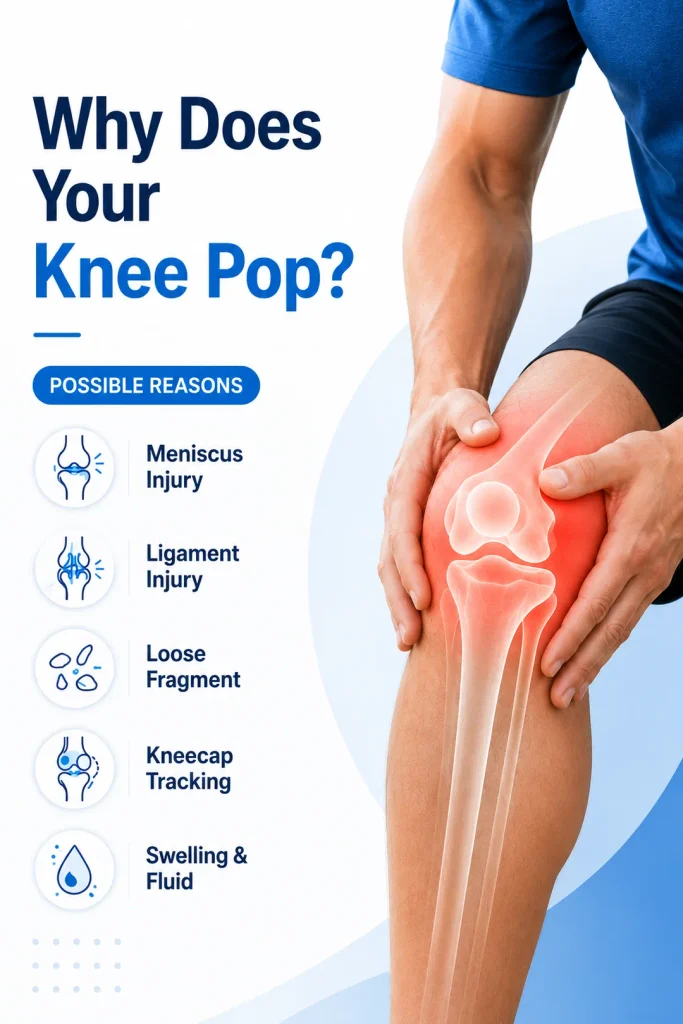
- Meniscus tear. The meniscus is the curved cushion of cartilage between the thighbone and shinbone. A twisting injury can tear it, and a flap of torn tissue catching inside the joint is one of the most common causes of clicking after an injury. Read more about meniscus tear treatment options.
- Ligament sprain or tear. An ACL, PCL, or collateral ligament injury changes how the bones glide against each other. The knee can feel loose and click during movements that used to feel stable.
- A loose fragment inside the joint. A piece of bone or cartilage that has broken off during the injury can float inside the joint space and cause a sharp click or a catching sensation.
- Kneecap tracking problems. An injury can shift how the kneecap glides in its groove. When it tracks slightly off center, it clicks or grinds during bending, especially going up or down stairs.
- Swelling and fluid buildup. Extra fluid after an injury changes the pressure and space inside the joint capsule, which can make normal joint movement sound louder or different than usual.
- Early cartilage wear. An injury that damages the smooth cartilage lining can accelerate wear on that surface, producing a grinding click that was not present before the injury occurred.
Harmless Clicking Versus a Warning Sign
Not every click after an injury points to damage. The table below outlines the pattern that usually needs attention compared with the pattern that is typically nothing to worry about.
| Feature | Usually Harmless | Usually Needs Evaluation |
|---|---|---|
| Pain | None | Present, especially sharp or worsening |
| Swelling | Absent | Visible or feels tight |
| Frequency | Occasional, same as before injury | Constant or new since the injury |
| Knee stability | Feels steady | Feels like it might give way |
| Range of motion | Full and comfortable | Locked, stuck, or limited |
When Knee Clicking After an Injury Needs a Doctor’s Attention
A single painless click while stretching is rarely worth worrying about. The picture changes once clicking appears alongside other symptoms after a specific injury.
- The knee clicks and also hurts, particularly along the joint line.
- The knee swells within a day or two of the injury.
- The knee locks, catches, or will not fully straighten.
- Walking or standing feels unstable, as though the knee could buckle.
- The clicking has gotten louder or more frequent since the injury happened.
Research reviewing degenerative meniscal tears has directly linked mechanical knee symptoms such as clicking, catching, and locking to damage inside the joint cartilage, which is why persistent clicking after an injury is worth a proper evaluation rather than guesswork.
A meniscal tear research review published in PMC found this connection consistently across patients with mechanical knee symptoms. If any of these apply, the safest step is a consultation rather than waiting to see if it settles down on its own.
What Happens During Your First Orthopedic Visit
Evaluating knee clicking after an injury usually starts with questions about how the injury happened, since a twisting fall points toward different structures than a direct blow. The doctor then examines the knee for swelling, tenderness along the joint line, and range of motion, and performs specific tests such as the McMurray test to check for a meniscus tear.
If the exam suggests structural damage, an MRI gives a detailed picture of the meniscus, ligaments, and cartilage that an X ray cannot show. X rays are still useful early on to rule out a fracture, particularly after a fall or sports collision. In some cases, a diagnostic knee arthroscopy procedure both confirms the diagnosis and treats the problem in the same sitting.
Treatment Options When Clicking Comes From an Injury
Conservative Care First
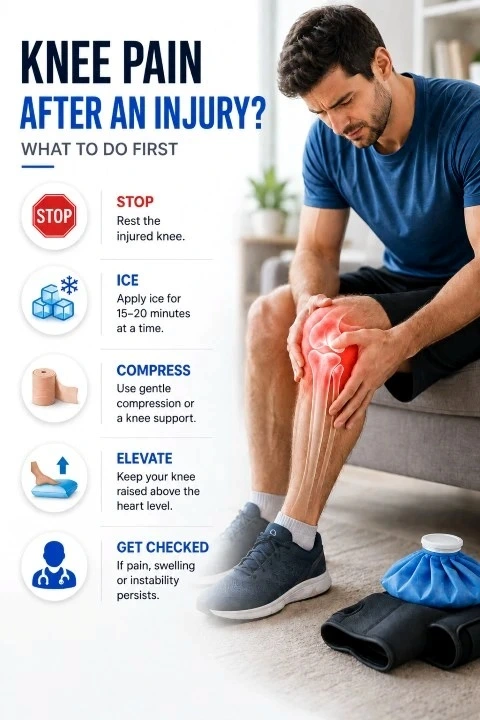
Many injuries that cause clicking respond well to non surgical care, especially when there is no locking or instability. Rest, ice, a short course of anti inflammatory medication, and guided physiotherapy help reduce swelling and rebuild the muscle support around the joint. A structured post injury rehabilitation program often resolves mild clicking within a few weeks by restoring normal joint mechanics.
When Surgery Is the Better Option
Surgery becomes the more sensible route when the knee locks, when a meniscus tear is large enough to keep catching inside the joint, or when a ligament injury leaves the knee genuinely unstable. In cases where a torn ligament and a meniscus tear occur together, treatment for the combined ligament and meniscus injury is planned as one coordinated procedure rather than two separate ones. Most of these repairs are done through minimally invasive arthroscopy, which uses small incisions and a camera rather than opening the joint fully.
Recovery and Keeping the Knee From Clicking Again
Recovery timelines for knee clicking after an injury vary with the structure involved and whether treatment was conservative or surgical. What stays consistent across cases is the value of finishing rehabilitation completely, not stopping once the pain fades.
- Strengthen the quadriceps and hamstrings evenly, since a muscle imbalance changes how the kneecap tracks.
- Return to sport or heavy activity gradually, guided by your physiotherapist rather than by how the knee feels on a good day.
- Warm up properly before activity, since a cold, stiff joint is more prone to popping under load.
- Keep follow up appointments even after symptoms improve, so any residual mechanical issue is caught early.
A knee that clicked after an injury and was treated properly usually settles into quiet, comfortable movement again. Most patients who complete a full rehabilitation program stop noticing the sound within a few months, though your doctor will advise on a timeline specific to your injury. Ignoring persistent knee popping after an injury, on the other hand, allows small problems like a partial meniscus tear more time to worsen.