Key Takeaways
- Gout affects over 1% of adults globally and is rising in India due to changing diets, alcohol use, and metabolic disease. PMC Global Gout Epidemiology
- Managing only the flare without lowering uric acid is the #1 reason gout keeps returning and eventually destroys joints permanently.
- In my clinic in Nipania, Indore, I see gout patients who have been on painkillers for years without anyone checking their serum uric acid or starting allopurinol. By the time they reach me, tophi have already eroded into joints.
- Gout treatment in Indore must include both flare management and long-term urate-lowering therapy to prevent irreversible joint damage.
- Uric acid target is below 360 µmol/L (6 mg/dL), which is the threshold below which crystals dissolve and attacks stop occurring.
What Gout Actually Is and Why It Keeps Coming Back
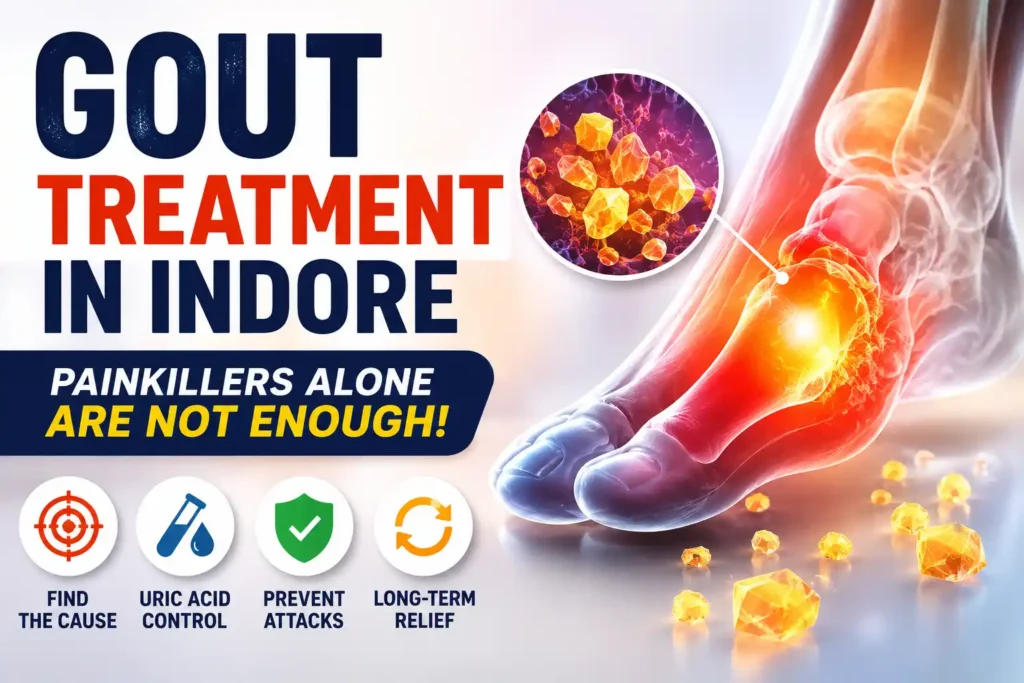
Gout treatment in Indore often starts late because the first attack is managed as a one-off event rather than a sign of a systemic problem. Gout is a form of inflammatory arthritis caused by monosodium urate crystal deposition in joints when serum uric acid remains chronically elevated. The crystals trigger an acute immune response producing the hallmark attack: sudden, severe, throbbing pain, swelling, redness, and warmth that peaks within 24 hours and feels unbearable even with bedsheet contact.
The first metatarsophalangeal joint (big toe) is affected in roughly 60% of first attacks. But gout also attacks the ankle, knee, wrist, and elbow. After a first attack, most patients have another within a year if nothing changes.
“Every gout patient I see in Indore has the same story. Extreme pain for a week, takes anti-inflammatory, pain goes, patient thinks it is over. Nobody checks uric acid. Nobody starts allopurinol. Six months later it comes back worse. Gout is 100% controllable, but only if you treat the uric acid, not just the pain.”, said Dr. Prince Uchadiya.
Why Gout Is More Common in Indore Than People Realise
- High purine diets: red meat, organ meat, and high-fructose consumption are increasingly common
- Rising rates of metabolic syndrome, hypertension, and diabetes, all linked to hyperuricaemia
- Alcohol use, especially beer, significantly raises uric acid levels
- Certain medications: thiazide diuretics and low-dose aspirin impair uric acid excretion
- Dehydration, which concentrates serum uric acid and precipitates crystals
Gout vs Other Joint Conditions: A Quick Comparison
| Feature | Gout | Rheumatoid Arthritis | Osteoarthritis |
|---|---|---|---|
| Onset | Sudden, hours | Gradual, weeks | Gradual, months |
| Pain quality | Excruciating, throbbing | Aching, stiff | Dull ache |
| Joint pattern | Usually one joint at a time | Symmetrical, multiple | Weight-bearing joints |
| Diagnosis confirmed by | Serum uric acid, joint fluid | Anti-CCP, RF | X-ray, clinical exam |
| Definitive treatment | Urate-lowering therapy | DMARDs/biologics | Physio, surgery |
Gout Treatment in Indore: The Two-Phase Approach
Phase 1: Stopping the Acute Attack
- NSAIDs: Naproxen or indomethacin started within 24 hours dramatically shorten the attack. Full dose for 5 to 7 days.
- Colchicine: Highly effective when started early. Low-dose protocol (0.5 mg twice daily) is as effective as high-dose with fewer GI side effects.
- Corticosteroids: When NSAIDs are contraindicated, particularly in patients with renal impairment or GI issues. Oral prednisolone or intra-articular injection into the affected joint.
- Rest and ice: Elevate and ice the joint. Applying even slight pressure worsens the pain during an acute attack.
Phase 2: Long-Term Gout Treatment in Indore That Actually Works
- Serum uric acid testing: Every patient who has had a confirmed or suspected gout attack must have uric acid measured. A level above 6 mg/dL (360 µmol/L) requires treatment.
- Allopurinol: First-line urate-lowering agent. Start at low dose (100 mg/day) 2 to 4 weeks after the acute attack resolves, then titrate to achieve target. Do not start during an active flare.
- Febuxostat: Alternative to allopurinol for patients who cannot tolerate it or have renal impairment. More potent uric acid reducer.
- Prophylactic colchicine: During the first 3 to 6 months of starting urate-lowering therapy, a low-dose colchicine is continued to prevent paradoxical flares as uric acid falls and crystals begin mobilising.
- Dietary modification: Reduce organ meat, shellfish, red meat, and alcohol. Increase water intake to at least 2 to 3 litres per day. Low-fat dairy is actually protective.
When Gout Destroys Joints: The Orthopaedic Stage
When gout treatment in Indore is limited to flare management without urate-lowering therapy, the disease progresses to tophaceous gout. where large crystal deposits (tophi) erode into bone and cartilage producing permanent structural damage. This is when gout treatment in Indore moves from medical management to orthopaedic intervention. For patients with advanced joint destruction from chronic gout, the ankle and foot arthritis treatment page and knee arthritis treatment outline the surgical options available at Dr. Prince Uchadiya Orthopaedic And Joint Care Clinic, Nipania, Indore.
Tophi surgery may also be needed when large deposits compress nerves, restrict joint movement, or break through skin. This is managed as part of comprehensive musculoskeletal care at the clinic.
Real Questions Patients Ask About Gout Treatment in Indore (from Quora and Reddit)
1. Can gout be cured permanently or does it always come back?
With proper urate-lowering therapy that keeps uric acid consistently below 6 mg/dL, gout attacks stop completely. Most patients on allopurinol with good compliance go years or decades without a single attack. It is not “cured” in the sense that if allopurinol is stopped, uric acid rises again. But it is completely controlled.
2. My uric acid is 7.5 but I have no pain. Do I need medication?
Asymptomatic hyperuricaemia does not automatically require medication. The threshold for starting urate-lowering therapy is generally after a confirmed gout attack or when tophi are present. However, levels above 9 mg/dL with risk factors (renal impairment, hypertension) may warrant early treatment. Get assessed by a specialist rather than self-treating.
3. Why does gout always attack at night or after a long journey?
Urate crystals precipitate more easily at lower temperatures. Peripheral joints like the big toe are cooler than core body temperature. During sleep, mild dehydration concentrates uric acid further. Long car journeys combine dehydration, reduced mobility, and dietary changes, all raising crystal precipitation risk.
4. I have been on allopurinol for two months but still had an attack. Is it working?
Yes, this is normal and expected. When allopurinol first drops uric acid levels, crystals already deposited in joints begin dissolving and this paradoxically triggers inflammatory flares during the transition. This is why prophylactic colchicine is prescribed alongside allopurinol for the first 3 to 6 months. Do not stop allopurinol during a flare. This is a very common mistake that sets back treatment significantly.
5. Is gout related to kidney stones?
Yes. Chronic hyperuricaemia increases risk of uric acid kidney stones significantly. Adequate hydration and urate-lowering therapy protect both joints and kidneys simultaneously. If you have had kidney stones alongside recurrent joint attacks, gout should be specifically evaluated.
6. Can I take gout medication with my blood pressure tablets?
Some blood pressure medications, particularly losartan, actually have a mild uricosuric effect and are preferred in hypertensive gout patients. Thiazide diuretics raise uric acid and should be switched if alternatives are available. Always review the full medication list with your treating doctor when starting urate-lowering therapy.
7. Is Ayushman Bharat available for gout treatment in Indore?
Medical management of gout including investigations and medications is generally not covered under PM-JAY as it is outpatient care. However, surgical procedures for tophaceous gout complications or advanced joint destruction do fall within applicable package coverage for eligible patients. The Ayushman Bharat surgical process at the clinic covers relevant orthopaedic procedures.