
Ujjain is a city of faith, festivals, and fierce competition on the sports ground. From the gully cricket near Gopal Mandir to the kabaddi matches across Nanakheda, from college athletics at Vikram University to the morning runs along Kshipra ghat, physical activity is part of daily life. When a knee gives way during one of those moments, the torn ACL does not care about the match score or the morning routine. It only cares about what happens next.
What happens next determines whether that knee stays functional for 20 years or develops irreversible joint damage within 5. For Ujjain patients, advanced ACL surgery Ujjain families have been searching for is available just 55 km away in Indore, performed arthroscopically by a Gold Medalist surgeon through incisions smaller than a fingernail.
This page walks through every stage of ACL surgery Ujjain patients should understand: what happens before, during, and after the procedure, so the decision is built on clarity rather than anxiety.
What Exactly Happens During ACL Surgery: The Procedure Ujjain Patients Should Understand
ACL reconstruction is not a repair. The torn ligament is not stitched back together. Instead, it is replaced with a graft, a piece of tendon harvested from another part of the patient’s own body, that is positioned inside the knee to replicate the original ACL’s function.
The entire procedure is performed arthroscopically. No large incision. No opening of the knee joint. According to AAOS clinical guidelines, this arthroscopic approach has been the global standard for over a decade.
The step-by-step sequence:
- Anaesthesia. Spinal or general, depending on patient preference and anaesthesiologist recommendation. Ujjain patients meet the anaesthesia team before surgery and discuss the options in advance.
- Arthroscopic inspection. A small camera (arthroscope) enters through a 5 mm cut. The surgeon examines the entire knee joint on an HD screen: ACL stump, meniscus, cartilage surfaces, PCL, and other ligaments. Problems not visible on MRI are identified at this stage.
- Graft harvesting. Through a separate small incision, the surgeon harvests a tendon graft. Hamstring autograft (from the back of the thigh) or patellar tendon autograft (from the front of the knee), depending on the patient’s anatomy and activity demands.
- Tunnel drilling. Precise tunnels are drilled in the femur (thigh bone) and tibia (shin bone) at the exact positions where the native ACL was attached. Anatomic tunnel placement, matching the original footprint, produces superior rotational stability compared to older isometric techniques.
- Graft placement and fixation. The prepared graft is threaded through the bone tunnels and secured with fixation devices (bio-absorbable screws or titanium buttons). The graft sits in the exact position the original ACL occupied.
- Meniscus assessment and concurrent repair. If a meniscal tear is found during the arthroscopic inspection, it is repaired simultaneously whenever the tear pattern allows. Dr. Prince Uchadiya prioritises meniscal preservation over removal, protecting the knee’s long-term shock-absorbing capacity. The detailed reasoning is explained in the combined ACL and meniscus injury guide.
- Closure. Two to three 5 mm incisions closed with sutures or surgical staples. No cast. No plaster. A compression bandage and hinged knee brace are applied. Walking with crutch support begins within 24 hours.
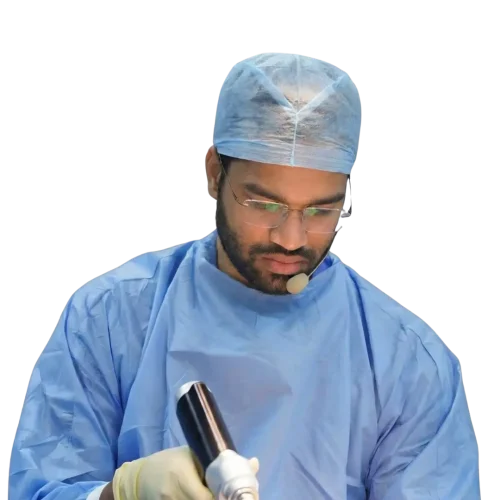
Total procedure time: 60 to 90 minutes. Ujjain patients undergoing ACL surgery at Dr. Prince Uchadiya’s Indore clinic typically walk with support the same evening or the next morning.
Hamstring Graft vs Patellar Tendon Graft: Which One Is Right for Ujjain Patients?
Graft selection is one of the most important decisions in ACL surgery. Ujjain patients should understand both options before the consultation:
| Factor | Hamstring Autograft | Patellar Tendon Autograft |
|---|---|---|
| Harvested from | Back of thigh (semitendinosus, gracilis) | Front of knee (patellar tendon with bone plugs) |
| Incision size | 2-3 cm | 3-4 cm |
| Anterior knee pain | Lower risk | Higher risk (kneeling discomfort possible) |
| Fixation strength | Strong (tendon-to-bone healing) | Strongest (bone-to-bone healing at both ends) |
| Ideal for | Most patients, especially those who kneel frequently | High-demand contact athletes, revision cases |
| Recovery difference | Slightly faster initial recovery | Slightly more anterior knee sensitivity initially |
Dr. Prince Uchadiya uses hamstring autograft for the majority of cases and reserves patellar tendon graft for specific clinical situations. The choice is individualised during consultation, never defaulted.
Why Arthroscopic ACL Surgery Is Fundamentally Different from Open Surgery
Some Ujjain patients hesitate about ACL surgery because family members or friends describe the experience from 10 or 15 years ago: large cuts, weeks in plaster, months of immobility. That was open surgery. Modern arthroscopic ACL reconstruction is an entirely different procedure:
| Aspect | Open Surgery (Outdated) | Arthroscopic Surgery (Current Standard) |
|---|---|---|
| Incision | 10-15 cm open cut | 2-3 cuts of 5 mm each |
| Joint exposure | Knee fully opened | Camera inside, joint never opened |
| Visualisation | Direct eye, limited angles | HD camera, magnified, all angles visible |
| Post-operative | Plaster cast, weeks of immobility | Hinged brace, walking within 24 hours |
| Hospital stay | 5-7 days typical | 1-2 days |
| Scarring | Prominent scar | Nearly invisible marks |
| Recovery speed | 6-12 months to basic function | 3-4 months to basic function, 6-9 for sport |
If any surgeon recommends open surgery for a standard ACL tear in 2026, seeking an arthroscopic specialist’s opinion is advisable before proceeding.
ACL Surgery Ujjain: The Complete Patient Journey from Kshipra to Nipania
For Ujjain families planning ACL surgery in Indore, the timeline looks straightforward:
- Before you travel: Get your knee MRI done at any 1.5T or 3T centre in Ujjain. Bring images on CD, not just the printed report. Share via WhatsApp for preliminary review if you want feedback before the consultation trip.
- Day 1 in Indore (Consultation): Clinical examination using the Lachman test, anterior drawer, and pivot shift. MRI reviewed slice by slice. Treatment options discussed. If surgery is indicated, pre-operative blood work and anaesthesia clearance happen the same day. Ayushman verification initiated.
- Days 2-7 (Pre-op window): Any required physiotherapy to restore full knee extension before surgery. Ayushman pre-authorisation processed. Surgery date confirmed.
- Surgery day: Arthroscopic ACL reconstruction. 60-90 minutes. Walking with crutch support begins same evening or next morning.
- Day 1-2 post-surgery: Discharge with detailed home exercise protocol. WhatsApp video guides for every exercise in weeks 1-6. First follow-up at day 10-14 for suture removal.
When it comes to ACL surgery Ujjain patients can access quickly, Nipania, Indore is just 55 km. The same road that takes families to Dewas or the Indore airport. For Ujjain patients, ACL surgery in Indore is closer than most assume and more accessible than any metro alternative.
What Determines Whether Ujjain Patients Need ACL Surgery or Not
Not every torn ACL requires reconstruction. The decision depends on five clinical variables that Dr. Prince Uchadiya assesses during consultation:
- Tear completeness. Partial tears with a firm Lachman endpoint may respond to structured rehabilitation. Complete tears with no endpoint typically need reconstruction for active patients.
- Functional stability. A knee that has not given way once since injury, despite normal daily activity, is functionally different from one that buckles on stairs.
- Meniscal status. Concurrent meniscal damage shifts the calculation strongly toward surgery because every instability episode in an ACL-deficient knee risks further meniscal destruction.
- Activity demands. A 55-year-old who walks for fitness has different requirements than a 22-year-old who plays competitive kabaddi. The former may manage conservatively. The latter almost certainly cannot.
- Age and long-term horizon. Younger patients face more decades of potential joint deterioration if instability persists. The long-term data is documented in the evidence on ACL healing without surgery.
Patients from cities like Ujjain and Ratlam benefit from this assessment-first approach because it prevents unnecessary surgery for those who do not need it and prevents unnecessary delay for those who do.
ACL Surgery Ujjain Cost: Transparent Breakdown for Every Family
Arthroscopic ACL reconstruction: Rs. 80,000 to Rs. 1,80,000. The range depends on:
- Graft type (hamstring vs patellar tendon)
- Fixation device (bio-absorbable vs titanium)
- Concurrent procedures (meniscus repair adds time and cost)
- Hospital facility charges
Ujjain residents with Ayushman Bharat PM-JAY cards can access ACL surgery under the scheme. Documentation and pre-authorisation are handled by the clinic. Travel cost from Ujjain: approximately Rs. 800 to 1,500 by taxi each way.
Advanced ACL surgery near Ujjain does not require a metro hospital budget. The same arthroscopic technique, the same graft quality, and the same Gold Medalist surgeon are available at a fraction of Mumbai or Delhi pricing.
Recovery After ACL Surgery: What Ujjain Patients Do at Home
The 9-month rehabilitation protocol is structured so Ujjain patients manage the majority at home:
- Weeks 1-6: Quad activation, extension maintenance, gentle range of motion. Video guides via WhatsApp. Phone check-in at week 2.
- Months 2-4: Progressive strengthening. A Ujjain physiotherapist follows Dr. Prince’s written protocol. The complete post-ACL physiotherapy guide covers every exercise with progression criteria.
- Month 3: Milestone assessment in Indore. Quad strength, functional testing. Half-day trip from Ujjain.
- Month 6: Clearance assessment. Hop test, strength symmetry. Return-to-activity timeline set.
- Months 6-9: Sport-specific training. The return-to-sport milestone framework determines when competitive activity resumes.
Total Indore visits across the full recovery: 4 to 5. Each one is a 55 km drive, under 2 hours round trip. ACL surgery Ujjain patients undergo at Dr. Prince’s clinic comes with a follow-up structure that respects the distance without compromising the outcome.
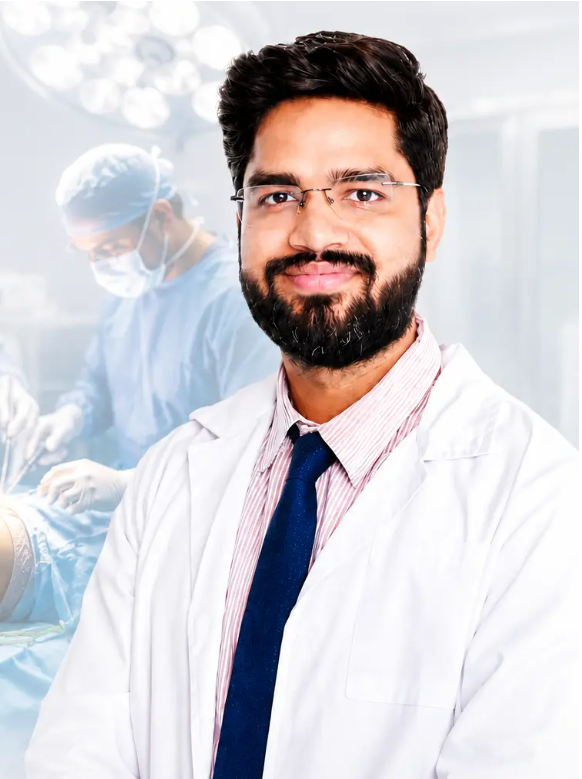
Dr. Prince Uchadiya, DNB Orthopaedics Gold Medalist, Orthopaedic and Arthroscopic Surgeon: “Ujjain patients often arrive expecting a long, complicated surgical process. When I show them the three 5 mm incisions after surgery, and they walk with support the same evening, the relief is visible. Arthroscopic ACL reconstruction has transformed what was once a major open procedure into something genuinely minimally invasive. The technique is what makes the difference. And the technique is the same whether you live in Mumbai or travel 55 km from Ujjain.”
10 Questions Ujjain Patients Ask About ACL Surgery in Indore
1. How is arthroscopic ACL surgery different from the open surgery my father had?
Completely different. Your father’s generation had 10-15 cm incisions, the knee fully opened, weeks in plaster, and months of immobility. Arthroscopic reconstruction uses a camera through a 5 mm cut, the knee is never opened, no plaster is needed, and walking starts within 24 hours. The outcomes are better, recovery is faster, and scarring is nearly invisible.
2. Which graft will Dr. Prince use for my ACL surgery?
The graft is chosen during consultation based on your specific anatomy, age, sport, and occupational demands. Hamstring autograft is standard for most patients. Patellar tendon autograft is reserved for high-demand contact athletes and revision cases. The decision is individualised, never defaulted.
3. Can ACL surgery be done the same week as my consultation?
If your MRI is ready and pre-operative blood work is completed on day 1, surgery can be scheduled within 3 to 7 days. Patients who arrive fully prepared from Ujjain sometimes complete the entire process within a single week-long stay.
4. My knee has been unstable for over a year. Is ACL surgery still effective?
Delayed reconstruction is common and produces good results. The concern with long delays is whether secondary meniscal damage occurred. A fresh MRI at consultation clarifies the current joint status. The surgery itself remains effective regardless of timing. The outcome ceiling depends on what the joint looks like when the surgeon operates, not on the calendar gap since injury.
5. Will I need to stay in Indore for the full recovery period?
No. The surgical stay is 3-4 days. Recovery happens at home in Ujjain with video-guided exercises. Milestone check-ins in Indore at months 3 and 6 take half a day each. Total Indore visits across 9 months: 4-5.
6. Is the ACL surgery covered under Ayushman Bharat for Ujjain residents?
Yes. Ayushman Bharat PM-JAY is a national scheme with no geographic restrictions. Ujjain residents with valid cards receive coverage at empanelled Indore hospitals. The clinic handles all documentation and pre-authorisation.
7. How soon after ACL surgery can I climb stairs normally?
Stair climbing with support begins around week 3-4. Comfortable, independent stair climbing without conscious effort typically returns by month 2-3. Full confidence on stairs, including descending without thinking about the knee, usually arrives by month 4.
8. Can my local physiotherapist in Ujjain supervise my rehabilitation?
Yes. Dr. Prince provides a phase-wise written protocol any qualified physiotherapist can execute. Milestone testing at months 3 and 6 should happen at the Indore clinic for objective measurement. Between visits, local supervision works well.
9. What is the risk of the graft tearing again after surgery?
Published re-rupture rates at high-quality centres range from 3-10%, depending on patient age and activity level. Younger athletes in pivoting sports sit at the higher end. Older, less active patients at the lower end. Completing the full 9-month rehabilitation programme and meeting all functional benchmarks before returning to sport significantly reduces re-rupture risk.
10. I am scared of going under anaesthesia. What are my options?
ACL surgery can be performed under spinal anaesthesia (you are awake but feel nothing below the waist) or general anaesthesia (fully asleep). Many patients prefer spinal because they remain conscious and can even watch the procedure on the screen. The anaesthesia team discusses both options with you before surgery day, addressing every concern individually.