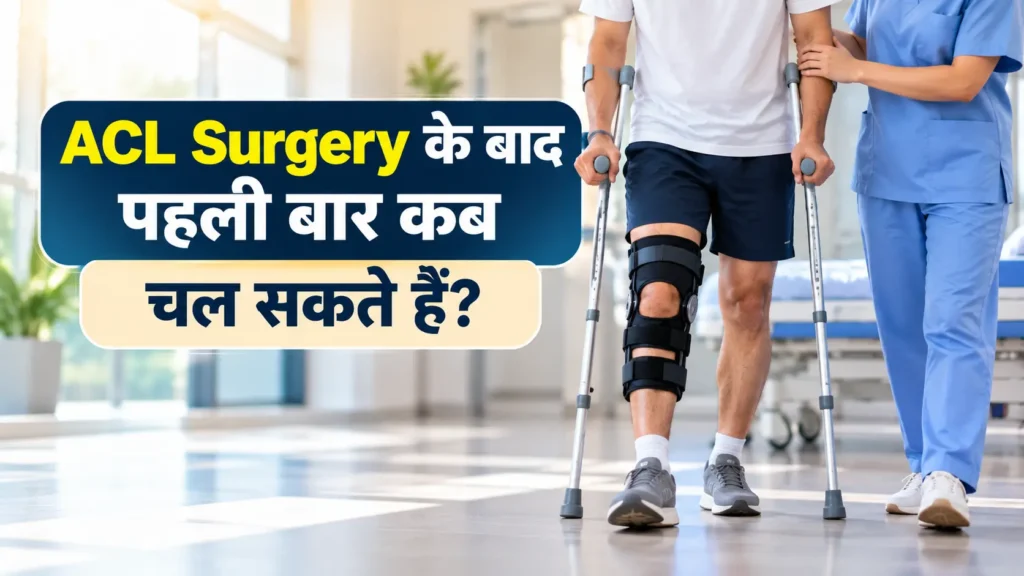
For most patients undergoing knee arthroscopy, ACL reconstruction, meniscus repair, fracture fixation, or total joint replacement, the day the brace comes off and normal walking resumes feels like the finish line. In clinical reality, Week 8 to Week 12 after surgery is only the halfway mark.
In our OPD at Dr. Prince Uchadiya Orthopaedic & Joint Care Clinic, we frequently evaluate patients who underwent successful surgery one or two years earlier (sometimes in Indore, sometimes in other cities) who now complain of dull ache on stairs, fatigue after standing, or new pain in the opposite unoperated knee. The surgery itself did not fail; what failed was stopping muscle conditioning the moment daily walking became painless. Here is Dr. Prince Uchadiya‘s (MS Orthopaedics Gold Medalist, MRCS England) clinical blueprint on how to keep joints strong after surgery in Indore for the next 15 to 25 years.
Why Operated Joints Remain Vulnerable Months After the Incision Heals
Skin incisions heal in 12 days, bone tunnels unite in 6 to 8 weeks, and soft-tissue grafts or repaired menisci mature over 6 to 9 months. However, three hidden physiological changes persist inside an operated limb unless you actively reverse them:
- Residual Quadriceps & Gluteal Strength Asymmetry: Research indexed on PubMed demonstrates that patients who stop rehabilitation early often retain a 15% to 25% quadriceps strength deficit in the operated leg even a year after surgery. Because the quadriceps muscle absorbs braking forces during walking and stair descent, a weak thigh forces your articular cartilage and meniscus to absorb raw impact.
- Proprioceptive (Joint Position Sense) Delay: Joint capsules and ligaments contain microscopic mechanoreceptors (Ruffini endings and Pacinian corpuscles) that tell your brain the exact angle of your joint within milliseconds. After arthroscopic surgery or joint replacement, retraining this neuromuscular reflex loop is essential to prevent awkward missteps on uneven roads.
- Subconscious Off-Loading onto the Opposite Leg: When one knee or hip is weaker, your body automatically shifts 60% to 65% of your weight onto the unoperated leg during standing, squatting, and climbing stairs. Over 2 to 3 years, this silent overload triggers early cartilage damage signs in the healthy joint.
The 4-Stage Post-Surgery Joint Strength Blueprint (Month 1 to Year 5+)
Whether you are recovering from ACL reconstruction surgery in Indore, a combined ACL and meniscus repair, or following our knee replacement recovery timeline, long-term joint strength follows four progressive stages outlined in the AAOS OrthoInfo Knee Conditioning Program:
| Recovery Stage | Primary Physiological Goal | Core Strength & Mobility Exercises | Objective Benchmark Before Advancing |
|---|---|---|---|
| Stage 1: Weeks 1 to 6 (Neuromuscular Awakening) | Eliminate swelling, achieve 0-degree extension, and reverse Arthrogenic Muscle Inhibition | Isometric quad sets, straight-leg raises, heel slides, ankle pumps, and glute bridges (guided via clinic or home physiotherapy) | Zero extension lag, minimal joint effusion, and smooth pain-free walking gait |
| Stage 2: Weeks 6 to 12 (Closed-Chain Foundation) | Rebuild concentric & eccentric muscle control across hip, knee, and ankle | Stationary cycling (low resistance, high cadence), mini wall squats (0-60 degrees), bilateral leg press, clamshells, and calf raises | Ability to perform 15 controlled step-ups on a 6-inch step without the knee caving inward (valgus) |
| Stage 3: Months 3 to 6 (Symmetry & Proprioception) | Restore 90%+ Limb Symmetry Index (LSI) between operated and unoperated limbs | Single-leg Romanian deadlifts, split squats, Bosu/balance board stability, resistance band monster walks, and controlled eccentric step-downs | Operated leg strength within 10% of the uninjured leg; zero joint swelling 24 hours after workouts |
| Stage 4: Month 6 to Lifetime Maintenance | Preserve cartilage thickness, subchondral bone density, and cardiovascular fitness | 2x/week lower-body & core resistance training + 150 mins/week low-impact aerobic loading (cycling, swimming, brisk walking) | Pain-free stairs, travel, and recreational sport with annual orthopaedic wellness check |
Why Avoiding Both “Too Much Rest” and “Premature High-Impact Shock” Matters
Cartilage and healing ligaments obey Wolff’s Law and Davis’s Law: biological tissues remodel and grow stronger in response to graduated mechanical load, but they degrade under either complete immobilization or sudden unconditioned impact. As we explain in our guide on why too much rest after surgery harms recovery, prolonged bed rest starves avascular cartilage of synovial fluid nutrition and causes rapid muscle atrophy.
At the same time, jumping straight back into concrete-road running, deep weighted squats below 90 degrees, or sudden competitive sports before your muscles are ready creates dangerous shear forces. According to Harvard Health’s joint protection guidelines, choosing the right daily activities protects both biological repairs and prosthetic implants:
| High-Benefit Joint-Strengthening Activities (Recommended) | Why They Protect Operated Joints | High-Shear Activities to Modify or Delay | Safer Biomechanical Modification |
|---|---|---|---|
| Stationary & Outdoor Cycling (Proper Seat Height) | Pumps synovial fluid across cartilage through 1000s of smooth revolutions with near-zero impact | Deep Cross-Legged Floor Sitting or Squat Toilets (Early After TKR/Meniscus Repair) | Use an elevated chair, chowki, or western commode to prevent extreme posterior horn meniscus pinching |
| Swimming & Hydrotherapy (Flutter Kick) | Water buoyancy removes 80% of body weight while providing 360-degree muscle resistance | Running on Hard Concrete Pavements in Worn Slippers | Walk/jog on synthetic tracks or grass in cushioned shoes (prevents heel & plantar fascia overload) |
| Controlled Gym Resistance (Leg Press, Hamstring Curls, Hip Abduction) | Builds targeted muscular shock absorbers around the joint in controlled planes | Heavy Deep Barbell Squats with Knee Valgus Collapse | Perform box squats to parallel with a resistance band around the knees to engage gluteus medius |
| Brisk Level Walking & Elliptical Cross-Trainer | Maintains subchondral bone mineral density and metabolic weight control | Weekend Turf Football/Badminton Without Neuromuscular Warm-Up | Follow a 10-minute surgeon-approved sports injury prevention warm-up |
Nutrition, Body Weight & Metabolic Support for Post-Surgical Joints
Mechanical exercise must be matched with internal metabolic support so your muscles, tendons, and subchondral bone can repair daily micro-strain:
- The 1:4 Body-Weight Multiplier on Knee Joints: Every 1 kg of excess body weight places 4 kg of compressive force across your knee joint during walking and up to 6 kg on stairs. Maintaining a healthy BMI is the single most powerful way to prevent obesity-related knee pain and implant wear.
- Leucine-Rich Protein Intake for Muscle Hypertrophy: Post-surgical physiotherapy cannot build quadriceps muscle without adequate dietary protein. Aim for 1.0 to 1.3 grams of protein per kilogram of body weight daily (paneer, curd, dal, chana, soy, eggs, fish, or whey isolate) distributed across three meals.
- Targeted Bone & Cartilage Micronutrients: Maintain blood 25-OH Vitamin D3 between 40 and 60 ng/mL, ensure adequate dietary calcium (1,000 mg/day) and magnesium, and consider evidence-backed supplements for cartilage in Indore (such as UC-II or Omega-3 EPA/DHA) if your surgery involved chondral wear.
Joint-Specific Longevity Rules: Knee vs Hip vs Shoulder Post-Surgical Care
Every major human joint has a distinct anatomical architecture, a modified hinge in the knee, a deep ball-and-socket in the hip, and a shallow muscle-suspended golf-tee socket in the shoulder. Because of this, the muscles you must prioritize to keep joints strong after surgery in Indore differ by joint:
1. After Knee Surgery (ACL, Meniscus, Cartilage, or Total Knee Replacement)
Never train the knee in isolation. The knee is caught between the hip above and the ankle below. Weak gluteus medius and hip external rotators allow the thighbone to rotate inward on every step, while tight calves and flat feet twist the shinbone from below. Your lifelong knee protection routine must include VMO terminal knee extensions, eccentric hamstring curls, lateral banded hip walks, and calf raises.
2. After Hip Surgery (Hip Replacement, Fracture Fixation, or FAI Arthroscopy)
After total hip replacement or proximal femur fixation, the hip abductors (gluteus medius and minimus) and deep external rotators determine whether you walk with a rock-steady pelvis or a permanent Trendelenburg limp. Standing hip abduction, bridges, step-ups, and avoiding extreme combined hip flexion + internal rotation in the early months protect both biological repairs and uncemented ceramic/titanium implants for 20+ years.
3. After Shoulder Surgery (Rotator Cuff Repair or Bankart Dislocation Repair)
The shoulder socket (glenoid) is tiny; stability relies on the scapular stabilizers (serratus anterior, lower/middle trapezius) and the four rotator cuff muscles centering the ball in the socket. Even years after a successful rotator cuff repair, performing 5 minutes of light resistance-band external rotations and scapular wall slides twice a week prevents recurrent subacromial impingement.
The 5-Point “Joint Readiness Self-Audit” at 6 and 12 Months After Surgery
How do you know if your operated joint is genuinely strong enough to handle a Himalayan trek, a marathon, a wedding dance, or heavy gym training? At our 6-month and 12-month follow-ups at Dr. Prince Uchadiya Orthopaedic & Joint Care Clinic, we verify five simple benchmarks:
- Thigh/Arm Girth Symmetry Within 1 cm: Measured 10 cm above the kneecap, your operated thigh circumference should match your unoperated leg within 1 centimeter.
- 30-Second Single-Leg Balance Test (Eyes Open & Closed): Standing on your operated leg alone without your pelvis dropping or ankle wobbling excessively confirms restored proprioception.
- Pain-Free Eccentric Step-Down Test: Slowly lowering your opposite heel to the floor from an 8-inch step 15 times without your operated knee shaking or caving inward.
- Zero Next-Morning Effusion Test: The joint feels completely cool and flat the morning after a brisk 45-minute walk or workout.
- Full Symmetrical Terminal Extension & Flexion: Your operated knee straightens to the exact same 0-degree (or slight hyperextension) angle as your healthy leg.
Warning Signs After Joint Surgery That Require Immediate Orthopaedic Review
Mild muscle fatigue that resolves within 24 hours of a workout is normal muscle adaptation. However, schedule a prompt clinical review at Dr. Prince Uchadiya Orthopaedic & Joint Care Clinic in Nipania (Divyansh Square 2, Above Roshni Eye Hospital) or Kanadia Main Road (near Bengali Square) if you experience:
- New Joint Effusion (Swelling) or Warmth: Fluid puffiness above the kneecap the morning after exercise signals that mechanical load exceeded your cartilage or graft capacity.
- Mechanical Catching, Locking, or Giving Way: A sudden block to straightening the knee or a feeling of rotational instability requires a clinical Lachman/McMurray check.
- Fever, Redness, or Sudden Calf Pain/Swelling: In the early post-operative weeks, redness around a portal/incision or unilateral calf tenderness requires urgent medical evaluation.
Want a structured post-surgery strength assessment or long-term joint preservation plan? Book your consultation online or message our team on WhatsApp (+91 70457 04243) today.